


Deep beneath the…
The discovery of Triplophysa xingyiensis adds a notable chapter to the unfolding story of China’s subterranean fish fauna, but it also raises questions that extend well beyond a single species description. Cave loaches of the genus Triplophysa represent one of the most striking examples of repeated evolutionary transitions from surface waters into underground habitats anywhere in the world. Each new hypogean species described from the karst landscapes of Guizhou and neighbouring provinces refines our understanding of how frequently these transitions have occurred, how isolated populations have become from one another, and how the underground drainage networks of southern China have shaped the distribution of life beneath the surface.
The karst terrain of Guizhou Province deserves particular attention in this context. Karst landscapes form when slightly acidic water slowly dissolves soluble bedrock, typically limestone, over millions of years. The result is a three-dimensional labyrinth of sinkholes, caves, and subterranean channels that can carry water for tens of kilometres beneath the surface before it re-emerges at springs or river outlets. In Guizhou, this geological architecture has produced an extraordinary number of isolated aquatic habitats, each of which can function as an evolutionary island. Fish populations that colonise these underground systems, or that become trapped in them as surface connections are severed by erosion and collapse, may then diverge in isolation over long periods. The pattern seen in Triplophysa, with dozens of cave-restricted species packed into a relatively small geographic region, is a direct consequence of this fragmented subterranean geography.
The morphological features that distinguish T. xingyiensis reflect a suite of traits commonly associated with life in perpetual darkness. The complete loss of scales, for instance, is a recurring theme among cave-dwelling fishes worldwide. In the lightless, current-quiet waters of subterranean streams, scales offer little protective benefit while potentially imposing energetic costs, and their reduction appears to have evolved independently many times across unrelated cave fish lineages. Similarly, the degeneration of the posterior chamber of the swim bladder observed in the new species fits a broader pattern: in still or slow-moving underground waters, the fine buoyancy control that a fully developed swim bladder provides in flowing surface rivers becomes less critical, and the structure is often reduced.
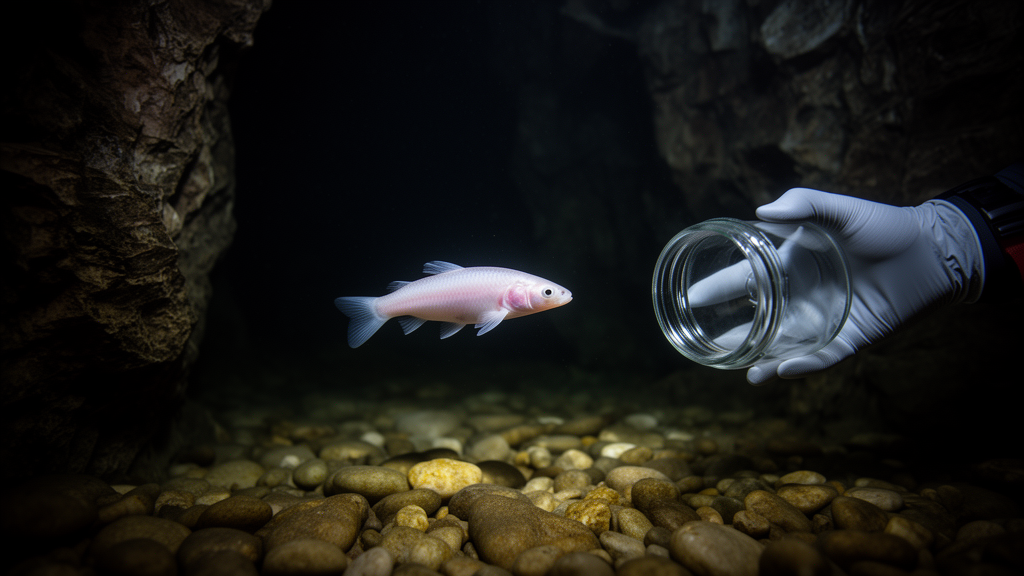
Notably, however, T. xingyiensis retains normal, functional eyes, with eye diameter falling between 9.1 and 17.3 percent of head length. This is an interesting intermediate condition among hypogean Triplophysa. Some cave loaches from the same region show dramatically reduced eyes or complete external loss of visual structures, while others, like the new species, retain eyes of appreciable size. This variation among species that share similar underground habitats suggests that the degree of eye reduction may depend on how long a population has been isolated underground, on the depth and permanence of its subterranean habitat, or on the amount of light that penetrates near the cave entrances where these fish are sometimes collected. The two subterranean river outlets from which the type specimens were obtained are, by definition, points where underground water reaches the surface, and such transitional zones may receive at least traces of ambient light, potentially relaxing the selective pressure for complete eye loss.
The elongated rostral barbel, reaching 34.3 to 48.0 percent of head length, represents the opposite side of the sensory trade-off that characterises cave adaptation. Barbels are richly supplied with taste buds and mechanoreceptors, and in darkness they serve as the primary tools for locating food and navigating the environment. Cave-dwelling fishes across many families show elaboration of these non-visual sensory structures, and the pronounced barbels of T. xingyiensis are consistent with this pattern. Together with an enlarged or elongated fin configuration that improves manoeuvrability in confined spaces, these traits illustrate how evolution in caves tends to reallocate sensory and locomotor investment away from vision and toward touch and chemical detection.
The molecular evidence presented in the study adds an important dimension to the species description. By sequencing complete mitochondrial genomes and analysing the thirteen protein-coding genes they contain, the authors were able to place T. xingyiensis within the broader phylogenetic framework of the genus. The finding that the new species forms a monophyletic group, meaning that all sampled individuals share a most recent common ancestor exclusive to the species, is a fundamental requirement for species recognition under modern taxonomic standards. Mitochondrial genomes are particularly useful in this context because they are inherited as a single unit, evolve relatively rapidly, and can be recovered reliably even from small tissue samples preserved in ethanol.
The cytochrome b gene, which the authors used to calculate pairwise genetic distances, is one of the most widely employed markers in fish taxonomy and barcoding. The distances of 1.8 to 2.4 percent separating T. xingyiensis from its closest relatives, T. anlongensis, T. rongduensis, and T. zhenfengensis, fall within the range typically observed between distinct species of freshwater fishes. These three relatives are themselves cave dwellers from the same general region of Guizhou, and their close genetic relationship to the new species suggests a recent common ancestry, possibly reflecting a shared colonisation of underground waters followed by geographic isolation in separate karst drainage systems. The Nanpanjiang River Basin, to which all these species are at least partially tied, drains a substantial portion of western Guizhou and eastern Yunnan, and its tributary network likely provided multiple independent routes by which ancestral fish populations could enter and become established in subterranean waters.
The vertebral count of 4 plus 36, determined through micro-computed tomography, illustrates how modern imaging technology has transformed taxonomic practice. Traditional methods for counting vertebrae required clearing and staining specimens or making destructive dissections, both of which are undesirable when working with rare cave species known from few individuals. Micro-CT scanning allows researchers to visualise the internal skeleton in three dimensions without damaging the specimen, preserving the holotype and paratypes in their entirety for future study. This is particularly valuable for cave fishes, where specimens are difficult to obtain and each individual carries irreplaceable scientific information.
The co-occurrence of T. xingyiensis with Sinocyclocheilus xingyiensis at the same collection sites is also noteworthy. Sinocyclocheilus is another genus of cyprinid fish famous for its cave-adapted species, with dozens of described forms concentrated in the same karst region of Guizhou and Guangxi. The fact that both genera have produced cave-restricted species at the same localities suggests that these underground ecosystems support enough resources, in the form of dissolved organic matter, invertebrate prey, and stable water conditions, to sustain multiple fish lineages simultaneously. It also raises the possibility of ecological interactions between the two species, whether competitive or otherwise, that could have influenced their respective evolutionary trajectories.
From a conservation standpoint, the description of T. xingyiensis carries implications that extend beyond taxonomy. Cave species are inherently vulnerable to environmental disturbance because their habitats are small, isolated, and easily degraded by changes in water quality, hydrology, or land use above ground. Pollution from agricultural runoff, mining activity, or urban development can travel rapidly through karst aquifers with little natural filtration, reaching underground streams that harbor endemic fish. Water extraction and diversion for human use can alter the flow regimes of subterranean rivers, and physical disturbance of cave entrances can disrupt the delicate energy balance of these systems. Given that T. xingyiensis is known from only two subterranean river outlets, its population size, range, and long-term viability remain uncertain, and the species may warrant conservation attention even before comprehensive population assessments are conducted.
The broader picture that emerges from this and related studies is one of remarkable but under-documented biodiversity. With 44 hypogean species of Triplophysa now recognised from southern China, and 15 of those from Guizhou Province alone, the region clearly ranks among the world’s most important centres of cave fish diversity. Yet the pace of discovery shows no sign of slowing, with multiple new species described in recent years, suggesting that many more underground habitats remain unsurveyed. Each new species not only adds to the catalogue of life but also provides a data point for understanding how evolution proceeds in isolated, resource-limited environments, and how the unique geological history of the southern Chinese karst has generated biological diversity found nowhere else on Earth.
The integrative approach employed in this study, combining detailed morphological comparison across 25 related species with molecular phylogenetics and genetic distance analysis, reflects a methodological standard that is increasingly expected in modern taxonomy. By examining specimens from type localities and using both traditional measurements and advanced imaging, the authors have built a case for species status that rests on multiple independent lines of evidence. This thoroughness matters because species descriptions are the foundation upon which all subsequent biological research depends, and because poorly supported descriptions can create confusion that persists for decades. In a genus as species-rich and morphologically conservative as Triplophysa, where many species differ only subtly in proportions, fin ray counts, and barbel length, the combination of morphological and molecular data is not merely helpful but essential for arriving at stable, defensible taxonomic conclusions.
Subject of Research: A new cave species of the genus Triplophysa (Teleostei, Cypriniformes, Nemacheilidae) from Guizhou, China
Article Title: A new cave species of the genus Triplophysa ( Teleostei , Cypriniformes , Nemacheilidae ) from Guizhou, China
Article References: Yuan, F.-H., Zhu, T.-T., & Zhang, R.-Y. (2026). A new cave species of the genus Triplophysa (Teleostei, Cypriniformes, Nemacheilidae) from Guizhou, China. Zoosystematics and Evolution, 102(2), 443-456. https://doi.org/10.3897/zse.102.176660
Image Credits: AI Generated
Keywords: cave, species, genus, Triplophysa, Teleostei, Cypriniformes, Nemacheilidae, Guizhou, China, scientific research
Cite Scienmag News
Gavin Prescott. (October 18, 2026). New blind-zone cave loach discovered in Guizhou karst rivers. Scienmag. https://scienmag.com/new-blind-zone-cave-loach-discovered-in-guizhou-karst-rivers/
Gavin Prescott. "New blind-zone cave loach discovered in Guizhou karst rivers." Scienmag, 18 October 2026, https://scienmag.com/new-blind-zone-cave-loach-discovered-in-guizhou-karst-rivers/. Accessed 18 October 2026.
Gavin Prescott. "New blind-zone cave loach discovered in Guizhou karst rivers." Scienmag. October 18, 2026. https://scienmag.com/new-blind-zone-cave-loach-discovered-in-guizhou-karst-rivers/


