


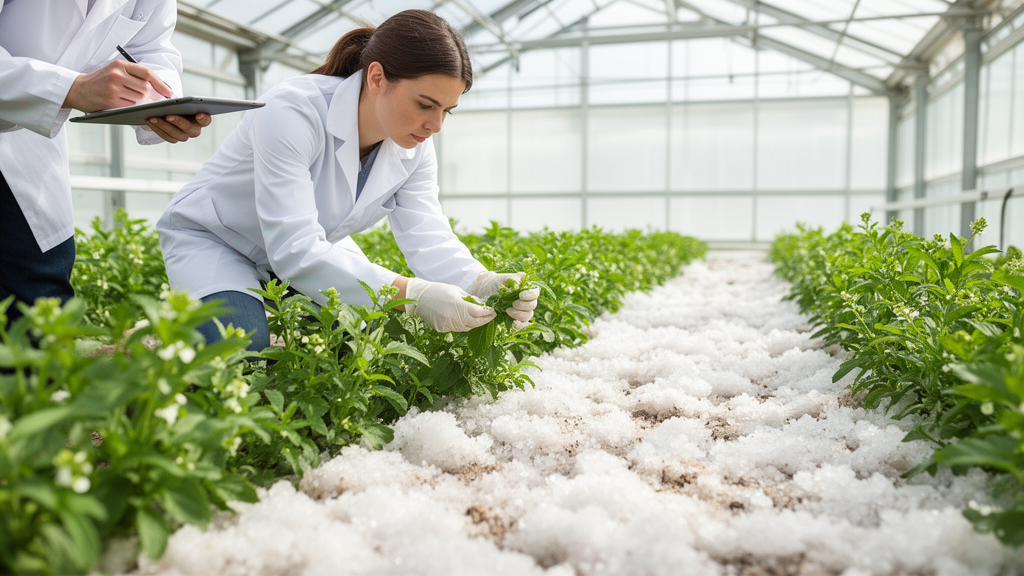
In the arid and semi-arid regions of northern China, where soils can turn salty and alkaline enough to stunt or kill most crops, a humble medicinal herb clings on and thrives. Codonopsis pilosula, a climbing plant whose roots are prized in traditional medicine and increasingly traded as a health food, has long been cultivated on marginal land. Now a team of researchers in China has taken a major step toward explaining how it copes with one of agriculture’s most stubborn enemies: saline-alkali stress. In a study published in BMC Plant Biology, the group carried out the first genome-wide survey of a family of master regulatory genes in this species and connected specific members of that family to the plant’s response to salty, alkaline soil.
The genes in question belong to the WRKY family, one of the largest families of transcription factors in plants. Transcription factors are proteins that bind to specific DNA sequences and switch other genes on or off, acting like the conductors of a genetic orchestra. WRKY factors are named for a highly conserved stretch of amino acids, the WRKY motif, and they are known to orchestrate a plant’s reactions to drought, cold, disease, and salinity. Until now, however, no systematic catalogue of WRKY genes existed for Codonopsis pilosula, leaving a gap in understanding how this economically significant edible and medicinal plant mounts its defense against soil stress.
To fill that gap, the researchers scanned the entire genome of the species and identified 47 WRKY genes, which they named CpWRKYs. The genes were not spread evenly across the plant’s genetic blueprint; instead, they were distributed unevenly across eight chromosomes, a pattern that often reflects the uneven pressures of evolution. Using phylogenetic analysis, which compares gene sequences to reconstruct family trees, together with examinations of conserved protein domains and motifs, the team sorted the 47 genes into seven subfamilies. Members of each subfamily shared similar conserved motifs but differed in their gene structures, the arrangement of coding regions and intervening sequences that shapes how each gene is read and regulated.
A second layer of analysis focused on how the family grew over evolutionary time. Collinearity analysis, which looks for stretches of DNA that appear in duplicated blocks across the genome, revealed 13 duplicated gene pairs among the CpWRKYs. This pointed to segmental duplication, the replication of large chromosomal segments, as the main engine driving the expansion of the WRKY family in this species. Such duplication events give evolution raw material to work with: one copy can keep performing the ancestral job while the other is free to mutate and take on new roles, including the fine-tuning of stress responses.
Identifying the genes was only the first step. The real question was which of them actually respond when the plant’s roots hit salty, alkaline soil. To answer it, the researchers turned to transcriptome analysis, a technique that measures which genes are actively being transcribed into RNA under given conditions. When they compared plants exposed to saline-alkali stress with unstressed controls, they found that the differentially expressed WRKY genes, the ones whose activity changed markedly, mostly belonged to three groups: I, IIc, and III. These groups are known in other species to be involved in stress signaling, suggesting that Codonopsis pilosula recruits a familiar cast of molecular players to deal with an unfamiliar challenge.
But gene expression alone does not tell the whole story. Plants respond to stress not only by changing which genes are active but also by altering their metabolism, the chemical reactions that keep cells alive. The team therefore performed metabolic profiling to see which small molecules accumulated or declined under saline-alkali conditions. The results were striking: lipid metabolites, the fat-derived molecules that make up cell membranes and serve as signaling compounds, were the main differentially accumulated metabolites under stress. This makes biological sense, because saline-alkali stress damages membranes and triggers a cascade of lipid-based signaling that helps the plant reorganize its cellular defenses.
The most intriguing finding came when the researchers connected the two data streams. Using gene co-expression network analysis, a computational approach that identifies groups of genes whose activity rises and falls in tandem, they discovered that the genes involved in lipid metabolism were linked to specific WRKY transcription factors. One gene in particular, Cpi05G005333-I, emerged as a hub in this network, suggesting that it may act as a master switch coordinating the lipid-based response to saline-alkali stress. In other words, the WRKY factors appear to sit upstream of the metabolic changes, turning on the machinery that reshapes the plant’s lipid profile when the soil turns hostile.
By combining phylogenetic classification, duplication analysis, transcriptomics, metabolomics, and network modeling, the study offers the first comprehensive portrait of the WRKY family in Codonopsis pilosula and identifies candidate genes that likely participate in the transcriptional response to saline-alkali stress. The work was carried out by researchers at Changzhi Medical College in China, with additional contributions from the Inner Mongolia Key Laboratory of Plants Adversity Adaptation and Genetic Improvement in Cold and Arid Regions at Inner Mongolia Agricultural University, and was supported by funding from Changzhi Medical College and the Fundamental Research Program of Shanxi Province.
The practical implications could be significant. Codonopsis pilosula is not only a staple of traditional herbal medicine but also a crop whose cultivation is expanding into marginal, salt-affected soils. Understanding which WRKY genes drive salt tolerance opens the door to breeding or engineering varieties that can withstand saline-alkali conditions more effectively, whether through conventional selection informed by genetic markers or through targeted genome editing. The lipid connection is particularly interesting because membrane remodeling is a shared feature of stress responses across many plant species, meaning the findings could inform broader efforts to develop stress-resilient crops.
There is still much to confirm. The study identifies candidate genes and networks, but functional validation, the laboratory work of silencing or overexpressing individual genes to see how the plant responds, will be needed to prove which CpWRKYs are truly indispensable for salt tolerance. Nevertheless, the research lays a solid foundation. It demonstrates how a genome-wide, multi-omics approach can turn a medicinal herb into a model for understanding stress adaptation, and it brings scientists one step closer to the goal of growing valuable crops on land that would otherwise remain barren.
Subject of Research: Genome-wide identification of WRKY transcription factors and their role in saline-alkali stress response in Codonopsis pilosula roots
Article Title: Genome-wide identification of CpWRKYs and elucidation of the saline-alkali response mechanism in Codonopsis pilosula roots
Article References: Liu, J., Zhang, X., Jing, X., Zhao, L., Yan, Y., Song, X., Li, Y., Su, W., & Wan, Y. (2026). Genome-wide identification of CpWRKYs and elucidation of the saline-alkali response mechanism in Codonopsis pilosula roots. BMC Plant Biology. https://doi.org/10.1186/s12870-026-09770-6
Image Credits: AI Generated
DOI: 10.1186/s12870-026-09770-6
Keywords: Codonopsis pilosula, WRKY transcription factors, saline-alkali stress, genome-wide analysis, transcriptomics, lipid metabolism, gene co-expression network, segmental duplication, plant stress response, medicinal plants, BMC Plant Biology, transcriptional regulation
Cite Scienmag News
Juliet Wilcox. (October 18, 2026). Scientists Map the Genetic Switches That Help a Healing Herb Survive Salty Soil. Scienmag. https://scienmag.com/scientists-map-the-genetic-switches-that-help-a-healing-herb-survive-salty-soil/
Juliet Wilcox. "Scientists Map the Genetic Switches That Help a Healing Herb Survive Salty Soil." Scienmag, 18 October 2026, https://scienmag.com/scientists-map-the-genetic-switches-that-help-a-healing-herb-survive-salty-soil/. Accessed 18 October 2026.
Juliet Wilcox. "Scientists Map the Genetic Switches That Help a Healing Herb Survive Salty Soil." Scienmag. October 18, 2026. https://scienmag.com/scientists-map-the-genetic-switches-that-help-a-healing-herb-survive-salty-soil/


