


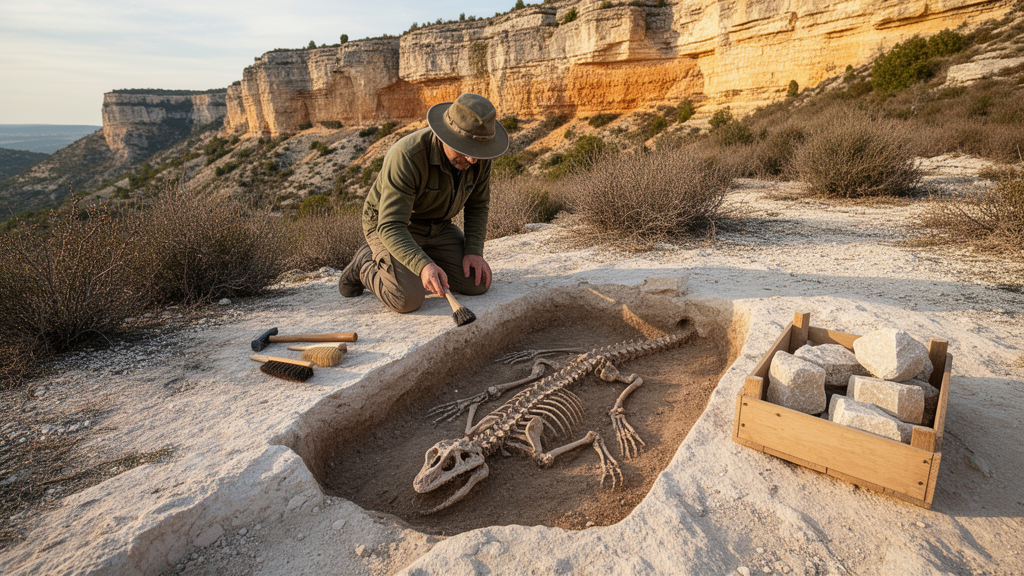
A fissure fill in the Jurassic limestone of southern France has yielded one of the richest reptile assemblages ever documented from the late middle Eocene of Europe. The Lavergne locality, part of the celebrated Phosphorites du Quercy fossil sites, preserves the disarticulated but three-dimensionally preserved bones of lizards, snakes, turtles and crocodiles that lived roughly 41 to 38 million years ago, during the Bartonian stage. A new comprehensive study published in the Swiss Journal of Palaeontology identifies at least 16 reptile taxa from the site, including a previously unknown species of skink named in honour of the French naturalist Jean-Baptiste Lamarck.
The Phosphorites du Quercy are phosphatic clays that accumulated in fissures in the limestone plateaux of the Quercy region, and the area is regarded as a lagerstätte owing to its exceptional fossil preservation, including natural mummies of small vertebrates. More than 100 fossiliferous fissure-fill sites are known across southern France, and their geological ages range from the early Eocene to the Early Miocene. Lavergne itself has already yielded at least 52 mammal species and ranks among the richest localities for rodents at the MP 16 biochronological zone, which corresponds to the end of the middle Eocene. Yet until now, the reptiles of Lavergne had only been reported occasionally, with most material simply listed and never figured or described.
The new research documents a remarkable diversity of squamates. Among the lizards, the team identified gekkotans, a pleurodontan iguanian, lacertids, skinks, glyptosaurids, anguids and palaeovaranids. The gekkotan material consists of two left dentaries with a closed Meckelian canal and a high number of pleurodont teeth, features characteristic of crown gekkotans. Previously, the gekkotan Cadurcogekko piveteaui had been documented from Lavergne on the basis of three vertebrae, but the new dentaries cannot be identified with certainty because no tooth is completely preserved. A small fragment of a left maxilla with tricuspid teeth forms the first documented evidence of the Pleurodonta clade at the site, and its morphology resembles that of the common European Palaeogene pleurodontan Geiseltaliellus, although the fragmentary nature of the specimen prevents a definite assignment.
The most significant taxonomic contribution of the study is the description of Lavergnesaurus lamarcki gen. et sp. nov., a small skink known so far exclusively from a single incomplete left dentary. The new genus is diagnosed by a combination of features, including a partly enclosed Meckelian canal, blunt tooth crowns rather than pointed ones, the presence of lingual cusps that continue into short widely diverging striae, faintly tricuspid tooth crowns in which the mesial and distal portions form a distinct shoulder, and a short coronoid process of the dentary. The enclosed Meckelian canal indicates that Lavergnesaurus is indeed a skink rather than a cordyliform, as many scincid lizards show a closed Meckelian canal in contrast to cordylids. The species name honours Lamarck for his valuable contributions to early ideas about biological evolution.
Skinks are reported from Lavergne for the first time, and the study shows that at least two types of skinks were present at the site, based on dentition. A second, indeterminate skink is represented by a right maxilla with transversely bicuspid tooth crowns bearing a lingual cusp and striations on the lingual surface. This material is clearly different from skink material described from the coeval Mazaterón locality in Spain, indicating the presence of several skink taxa in Europe during MP 16. Lacertids are also present, identified from two dentary fragments showing the sulcus dentalis, a synapomorphy of the family, together with bicuspid teeth and weak apicobasal striations restricted to the lingual side.
Anguimorph lizards are particularly diverse at Lavergne. Glyptosaurids are well documented, with three right maxillae and a cranial fragment referred to Placosaurus sp., the hexagonal osteoderms of the cranial fragment and their arrangement highly resembling the morphology known in that genus. Additional glyptosaurid material includes a left dentary and eleven osteoderms of two types, hexagonal cranial osteoderms with tuberculate sculpture and roughly rectangular body osteoderms with a smooth articular surface. A single dorsal vertebra documents the presence of Anguidae at Lavergne for the first time, its morphology resembling that of Ophisaurus. Palaeovaranids are represented by a diverse array of elements including maxillae, dentaries, a frontal, an osteoderm and dorsal, sacral and caudal vertebrae, referred to Palaeovaranus sp. The fused narrow frontal and the widely spaced plicidentine infoldings at the tooth bases support this allocation.
Snakes are equally diverse in the assemblage. The team identified the enigmatic alethinophidian Platyspondylia sudrei, known otherwise only from its type locality at the nearby and coeval Le Bretou, making the Lavergne material only the second known occurrence of this poorly known species. The ?tropidophiid Cadurceryx filholi is represented by five trunk and eleven caudal vertebrae from the University of Montpellier collections, adding to the most complete material known for this bizarre genus. Cadurceryx possessed highly distinctive complex vertebral structures, including additional apophyses throughout the trunk and caudal vertebrae that form at least partly true articular joints linking neighbouring vertebrae. The large constrictor Palaeopython cadurcensis is documented from a dentary fragment and numerous trunk and caudal vertebrae, with the largest vertebra reaching a centrum length of 10.2 millimetres and a neural arch width of 17.1 millimetres, making it the largest snake taxon in the assemblage.
Two further constrictors are present. Material tentatively referred to ?Eoconstrictor sp. includes two slender right dentaries and twelve trunk vertebrae, and if correct this would mark the first known occurrence of this genus in Quercy, as Eoconstrictor was otherwise known from Messel and Geiseltal in Germany and Diesdorf in Switzerland. The identification should be handled with caution, however, because vertebrae of the booid Phosphoroboa, known from younger Quercy localities, are relatively similar to those of Eoconstrictor. Dunnophis cadurcensis is identified from three trunk vertebrae, augmenting its distribution, which was so far exclusively confined to the Phosphorites du Quercy area. A single trunk vertebra is tentatively referred to ?Russellophiidae indet., based on the ventrolateral inclination of the prezygapophyseal articular facets in anterior view, a feature highly distinctive and unique to russellophiids. This occurrence represents one of the youngest records of russellophiids from Europe and globally, as the only other younger occurrence is from the late Eocene of Fayum in Egypt.
Beyond the squamates, the study documents turtles and crocodiles from Lavergne. The few turtle specimens represent the first chelonian remains described from the locality, and their large size, shell thickness and overall morphology suggest they pertain to a relatively large testudinoid, potentially a large testudinid. Crocodylian remains from Lavergne consist of two isolated teeth and five osteoderms. The teeth are incomplete and partly eroded, but the presence of denticles on the mesiodistal carinae hints towards an assignment to either a planocraniid or a crocodyloid, setting them apart from Diplocynodon. Because crocodylian fossils are extremely rare in the Phosphorites du Quercy in general, the team also took the opportunity to describe additional crocodylian specimens from the old collections of Quercy, including a left dentary referred to Arambourgia sp. that represents only the second known specimen of this peculiar alligatorid, and a left dentary fragment and two dorsal osteoderms referred to Diplocynodon sp.
The reptile assemblage of Lavergne carries important palaeoclimatic and palaeobiogeographic implications. Squamate faunas indicate a relatively warm temperature, as demonstrated by the presence of thermophilic taxa including gekkotans, iguanians, glyptosaurids, palaeovaranids and large constrictors. The same is true for crocodyliforms, as analysis of modern crocodylians indicates that temperature has a fundamental influence on their global distribution, with a minimum average annual temperature of 14.2 degrees Celsius required for successful reproduction. This supports the suggestion that although temperatures decreased during the Eocene, they remained relatively high, and the European squamate faunas of the end of the middle Eocene and late Eocene were very rich and diverse. Overall, the European MP 16 squamate fauna does not seem to be highly different from those of MP 14 or MP 17, and no faunal reorganisation or significant extinction event can be recognised at the middle to late Eocene boundary in Europe. Lavergne yields a relatively similar, though not identical, herpetofauna to Le Bretou in France and Mazaterón in Spain, but Lavergne and Le Bretou appear more similar to each other when lizards and snakes are considered. Larger faunal changes are recognisable only when early Eocene herpetofaunas are taken into account, suggesting that the transition from greenhouse to icehouse conditions at the end of the Eocene was not marked by a sudden collapse of reptile diversity in Western Europe.
Subject of Research: Palaeontology
Article Title: The reptiles from the Lavergne locality of Phosphorites du Quercy in France show a high taxonomic diversity at the end of the middle Eocene (MP 16)
Article References: Čerňanský, A., Georgalis, G. L., Orliac, M. J., & Martin, J. E. (2026). The reptiles from the Lavergne locality of Phosphorites du Quercy in France show a high taxonomic diversity at the end of the middle Eocene (MP 16). Swiss Journal of Palaeontology, 145, 343-401. https://doi.org/10.3897/sjp.145.178570
Image Credits: AI Generated
Keywords: reptiles, Lavergne, locality, Phosphorites, Quercy, France, show, high, taxonomic, diversity, middle, Eocene
Cite Scienmag News
Natalie Richardson. (October 18, 2026). Ancient French fossil site reveals a thriving reptile world just before Eocene cooling. Scienmag. https://scienmag.com/ancient-french-fossil-site-reveals-a-thriving-reptile-world-just-before-eocene-cooling/
Natalie Richardson. "Ancient French fossil site reveals a thriving reptile world just before Eocene cooling." Scienmag, 18 October 2026, https://scienmag.com/ancient-french-fossil-site-reveals-a-thriving-reptile-world-just-before-eocene-cooling/. Accessed 18 October 2026.
Natalie Richardson. "Ancient French fossil site reveals a thriving reptile world just before Eocene cooling." Scienmag. October 18, 2026. https://scienmag.com/ancient-french-fossil-site-reveals-a-thriving-reptile-world-just-before-eocene-cooling/


