


When someone suffers a stroke, every minute counts. Brain tissue dies at an astonishing rate—roughly 1.9 million neurons per minute in a large vessel occlusion—which is why stroke medicine is built around the principle of time is brain. But according to a sweeping new scoping review published in BMC Health Services Research, the COVID-19 pandemic fractured that time-critical architecture on a global scale, leaving stroke survivors facing delayed treatment, reduced access to life-saving interventions, and a healthcare system stretched beyond its limits.
The review, led by Alixe Ménard and colleagues at the University of Ottawa’s Interdisciplinary School of Health Sciences and LIFE Research Institute, with additional contribution from Kanika Sarwal at the University of Waterloo, set out to answer a deceptively simple question: what actually happened to stroke care when COVID-19 swept through hospitals worldwide? The answer, drawn from 107 studies that met rigorous inclusion criteria out of 1,405 initially screened, reveals a story of systemic disruption that touched every link in the stroke care chain—from the moment a patient notices symptoms to long-term rehabilitation and quality of life.
Using the Joanna Briggs Institute Methodology for Scoping Reviews, the team searched four major electronic databases—APA PsycInfo, Embase, Medline, and CINAHL—for English-language primary research articles published between December 2019 and September 2024. They focused specifically on individuals who experienced a stroke during the pandemic, extracting study characteristics and significant findings to enable a qualitative and narrative synthesis. The review followed PRISMA-ScR reporting guidelines, the preferred reporting standard for scoping reviews, ensuring transparency in how studies were identified and included.
From the 107 included articles, seven sub-themes emerged, painting a picture of stroke care under siege. The first and perhaps most striking theme concerns patient behavior and awareness. Fear of contracting COVID-19 in hospitals became a powerful deterrent, causing many people to ignore or downplay stroke symptoms rather than seek emergency care. This reluctance to present to emergency departments was not a marginal effect—it was a fundamental shift in how patients weighed the risk of staying home against the risk of going to hospital during a respiratory pandemic.
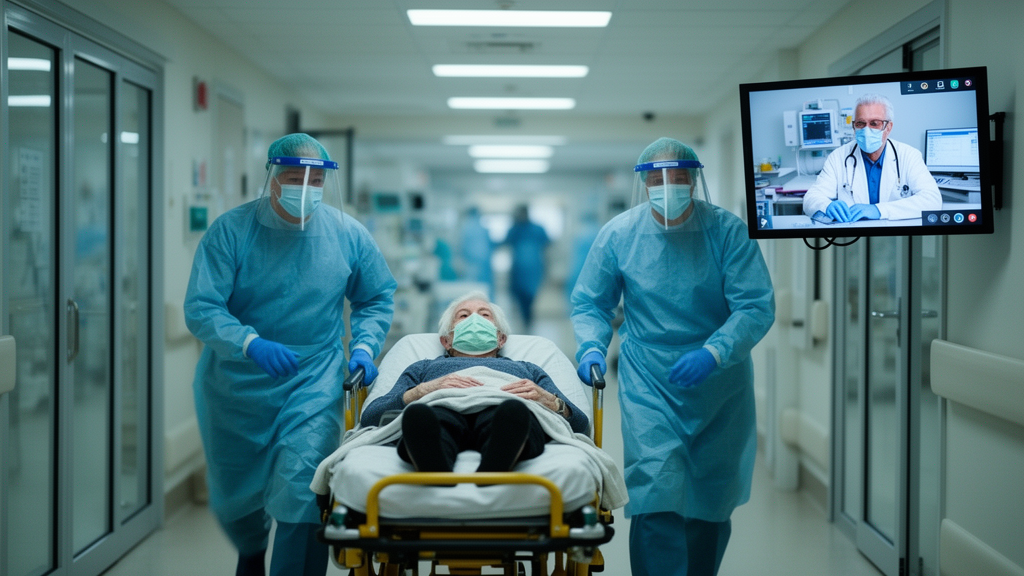
The second theme involves the rapid and often disruptive pivot to telemedicine and remote care. In-person consultations dropped sharply as healthcare systems tried to limit viral transmission, and while telemedicine offered a lifeline for continuity of care, it also introduced new barriers. Stroke assessment relies heavily on physical examination—neurological deficits, facial asymmetry, motor weakness, speech patterns—and remote evaluation cannot fully replicate that hands-on diagnostic precision. For a condition where minutes determine outcomes, the shift to virtual care was a double-edged sword.
Delays in treatment formed the third theme, with the review documenting reduced utilization of critical interventions. Time-sensitive treatments for stroke—particularly thrombolysis with tissue plasminogen activator and mechanical thrombectomy for emergent large vessel occlusion, or ELVO—depend on rapid presentation, rapid imaging such as CT, and rapid intervention. When patients delayed seeking help, or when hospital processes were reconfigured around infection control, the window for these interventions narrowed. The review found that this translated into measurable declines in the use of these treatments, meaning fewer patients received the therapies that could reverse their deficits.
The fourth theme addresses the strain on healthcare resources, which led to fragmented care. Hospitals repurposed beds, redeployed staff, and reorganized workflows around COVID-19 surges. Stroke units—specialized wards with dedicated nursing, neuroimaging access, and rehabilitation expertise—were among the resources diverted. When a stroke unit becomes a COVID ward, or when stroke neurologists are pulled to pandemic duties, the coordinated pathway from emergency department to imaging to intervention to rehabilitation breaks apart. The review describes this fragmentation as a direct consequence of resource strain, not a failure of individual clinicians.
Quality of care metrics declined as a fifth theme, with documented drops in care benchmarks and patient outcomes. Stroke care is measured through specific quality indicators—door-to-needle time for thrombolysis, proportion of patients receiving reperfusion therapy, rates of appropriate imaging, and functional outcomes at discharge. The review found that these metrics deteriorated during the pandemic, reflecting the cumulative effect of delayed presentation, reduced interventions, and fragmented systems. Greater stroke severity at presentation formed the sixth theme: when patients finally did arrive at hospital, they were often sicker, having waited longer at home while their symptoms progressed. This created a vicious cycle—fewer admissions but more severe strokes among those admitted.
The seventh and final theme is perhaps the most alarming: a reduction in stroke admissions overall, driven by both patient reluctance and changes in healthcare practices. Stroke did not become less common during the pandemic. People continued to have ischemic strokes, hemorrhagic strokes, and transient ischemic attacks. But fewer of them reached hospital. This suggests a hidden burden of untreated stroke in communities—people who survived at home with deficits that could have been minimized, or who died without ever receiving a diagnosis. The review underscores that this reduction was not a reflection of reduced disease incidence but of reduced access and willingness to seek care.
The implications of this review extend far beyond historical documentation. The authors conclude that the pandemic significantly impacted stroke care globally, leading to increased patient reluctance to seek medical attention, delays in treatment, and a rise in stroke severity. The shift to telemedicine and the strain on healthcare resources further disrupted stroke care, resulting in declines in quality metrics and reduced stroke admissions. But the review is not simply a catalogue of failures—it is a call to action. The authors emphasize the need for adaptable stroke care systems, improved telemedicine access, and enhanced patient education to address pandemic-related challenges and inform future emergency preparedness.
For clinicians and policymakers, the message is clear: stroke care cannot be paused during a crisis. The systems that deliver thrombolysis and thrombectomy must be designed with surge capacity in mind, with contingency plans that preserve time-critical pathways even when infection control demands reorganization. Telemedicine must be developed not as a stopgap but as a robust complement to in-person care, with protocols that account for the limitations of remote neurological assessment. And public health messaging must evolve to address the dual fear that pandemic conditions create—the fear of the virus and the fear of the hospital—so that patients understand that stroke symptoms warrant immediate emergency attention regardless of circulating pathogens.
As the world moves past the acute phase of COVID-19, the lessons embedded in this review serve as a blueprint for resilience. Stroke will remain a leading cause of death and disability worldwide, and the next pandemic or large-scale emergency will test healthcare systems again. The evidence gathered by Ménard and colleagues shows that when systems are not prepared, the consequences ripple through every stage of stroke care—from prevention and awareness through acute intervention to rehabilitation and quality of life. Building adaptable, resilient stroke systems is not optional; it is the difference between recovery and permanent disability for millions of people who will experience stroke in the years to come.
Subject of Research: Stroke care during the COVID-19 pandemic: a scoping review of healthcare disruption, telemedicine, and emergency preparedness
Article Title: Navigating stroke care during the COVID-19 pandemic: a scoping review
Article References: Ménard, A., McLean, M., Oostlander, S., Sarwal, K., Manji, I., O’sullivan, T., & Fraser, S. (2026). Navigating stroke care during the COVID-19 pandemic: a scoping review. BMC Health Services Research. https://doi.org/10.1186/s12913-026-15676-8
Image Credits: AI Generated
DOI: 10.1186/s12913-026-15676-8
Keywords: Navigating, stroke, care, during, COVID-19, pandemic, scoping, review, scientific research
Cite Scienmag News
Cassandra Pierce. (October 18, 2026). How COVID-19 Reshaped Stroke Care: A Global Scoping Review Reveals Delays, Fear, and the Rise of Telemedicine. Scienmag. https://scienmag.com/how-covid-19-reshaped-stroke-care-a-global-scoping-review-reveals-delays-fear-and-the-rise-of-telemedicine/
Cassandra Pierce. "How COVID-19 Reshaped Stroke Care: A Global Scoping Review Reveals Delays, Fear, and the Rise of Telemedicine." Scienmag, 18 October 2026, https://scienmag.com/how-covid-19-reshaped-stroke-care-a-global-scoping-review-reveals-delays-fear-and-the-rise-of-telemedicine/. Accessed 18 October 2026.
Cassandra Pierce. "How COVID-19 Reshaped Stroke Care: A Global Scoping Review Reveals Delays, Fear, and the Rise of Telemedicine." Scienmag. October 18, 2026. https://scienmag.com/how-covid-19-reshaped-stroke-care-a-global-scoping-review-reveals-delays-fear-and-the-rise-of-telemedicine/


