


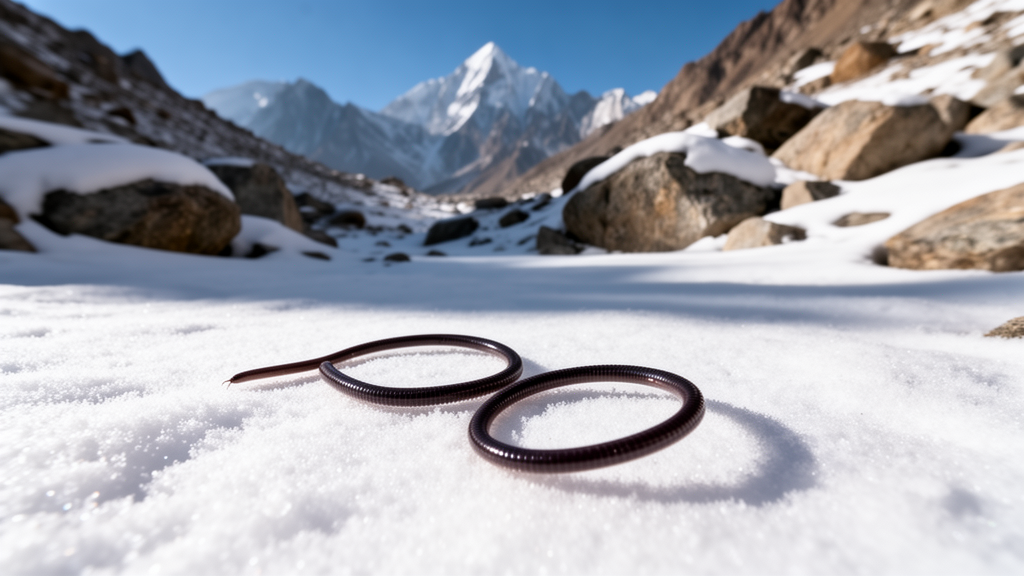
High in the mountains of northern Pakistan, researchers collecting specimens from freshly fallen snow made a discovery that has surprised parasitologists: living horsehair worms, actively wriggling on the frozen surface far from any visible water. The animals, gathered during several winter expeditions between December 2020 and January 2025, have now been formally described as Gordius nixus, a new species whose name derives from the Latin word for snow. The finding, published in the journal Evolutionary Systematics, represents the first record of a horsehair worm from Pakistan and one of the most unusual habitat associations ever documented for the entire phylum Nematomorpha.
Horsehair worms, of which roughly 360 species are currently described, lead a double life that reads like science fiction. As juveniles they are internal parasites, hijacking the bodies of insects such as grasshoppers, beetles and praying mantids, along with other arthropods including centipedes and millipedes. Marine species in the genus Nectonema parasitize decapod crustaceans, while the freshwater gordiids, the group to which the new species belongs, target terrestrial and aquatic insects. Once mature, the worms manipulate their hosts to seek water, then burst out as free-living adults to find mates and lay eggs. Adults are typically encountered in lakes, ponds, rivers, streams and even artificial water bodies such as cattle troughs, which makes their repeated appearance on snow in the Hindu Kush, Karakoram and Himalayan ranges all the more remarkable.
The specimens were collected from two districts of Khyber Pakhtunkhwa province. In Dir Upper, thirteen worms were taken from the village of Gat Koto, the type locality at an altitude of about 2,333 meters, and seven more from Shaltaloo, roughly 2.5 kilometers away, during three separate visits in December 2020, December 2021 and March 2024. Four live specimens were later collected from Karang in Upper Kohistan on 10 January 2025. At every locality and on every occasion, the animals were found alive and actively moving on freshly fallen snow in the early morning. Thorough searches of nearby freshwater failed to turn up any worms, and no potential hosts were observed close to the collection sites, deepening the mystery of why the adults emerged onto snow at all.
Identifying horsehair worms to species level is notoriously difficult, and the new study relied on scanning electron microscopy to resolve the fine cuticular details that separate closely related forms. In the genus Gordius, males are recognized by a postcloacal crescent at the posterior end and paired rounded tail lobes, whereas in the only other genus with a crescent, Acutogordius, the tail lobes are pointed. Beyond these features, differences between Gordius species are often minute and their variability is poorly understood, making it hard to distinguish within-species variation from true species differences. Females are even harder to identify because they possess fewer diagnostic characters. The research team, working at the Laboratory of Entomology and Vector-borne Diseases at the University of Peshawar, examined live specimens under a stereomicroscope, preserved males in 70 percent ethanol, and reared females in spring water until their natural death in early March 2022 to check for oviposition.
The electron micrographs revealed the character that sets the Pakistani worms apart from every other known member of the genus: a dense covering of fine spines, or bristles, concentrated in the anterior body region. While several Gordius species carry sparsely distributed short spines on the body cuticle, only two species are known to have bristles in the anterior end. Gordius terrestris from North America has very fine bristles, but it also bears polygonal areoles on the cuticle, a feature absent in the Pakistani specimens. Gordius wulingensis, described from China in 2025, has anterior bristles but in far smaller numbers. The smooth cuticle and the morphology of the male and female posterior ends of the new species otherwise correspond to several other Gordius species, so it is the sheer density of anterior spines that justifies the description as new.
The physical description of the worms follows familiar gordiid proportions. Males measured between 110 and 185 millimeters in length and around one millimeter in width, with a yellowish brown to light brown coloration that darkened after preservation. Living specimens carried light creamy white spots on the cuticle, densest from the anterior to mid-body and becoming scant toward the posterior, along with two creamy dorsal lines prominent in the anterior region. The anterior tip bears a white calotte followed by a dark black collar, and the posterior end carries a semicircular postcloacal crescent and two blunt tail lobes. Females, of which thirteen were examined, measured between 160 and 255 millimeters, shared the same spotting and coloration, and possessed a round posterior end bearing a vase-like cloacal opening at the tip. Some females carried a sperm drop on their posterior end, indicating they had mated before collection.
Laboratory observations added unexpected biological detail. Adult mated females lived for more than two months in spring water at room temperature, with average day and night temperatures of 20 and 5 degrees Celsius from December through February, spanning collections from December 2020 to March 2021 and December 2021 to March 2022. The team also documented the stubborn resistance of the worms’ cuticle to standard clearing techniques: mid-body segments of males mounted in Puri’s gum-chloral medium took a full year to become clear enough for microscopy, while female specimens placed overnight in 10 percent potassium hydroxide, a common clearing agent for insects and arachnids, were largely dissolved, leaving behind only the anterior collar and posterior tip. Ironically, this harsh treatment helped reveal the bristles around the collar that proved so taxonomically decisive.
The association with snow is a genuinely exceptional phenomenon among nematomorphs. Because it was observed repeatedly across multiple localities and years, the researchers believe it is a natural occurrence rather than an anomaly. Yet the life cycle of Gordius nixus remains completely unknown, with no host species found near the worms. In temperate regions, horsehair worm life cycles appear coupled to the seasons: in central Europe, free-living specimens emerge most abundantly in summer and fall, with species-specific time windows of occurrence. Adults die after depositing gametes, and nematomorphs are thought to survive the winter as eggs, larvae or within their intermediate hosts. Occasional records of adult worms during winter and under icy conditions exist, including one from 1913, but such records are rare and considered exceptions. How G. nixus times its emergence, finds partners on snow, and which hosts sustain its larvae are questions that now demand field observation.
The formal description of G. nixus also redraws the biogeographic map of a phylum whose documentation is strikingly uneven. Pakistan had no previously recorded horsehair worm species, and neighboring countries fare little better. Afghanistan has no records at all, Iran has only three, all from the northern region, and India’s 22 known species come mostly from the east, with just three records from the northwest. China reports 17 species from five genera, including six Gordius species, though most are insufficiently well described for in-depth comparison. Beyond the investigated specimens, the authors received confirmed reports of horsehair worms from seven further Pakistani locations, spanning altitudes from about 780 to 1,550 meters, including one sighting from a rice paddy and another from water, suggesting the animals are far more widespread than the formal record indicates.
With parts of the region crisscrossed by streams and rivers that appear well suited for nematomorphs, the researchers expect the true biodiversity of horsehair worms in Pakistan and neighboring regions to be considerably higher than current records suggest. The holotype, allotype and paratypes have been deposited in the Pakistan Museum of Natural History, providing an anchor for future taxonomic work. Whether Gordius nixus proves to be a cold-adapted specialist of high mountain ecosystems or simply the first documented member of a hidden diversity of snow-associated worms, its discovery demonstrates how much remains unknown about parasites in underexplored landscapes, and how even a routine winter walk across fresh snow can yield a species new to science.
Subject of Research: First horsehair worm species described from Pakistan, discovered unusually on snow
Article Title: Gordius nixus sp. nov.: first report of a horsehair worm ( Gordiida , Nematomorpha ) from snow in Pakistan
Article References: Jamal, Q., Riaz, M., Uddin, M., & Schmidt-Rhaesa, A. (2025). Gordius nixus sp. nov.: first report of a horsehair worm (Gordiida, Nematomorpha) from snow in Pakistan. Evolutionary Systematics, 9(2), 183-189. https://doi.org/10.3897/evolsyst.9.153102
Image Credits: AI Generated
DOI: 10.3897/evolsyst.9.153102
Keywords: Nematomorpha, horsehair worms, parasitology, Pakistan, new species, taxonomy, Hindu Kush, biodiversity, Gordius, nixus, first, report
Cite Scienmag News
Gavin Prescott. (October 18, 2026). New Horsehair Worm Species Found Wriggling on Snow in Pakistan Mountains. Scienmag. https://scienmag.com/new-horsehair-worm-species-found-wriggling-on-snow-in-pakistan-mountains/
Gavin Prescott. "New Horsehair Worm Species Found Wriggling on Snow in Pakistan Mountains." Scienmag, 18 October 2026, https://scienmag.com/new-horsehair-worm-species-found-wriggling-on-snow-in-pakistan-mountains/. Accessed 18 October 2026.
Gavin Prescott. "New Horsehair Worm Species Found Wriggling on Snow in Pakistan Mountains." Scienmag. October 18, 2026. https://scienmag.com/new-horsehair-worm-species-found-wriggling-on-snow-in-pakistan-mountains/


