


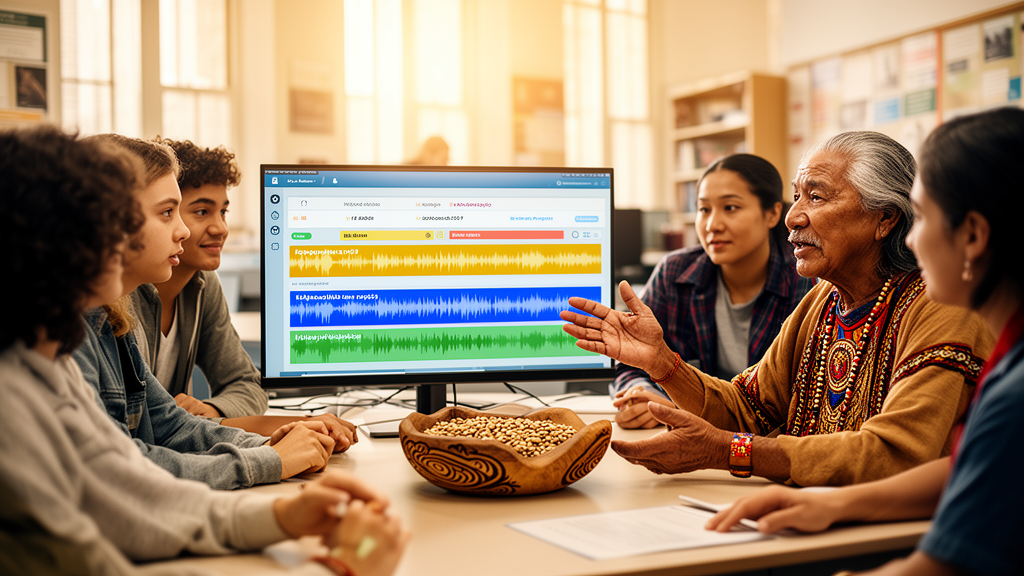
Learning management systems have become the invisible architecture of modern higher education, yet their design rarely reflects the languages and cultural referents of the diverse populations that depend on them. A new study published in SN Social Sciences argues that this neglect is not inevitable. Chinaza Solomon Ironsi of the University of Mediterranean Karpasia in North Cyprus examined what happens to user experience when indigenous knowledge is deliberately built into a multilingual Moodle installation, and the results suggest that culturally responsive software design can measurably reshape how instructors and students perceive educational technology.
Indigenous knowledge, as the study frames it, encompasses the place-based languages, values and cultural practices that communities develop and transmit across generations. Such knowledge is frequently absent from technology design, a gap that becomes most visible in learning management systems, which are seldom engineered to mirror the linguistic diversity of the campuses they serve. Little empirical work has previously examined the consequences of embedding indigenous knowledge directly into these platforms, leaving institutions to guess whether cultural responsiveness in software actually improves the experience of use.
To address that gap, Ironsi drew on the Technology Acceptance Model, a foundational framework in information systems research that explains technology adoption through two constructs: perceived usefulness, the belief that a system enhances performance, and perceived ease of use, the belief that operating it requires minimal effort. These constructs were combined with culturally responsive and critical indigenous pedagogies, theoretical approaches that insist education should recognize learners’ languages, histories and ways of knowing rather than assimilate them into a dominant cultural frame.
The empirical core of the research was a convergent mixed-methods design involving 1,185 participants at a private university in North Cyprus: 27 instructors and 1,158 students. Quantitative data came from a validated 11-item questionnaire measuring perceived usefulness and perceived ease of use, while qualitative data came from semi-structured interviews with 20 instructors and 45 students. Questionnaire responses were analysed with descriptive statistics and multiple linear regression, and interview transcripts were subjected to thematic analysis, the widely used qualitative technique formalized by Braun and Clarke that identifies recurring patterns of meaning across data.
The statistical findings were unambiguous. Both perceived ease of use and perceived usefulness significantly predicted user experience, confirming that the two classic acceptance constructs remain powerful determinants of how people judge educational platforms even when cultural design elements are added. In practical terms, students and instructors who found the multilingual system easier to navigate and more helpful for their work reported substantially better overall experiences, a result consistent with decades of Technology Acceptance Model research but newly contextualized for a multicultural campus.
The interviews added texture that numbers alone cannot supply. Thematic analysis yielded three student themes: usefulness, language and culture. Students emphasized comprehension, describing how encountering course content through their own languages and cultural referents deepened their understanding, and they stressed cultural recognition, the feeling of being seen and respected by the institution’s digital infrastructure. Instructors, by contrast, produced two themes: usefulness and language. For teaching staff, the multilingual platform translated into reduced workload, since culturally responsive materials and interface language options lessened the burden of repeatedly explaining content across linguistic boundaries.
This divergence between student and instructor priorities is one of the study’s most instructive technical observations. Students foregrounded comprehension and cultural recognition, dimensions tied to identity and learning depth, whereas instructors foregrounded efficiency, a dimension tied to professional practice. A design that satisfies both groups must therefore serve double duty: it must function as a comprehension aid and identity mirror for learners while simultaneously operating as a workload reducer for educators. The findings indicate that embedding indigenous knowledge in learning management system design offers a workable route to achieving both goals at once.
The study also situates itself within a growing international conversation about indigenous knowledge and digital technology. Prior work has explored preserving indigenous knowledge through e-learning, translating Moodle into te reo Māori, and fostering indigenous knowledge through video-mediated communication, among many other efforts. Earlier research on learning management systems and indigenous cultural perspectives documented perceptual gaps between platform design and indigenous holistic pedagogies, suggesting that standard systems can actively alienate culturally diverse users. The new research extends this literature by providing large-scale empirical evidence that deliberate cultural integration changes user experience in measurable ways.
For institutions serving linguistically diverse student bodies, the study offers concrete design guidance. Multilingual interfaces should be treated not as cosmetic translation layers but as core features that carry cultural referents, values and place-based knowledge into the software itself. Because perceived ease of use and perceived usefulness both significantly predicted user experience, designers should ensure that multilingual and culturally responsive elements enhance rather than complicate navigation. The research provides a template for universities in multicultural regions, from Cyprus to sub-Saharan Africa to Southeast Asia, where student populations span numerous languages and cultural traditions.
The implications reach beyond any single campus. As higher education becomes increasingly international, the software that mediates teaching and learning will either reflect the full diversity of its users or quietly reproduce a narrow cultural default. This study demonstrates that the choice is a design decision, not a technical constraint. By integrating indigenous knowledge into a mainstream platform like Moodle, a university transformed its learning management system from a generic tool into an inclusive multicultural environment, one that students experienced as comprehensible and culturally recognizing and instructors experienced as useful and workload reducing. The research suggests that the future of educational technology may belong to systems that speak many languages and carry many ways of knowing, and it supplies the empirical evidence that such systems work.
Subject of Research: Enhancing multicultural user experience in higher education: a multilingual LMS integrating indigenous knowledge
Article Title: Enhancing multicultural user experience in higher education: a multilingual LMS integrating indigenous knowledge
Article References: Ironsi, C. S. (2026). Enhancing multicultural user experience in higher education: a multilingual LMS integrating indigenous knowledge. SN Social Sciences, 6(11), Article 552. https://doi.org/10.1007/s43545-026-01854-2
Image Credits: AI Generated
DOI: 10.1007/s43545-026-01854-2
Keywords: Enhancing, multicultural, user, experience, higher, education, multilingual, integrating, indigenous, knowledge, scientific research
Cite Scienmag News
Courtney Benton. (October 18, 2026). Multilingual Learning Platform Weaves Indigenous Knowledge Into University Software. Scienmag. https://scienmag.com/multilingual-learning-platform-weaves-indigenous-knowledge-into-university-software/
Courtney Benton. "Multilingual Learning Platform Weaves Indigenous Knowledge Into University Software." Scienmag, 18 October 2026, https://scienmag.com/multilingual-learning-platform-weaves-indigenous-knowledge-into-university-software/. Accessed 18 October 2026.
Courtney Benton. "Multilingual Learning Platform Weaves Indigenous Knowledge Into University Software." Scienmag. October 18, 2026. https://scienmag.com/multilingual-learning-platform-weaves-indigenous-knowledge-into-university-software/


