


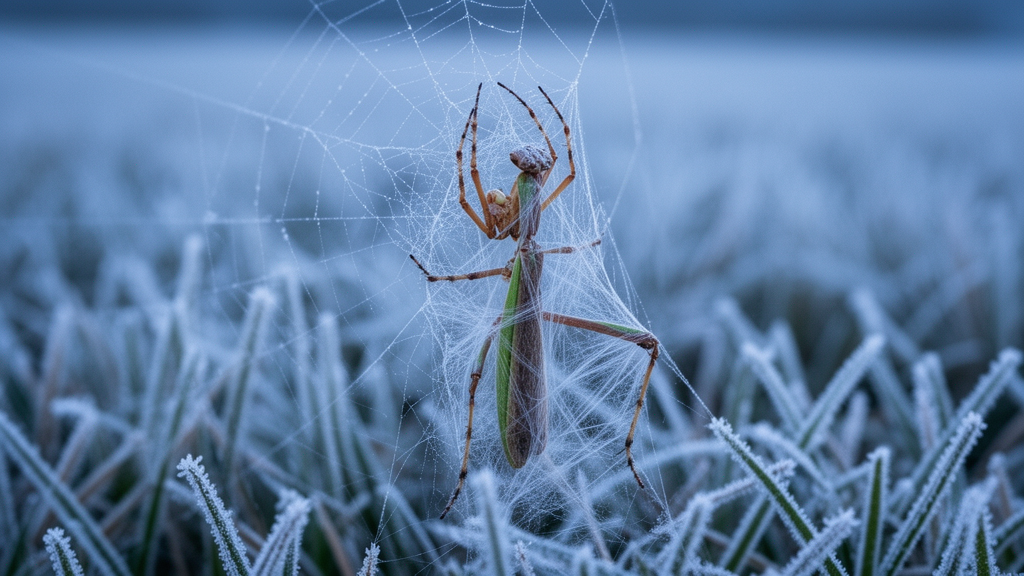
On a chilly November morning in a mixed forest on Honshu Island, Japan, a researcher monitoring praying mantises found something that should not have been possible. Perched on a tree branch roughly two meters above the ground was an adult female Chinese reddish mantis, Hierodula chinensis, more than 70 millimeters long. She was dead, but her body was still gripping the branch. On her head sat a juvenile orb-web weaving spider, Gibbaranea abscissa, measuring just 8.5 millimeters, actively feeding on the much larger insect. The size ratio between predator and prey was about eight to one, a reversal of the usual relationship between mantises and web-building spiders that has now been documented in the Journal of Orthoptera Research.
Intraguild predation, the predatory interaction among members of the same ecological guild, is a key force shaping community dynamics. Mantises and web-weaving spiders are both important predators in natural ecosystems, and they frequently prey on each other. In temperate regions, however, this relationship is strongly asymmetrical: mantises are larger, and they are generally the intraguild predators, while spiders are the prey. Mantises can even cut through spider capture threads with their mouthparts and escape when ensnared in a web, and some web-weaving spider species show defensive behaviors specifically to avoid mantis predation. Spiders are so frequently eaten by mantises that researchers consider mantises an important agent of selection pressure on web-building spider evolution.
The field observation, conducted on the morning of November 28, 2015 in Ashigarakami-gun, Kanagawa Prefecture, was part of a sight-based survey aimed at monitoring the local population of H. chinensis. The researcher searched with the naked eye for mantises and collected them by hand. The dead mantis was identified as H. chinensis by established taxonomic characters. When the individual was checked after collection, the juvenile female spider was found on the mantis head, feeding. Although spider silk was wrapped around the mantis head and forelegs, there was no web around the rest of the body, indicating that the spider had attacked and immobilized the mantis directly with capture silk, without constructing an orb web at all.
Photos of web-weaving spiders eating mantises can occasionally be found on the internet, but this is believed to be the first field record of a web-building spider observed feeding on an adult mantis without using a silk web. Gibbaranea abscissa is an orb-web weaver, but it sometimes wanders and preys on insects without a web, a behavior described once before in a 1989 record involving an unidentified weevil of unknown size. The species is considered a generalist predator based on its web-building habit, yet its predatory behavior and prey range remain poorly documented. The mantis prey observed here, an adult female with a total length exceeding 70 millimeters, represents a huge prey item for a juvenile spider of this species.
The researchers did not witness the capture itself, but the state of the mantis body supports the interpretation that the spider preyed on a living mantis rather than scavenging a corpse. The mantis head and forelegs were entangled with capture threads, and it is unlikely that the spider fed on a dead mantis in this manner. The evidence suggests the spider attacked the mantis, blocked its movement with capture silk, and then fed on it while it was still perched on the branch. Mantises are capable of cutting capture threads and escaping webs, so the spider may have needed to immobilize the mantis quickly before it could defend itself.
The key to this unusual predation may have been the cold. The temperature at 9:30 a.m., when the mantis was collected, was 6 degrees Celsius, and the other live mantises collected at about that time were almost immobile from cold paralysis. In temperate regions, Japanese mantis species, with one exception, overwinter in their oothecae, and November marks nearly the end of the life history of H. chinensis in the study field. Some adult individuals reach the end of their lifespan and die. Even healthy adults that survive into December are active during the day but unable to move at night or in the morning because of low temperatures. In contrast, the juvenile spider was active enough to move around immediately after collection.
Several ecological characteristics suggest that G. abscissa is tolerant to low temperatures, even though its physiological cold tolerance has not been directly investigated. One is phenology: many Japanese orb-weaver species are active during the warm season and mature in summer, but G. abscissa is one of the few that mature during the cold season, from autumn to spring. The other is distribution: apart from Japan, G. abscissa is also found in Far Eastern Russia, where winter temperatures fall below freezing. By contrast, the northern distribution limit of H. chinensis is Beijing, China, and the mantis is distributed in warmer regions. These ecological aspects are consistent with the spider actively foraging in late autumn while the mantis was paralyzed by cold.
The finding suggests that intraguild prey-predator relationships can be reversed depending on ambient temperature and the temperature-dependent activity of each organism. Differences in low-temperature tolerance may allow a small spider to hunt a mantis prey roughly eight times its size without using a web. Body size typically determines which predator becomes prey, with the larger animal behaving as the predator and the smaller one as the prey. Size inversions associated with different developmental stages can weaken or reverse this relationship, but cases in which a smaller predator eats a larger predator remain rare. This observation adds a new dimension: temperature-dependent activity can flip the asymmetry between two predators of the same guild.
The observation is also novel because it shows that G. abscissa can be a natural enemy of H. chinensis, a mantis suspected of being an alien species in Japan. Its distribution in the country has only recently been confirmed, although no direct evidence yet supports the alien status possibility. The basic ecology of this potentially invasive mantis, including its effects on native species assemblages and the natural enemies of such species, remains largely unknown. Whether this unique predation event represents a usual intraguild interaction between the two species or a rare exception is not clear, and future studies will need to clarify the interspecific interactions involving this mantis, including prey-predator relationships, to understand its ecology.
The record demonstrates that even well-studied predator guilds can harbor surprising reversals when environmental conditions change. A juvenile spider weighing a fraction of its prey managed to subdue an adult mantis by exploiting a window of cold paralysis, a strategy that may be more widespread among temperate predators than currently recognized. As climate patterns shift and potentially invasive species such as H. chinensis expand their ranges, understanding how temperature-dependent activity shapes predator-prey dynamics will become increasingly important for predicting community structure and the impacts of exotic predators on native ecosystems.
Subject of Research: Attack on Titan: a record of predation on the Chinese reddish mantis Hierodula chinensis (Mantodea, Mantidae) by the orb-web weaving spider Gibbaranea abscissa (Araneae, Araneidae)
Article Title: Attack on Titan: a record of predation on the Chinese reddish mantis Hierodula chinensis ( Mantodea , Mantidae ) by the orb-web weaving spider Gibbaranea abscissa ( Araneae , Araneidae )
Article References: Yamasaki, K., & Baba, Y. G. (2025). Attack on Titan: a record of predation on the Chinese reddish mantis Hierodula chinensis (Mantodea, Mantidae) by the orb-web weaving spider Gibbaranea abscissa (Araneae, Araneidae). Journal of Orthoptera Research, 34(1), 131-134. https://doi.org/10.3897/jor.34.122095
Image Credits: AI Generated
Keywords: Attack, Titan, record, predation, Chinese, reddish, mantis, Hierodula, chinensis, Mantodea, Mantidae, orb-web
Cite Scienmag News
Gavin Prescott. (October 18, 2026). Tiny spider kills mantis eight times its size in cold Japanese field. Scienmag. https://scienmag.com/tiny-spider-kills-mantis-eight-times-its-size-in-cold-japanese-field/
Gavin Prescott. "Tiny spider kills mantis eight times its size in cold Japanese field." Scienmag, 18 October 2026, https://scienmag.com/tiny-spider-kills-mantis-eight-times-its-size-in-cold-japanese-field/. Accessed 18 October 2026.
Gavin Prescott. "Tiny spider kills mantis eight times its size in cold Japanese field." Scienmag. October 18, 2026. https://scienmag.com/tiny-spider-kills-mantis-eight-times-its-size-in-cold-japanese-field/


