


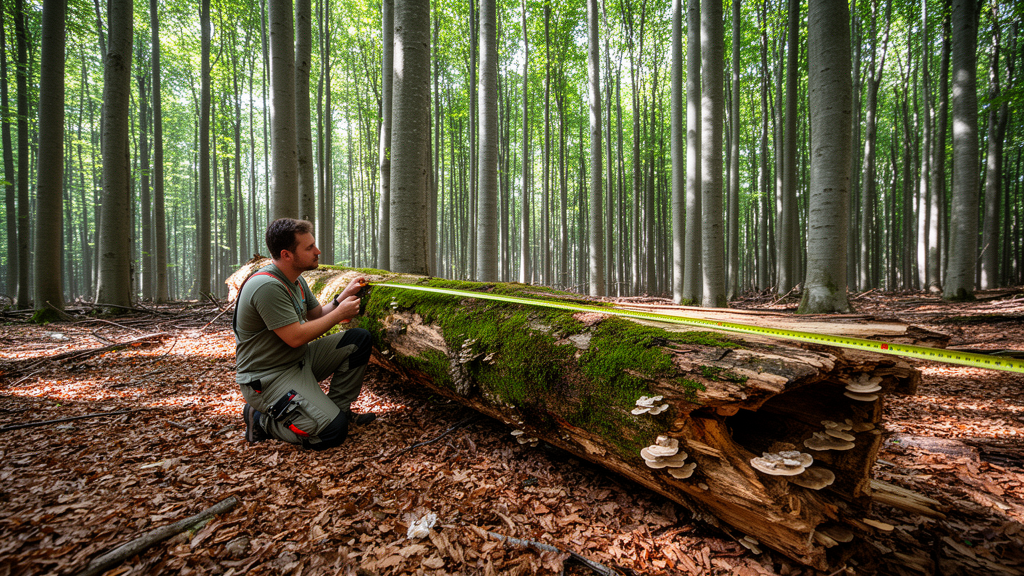
Deep in the forests of eastern Georgia, where the Greater Caucasus foothills meet the border with Azerbaijan, one of Europe’s least-studied old-growth ecosystems is quietly rewriting a rule that foresters across the continent have long taken for granted. A new field study comparing managed and virgin Oriental beech (Fagus orientalis) forests has found that deadwood, the standard benchmark for judging how natural a forest is, can be a misleading indicator in the Caucasus, where even logged stands retain as much coarse woody debris in absolute terms as untouched wilderness.
The research, published in the journal Caucasiana, set out to test two widely held assumptions drawn from western European forestry science: that deadwood accumulates more heavily in old-growth forests than in managed ones, and that natural regeneration is denser and more diverse where no cutting takes place. Both hypotheses were rejected by the data. Instead, the study paints a more complicated picture of how Georgian beech forests respond to timber harvesting, and it raises a warning about the long-term sustainability of current logging practices.
Oriental beech is the backbone of Georgian forestry, dominating roughly half of the country’s forests. In eastern Georgia it thrives between 1,000 and 2,000 meters above sea level, with optimal growth conditions between 1,000 and 1,500 meters, precisely the elevation band where most modern cuttings occur. To understand what harvesting does to these ecosystems, the researchers established ten study plots, each 37.5 by 37.5 meters, in the core zone of the Lagodekhi Protected Area, an unmanaged old-growth forest near the Azerbaijani border. Ten matching plots were laid out 20 kilometers to the east at Mtisdziri, on the same northwestern slope, the same soil type and similar site conditions, but in managed forest where cutting had occurred either five or fifteen years earlier.
The contrast in stand structure was stark. The old-growth forest at Lagodekhi held a living standing volume of 640 cubic meters per hectare, with Oriental beech making up 82 percent of the trees. The managed forest at Mtisdziri held only 271 cubic meters per hectare, and beech had fallen to just 41 percent of the tree count. Caucasian hornbeam (Carpinus caucasica), a minor player in the virgin forest at 7 percent, had surged to 39 percent in the managed stands. Linden (Tilia begoniifolia) held steady at around 7 to 8 percent in both areas, while scattered individuals of aspen, goat willow, wild cherry and wych elm appeared only in the logged forest.
Statistically, total tree species richness did not differ significantly between the two areas, with a p-value of 0.09. But the composition shift toward hornbeam is what concerns the authors. Dolukhanov had already noted decades ago that Caucasian hornbeam can replace Oriental beech in managed areas, and the new data confirm that this replacement is underway. In nearby unmanaged patches adjacent to the Mtisdziri plots, beech still prevails, suggesting the shift is a direct consequence of harvesting rather than a difference in site conditions.
The deadwood findings are the study’s most provocative result. In relative terms, deadwood made up only 5 percent of total wood volume in the old-growth forest but 14 percent in the managed forest, both five and fifteen years after cutting. Yet in absolute terms the two forest types were nearly identical: about 34 cubic meters of deadwood per hectare at Lagodekhi versus 43 at Mtisdziri, a difference well within the range of statistical noise. The explanation is simple arithmetic. Loggers in Georgia leave habitat trees and coarse woody debris behind when they cut, so the deadwood pool stays intact while the living volume collapses. Because the denominator shrinks, the relative deadwood share rises even though nothing was added.
This has real consequences for certification and sustainability assessment. Across Central Europe, deadwood proportions are a cornerstone indicator for judging sustainable forest management. The study argues that in Georgia, with its abundance of old-growth forest and its logging tradition of retaining dead and habitat trees, this indicator can be actively misleading. A heavily logged stand can look more natural by this metric than a pristine one. The authors suggest that maximum tree diameter or other old-growth indicators may serve better as yardsticks of naturalness in the Caucasus.
Regeneration told a similarly counterintuitive story. The managed forest actually hosted more seedlings, 14,200 per hectare compared with 9,588 in the old-growth forest, though the difference was not statistically significant. In the virgin forest, half of all seedlings were beech and 28 percent were linden. In the managed forest, hornbeam dominated the regeneration layer at 57 percent, with beech at 42 percent. Most strikingly, 92 percent of the tallest seedlings, those between one and two meters, were hornbeam, meaning the next generation of the managed forest is already tilting away from beech. Across all height classes, hornbeam seedling numbers were significantly higher in the managed forest, with a p-value below 0.001.
Canopy cover emerged as a key driver of this species shift. Under the densest canopy of the old-growth forest, 96 to 100 percent coverage, beech and linden seedlings prevailed, with 5,000 seedlings recorded in the darkest class alone. Where the canopy opened to 71 to 90 percent, beech made up 81 percent of regeneration. In the managed forest, hornbeam dominated the lowest canopy classes by up to 93 percent, while beech took the lead only where the canopy was most open, at 10 to 80 percent coverage, where it reached 74 percent of seedlings. The pattern suggests hornbeam thrives in the moderate shade left after selective beech removal, while beech requires larger gaps to assert itself.
The authors conclude that harvest intensity of Oriental beech should be reduced to preserve the uneven-aged beech-dominated ecosystem, and they recommend that hornbeam be harvested instead, with smaller individual removals of beech. They also suggest expanding the usable logging area through wires and winches on moderate slopes, which would spread the pressure rather than concentrating it. After heavy removals, competitive Rubus brambles can suppress tree regeneration for one to two decades, making overcutting doubly costly. The permanently marked study plots in both forests now form a long-term monitoring framework, allowing researchers to track whether the hornbeam takeover can be reversed and whether Georgian beech forests can keep their defining species for generations to come.
Subject of Research: Comparison of stand structure, deadwood and regeneration between managed and old-growth Oriental beech forests in eastern Georgia
Article Title: Comparison of tree species diversity, deadwood volume and regeneration of managed and old-growth Oriental beech ( Fagus orientalis L.) forests in Eastern Georgia
Article References: Droessler, L., & Wolff, T. (2023). Comparison of tree species diversity, deadwood volume and regeneration of managed and old-growth Oriental beech (Fagus orientalis L.) forests in Eastern Georgia. Caucasiana, 2, 171-176. https://doi.org/10.3897/caucasiana.2.e106898
Image Credits: AI Generated
DOI: 10.3897/caucasiana.2.e106898
Keywords: Oriental beech, Fagus orientalis, old-growth forest, deadwood, forest management, Caucasian hornbeam, natural regeneration, Georgia, Lagodekhi, forest ecology, sustainable forestry, Caucasus
Cite Scienmag News
Gavin Prescott. (October 18, 2026). Deadwood Fails as a Yardstick in Georgia’s Managed Beech Forests, Study Finds. Scienmag. https://scienmag.com/deadwood-fails-as-a-yardstick-in-georgias-managed-beech-forests-study-finds/
Gavin Prescott. "Deadwood Fails as a Yardstick in Georgia’s Managed Beech Forests, Study Finds." Scienmag, 18 October 2026, https://scienmag.com/deadwood-fails-as-a-yardstick-in-georgias-managed-beech-forests-study-finds/. Accessed 18 October 2026.
Gavin Prescott. "Deadwood Fails as a Yardstick in Georgia’s Managed Beech Forests, Study Finds." Scienmag. October 18, 2026. https://scienmag.com/deadwood-fails-as-a-yardstick-in-georgias-managed-beech-forests-study-finds/


