


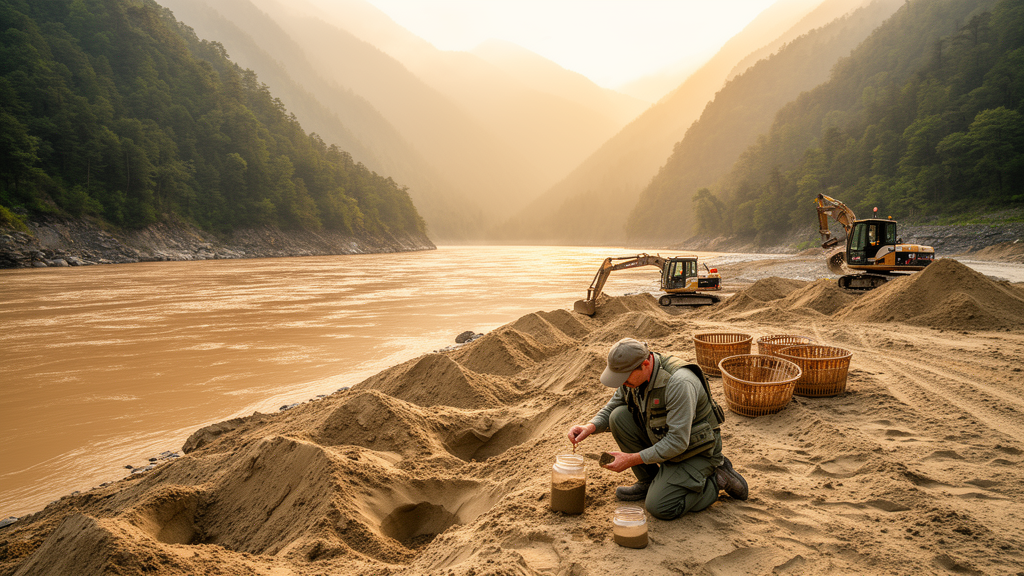
Deep in the mountains of Himachal Pradesh, India, the rivers that feed some of Asia’s great water systems are quietly keeping a chemical record of human activity. A new study published in Environmental Monitoring and Assessment has, for the first time, systematically quantified trace metal contamination in the sediments of three Himalayan rivers sitting at very different elevations, and the results paint a striking picture of how altitude, geology and human pressure combine to shape river health. Researchers from Panjab University, Chandigarh, Chandigarh University and Sri Guru Tegh Bahadur Khalsa College analysed surface sediments from the Chandra River in the Upper Himalayas, the Beas River in the Middle Himalayas and the Chakki Khad in the Lower Himalayas, measuring six metals of ecological concern: chromium, nickel, cobalt, copper, zinc and lead.
The motivation behind the work is deceptively simple. Riverbed mining exerts significant pressure on Himalayan river systems, yet its influence on trace metal dynamics in sediments remains poorly understood across elevation gradients. Sand and gravel extraction has become one of the most widespread forms of river modification in the region, disturbing channel beds, altering flow patterns and potentially remobilising metals that would otherwise remain locked in sediment. By sampling ten surface sediment sites from each of the three rivers, the team built an elevation transect that allowed them to separate the chemical fingerprint of pristine mountain catchments from that of intensively mined and industrially influenced lowland stretches.
The analytical approach was deliberately multi-layered. Rather than relying on a single contamination metric, the researchers evaluated the sediments using a battery of pollution indices, including the geoaccumulation index (Igeo), the Nemerow pollution index, the pollution load index (PLI), the potential ecological risk index (PERI), the mean effect range median quotient (MERMQ) and the mean effect concentration quotient (MEC). These were cross-checked against consensus-based sediment quality guidelines, which define threshold and probable effect concentrations above which adverse biological effects in aquatic organisms become likely. Pearson’s correlation analysis and hierarchical cluster analysis were then used to trace the likely sources of each metal, distinguishing geogenic inputs derived from rock weathering from anthropogenic contributions linked to mining and industry.
The concentration data revealed clear patterns. In both the Chandra and Beas Rivers, mean metal concentrations followed the order chromium greater than zinc greater than nickel greater than lead greater than copper greater than cobalt, while Chakki Khad showed a slightly different ranking in which nickel overtook zinc: chromium greater than nickel greater than zinc greater than lead greater than copper greater than cobalt. Chromium dominated every river, a finding that reflects both the geochemistry of Himalayan lithology and, in the lower reaches, additional human inputs. The consistency of the chromium signal across all three elevation zones underscores how the region’s geology sets a natural baseline that any contamination assessment must account for.
The most alarming results came from comparisons against sediment quality guidelines. Chromium exceeded the probable effect concentration, the threshold above which toxic effects on bottom-dwelling organisms are probable, in 40 percent of samples from the Chandra River, 20 percent from the Beas River and 40 percent from Chakki Khad. Nickel was even more concerning downstream: it surpassed the probable effect concentration in just 10 percent of Chandra samples but in 40 percent of Beas samples and a striking 70 percent of Chakki Khad samples. Because nickel and chromium are toxic to aquatic invertebrates and can bioaccumulate through food webs, these exceedances signal genuine ecological risk rather than a merely statistical anomaly.
The composite indices told a coherent story of escalating contamination with decreasing elevation. The Nemerow pollution index, which integrates the pollution levels of individual metals into a single warning score, indicated warning-level contamination in 70 percent of Chakki Khad samples. The mean effect range median quotient, a toxicity-predicting metric, reached 1.4 in Chakki Khad, with half of the samples from that river registering a 49 percent probability of sediment toxicity. By contrast, geoaccumulation index values were predominantly negative across all three rivers, indicating that most sediments are not strongly enriched relative to background geochemistry, with one isolated maximum of 1.71 for lead in the Chandra River pointing to a localised lead anomaly in the high Himalayan catchment.
Statistical source apportionment was where the elevation gradient became most revealing. In the Chandra River, correlation and cluster analyses pointed squarely to geogenic sources, meaning the metals there derive primarily from the weathering of the young, metal-rich rocks of the Himalayan orogen rather than from human activity. The Beas River showed mixed influences, a blend of natural background and moderate human pressure consistent with its position in a more developed middle-Himalayan valley. Chakki Khad, however, displayed pronounced anthropogenic inputs, which the researchers attribute to intensive sand mining and effluents from the dyeing industry. The chemical signature of that industrial discharge, visible in the nickel and chromium enrichments, effectively marks the point where a Himalayan river transitions from a geological archive to an industrial one.
Taken together, the ranking of contamination is unambiguous: Chakki Khad exhibited the highest contamination, followed by the Beas River and then the Chandra River. This inverse relationship between elevation and contamination risk carries important implications for how Himalayan basins are managed. Upstream catchments, though not untouched, remain dominated by natural geochemical processes, while downstream reaches bear the accumulating burden of extraction and industry. The pattern also suggests that regulatory attention focused only on the most visibly degraded lowland sites would miss the broader basin-scale dynamics that ultimately determine sediment quality throughout the river network.
The study’s significance extends beyond the three rivers it sampled. Sand mining is recognised internationally as a growing driver of river degradation, with documented consequences ranging from bank instability to the remobilisation of metals such as lead and cadmium in mined channels. In the Himalaya, where rivers carry some of the highest sediment loads on Earth and where infrastructure development is accelerating, the absence of systematic trace metal baselines has long hampered evidence-based regulation. By delivering the first systematic trace metal baseline for these river sediments, the research provides a reference point against which future monitoring can measure change, and a demonstration of how a multi-index, statistically grounded framework can disentangle natural from human contributions in complex mountain catchments.
The authors argue that the findings underscore the need for basin-scale monitoring and regulation of mining activities across Himalayan fluvial systems. That call comes at a critical moment: India’s sustainable sand mining guidelines and district-level survey reports already exist on paper, but enforcement in remote mountain terrain remains difficult, and the sediment chemistry documented in this study shows that the ecological stakes are real. For the benthic communities that form the foundation of river food webs, exceeding probable effect concentrations is not an abstraction but a direct threat. As demand for construction sand continues to climb across South Asia, studies like this one make clear that the sediments of Himalayan rivers are not inert ground to be excavated at will, but sensitive chemical archives whose degradation will be read, sooner or later, in the health of the entire river ecosystem.
Subject of Research: Trace metal contamination and ecological risk in sediments of three Himalayan rivers affected by riverbed mining and industrial effluents
Article Title: Quantification of trace metal contamination and ecological risks in river sediments of the Himalaya
Article References: Rishi, M. S., Singh, R., Kaur, L., & Sidhu, N. (2026). Quantification of trace metal contamination and ecological risks in river sediments of the Himalaya. Environmental Monitoring and Assessment, 198(9), Article 1030. https://doi.org/10.1007/s10661-026-15825-w
Image Credits: AI Generated
DOI: 10.1007/s10661-026-15825-w
Keywords: Himalayan rivers, trace metals, river sediments, sand mining, chromium, nickel, ecological risk, sediment quality guidelines, pollution indices, Himachal Pradesh, water pollution, geoaccumulation index
Cite Scienmag News
Violet Maxwell. (October 18, 2026). Himalayan River Sediments Reveal a Hidden Toll of Sand Mining on Trace Metals. Scienmag. https://scienmag.com/himalayan-river-sediments-reveal-a-hidden-toll-of-sand-mining-on-trace-metals/
Violet Maxwell. "Himalayan River Sediments Reveal a Hidden Toll of Sand Mining on Trace Metals." Scienmag, 18 October 2026, https://scienmag.com/himalayan-river-sediments-reveal-a-hidden-toll-of-sand-mining-on-trace-metals/. Accessed 18 October 2026.
Violet Maxwell. "Himalayan River Sediments Reveal a Hidden Toll of Sand Mining on Trace Metals." Scienmag. October 18, 2026. https://scienmag.com/himalayan-river-sediments-reveal-a-hidden-toll-of-sand-mining-on-trace-metals/


