


Burying nuclear waste deep underground is one of the most consequential engineering challenges of our time, and the difference between a safe repository and a leaking one can hinge on chemistry that happens at scales invisible to the naked eye. A new study published in the journal BioRisk takes a major step toward mastering that chemistry, presenting a set of highly accurate thermodynamic models that predict how nitrate salts behave in water — from the faintest traces all the way up to concentrations far beyond what most existing databases can handle. The work, led by researchers developing a chemical thermodynamic database for the geochemical storage of nuclear waste, covers ten binary nitrate systems and delivers predictions that match experimental data with remarkable precision.
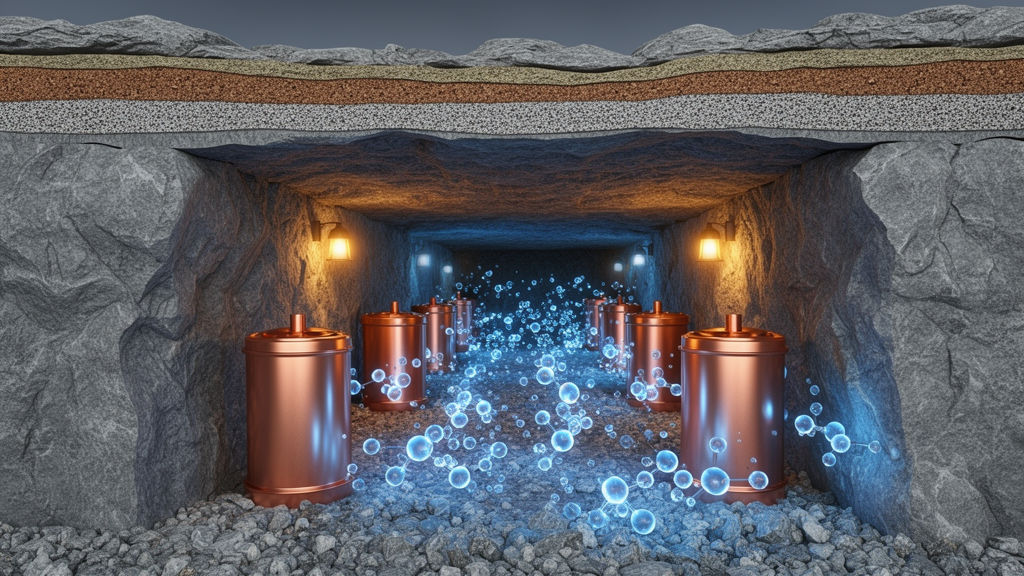
The ten systems in question span an impressive range of chemistry. Five are of the so-called 2–1 type, where a doubly charged cation pairs with nitrate: magnesium nitrate, calcium nitrate, barium nitrate, strontium nitrate, and uranyl nitrate. Four are 3–1 type systems involving trivalent cations — chromium, aluminum, lanthanum, and lutetium nitrates — and one, thorium nitrate, is a 4–1 system with a quadruply charged cation. All of these matter for nuclear waste disposal, because nitrates are expected to play a significant role in underground repositories. Long-lived, intermediate-level radioactive wastes destined for deep clay formations contain dried sludge from effluent treatment with substantial nitrate content, sealed in containers placed in cavities dug into very low-permeability argillite rock.
The problem is that water finds a way. Safety analyses show that despite protective concrete or stainless steel layers on the waste containers, formation water from the host rock is likely to migrate and reach the waste during the disposal period. When that happens, large amounts of nitrate and other elements can dissolve, creating a highly saline, corrosive, and oxidative medium that reacts aggressively with containment materials and the surrounding rock. Some waste management options even involve preliminary leaching with nitric acid or nitrate salts to recover uranium and plutonium before the residues are encased in concrete or metal packages and stored underground. Predicting what happens when groundwater finally meets these materials requires models that work at extremely high concentrations — precisely where most existing tools fail.
That failure is not a small technical footnote. The two flagship thermodynamic databases built for nuclear waste programs — the Yucca Mountain database developed at Sandia National Laboratories and the European THEREDA project — contain Pitzer-based models that are concentration restricted. The Yucca Mountain models for nitrate systems, for instance, are limited to solutions below 6 moles per kilogram of water, and THEREDA does not include models for nitrate solutions and solids at all. Yet saturated calcium nitrate solutions in the real world can reach nearly 15 moles per kilogram. A model that breaks down at half the relevant concentration is a model that cannot be trusted for repository safety cases.
The new study attacks this limitation using the Pitzer ion interaction approach, a semi-empirical framework introduced in the 1970s that remains the most accurate description of saline waters available. In Pitzer theory, electrolytes are treated as fully dissociated ions that interact with one another in two ways: long-range Coulomb forces between distant ions of opposite charge, described by Debye-Hückel type equations, and short-range interactions between two or three ions, captured by adjustable parameters. For a binary salt like calcium nitrate in water, the key parameters are the second virial coefficients beta-zero, beta-one, and, when needed, beta-two, along with a third virial coefficient C-phi. What makes the framework powerful is that it is based on excess free energy, so all activity expressions are thermodynamically consistent — osmotic coefficients, activity coefficients, and solubility data can all be combined in a single parameterization.
The innovation in this work lies in how the team handled the trickiest parameter. For most electrolytes with at least one univalent ion, the standard three-parameter approach works fine. But in many nitrate solutions, the curves of osmotic or activity coefficient versus concentration develop a wide maximum as they approach saturation, a signature of strong ion association at high molality that three parameters simply cannot reproduce. The researchers therefore deployed an extended four-parameter version of the Pitzer equations, adding beta-two and systematically varying the alpha terms that control how the parameters depend on ionic strength. By tuning these alpha values, the modelers can shift the concentration range at which ion association becomes important, effectively teaching the equations to behave correctly in the supersaturated zone.
The parameterization itself was a tour de force of data curation. The team assembled essentially all available raw experimental osmotic coefficient data for each of the ten systems, drawing on classic reference compilations and, for lutetium nitrate, the extensive measurements of Rard and Spedding. Crucially, for calcium nitrate, uranyl nitrate, and thorium nitrate, they incorporated data extending into the supersaturated region — solutions holding more dissolved salt than thermodynamics says should be stable. They tested both the classical three-parameter approach and the extended four-parameter scheme with several alpha combinations, accepting whichever version minimized the standard deviation of the fit. For barium and strontium nitrates, the simpler three-parameter model proved sufficient; for everything else, the extended approach won decisively, producing sigma values far below those of the classic Pitzer-Mayorga and Kim-Frederick parameterizations.
The validation results are striking. The new models reproduce experimental osmotic coefficients from dilute solutions all the way to saturation and beyond, achieving excellent agreement across all ten systems. The calcium nitrate model, in particular, matches data up to 14.77 moles per kilogram while simultaneously outperforming older models in the dilute range — a combination its three-parameter predecessors could not achieve. The models were also checked against literature recommendations for mean activity coefficients, which were deliberately withheld from the fitting process and used only as an independent test. Again, agreement was excellent from low to very high concentration.
Beyond solution properties, the study delivers two quantities of direct practical value for repository science. First, the team calculated the deliquescence relative humidity — the threshold humidity at which a solid salt spontaneously absorbs water vapor and dissolves into a saturated solution — for twelve solid nitrate phases that crystallize from saturated solutions, including hydrated forms of magnesium, calcium, uranyl, aluminum, lanthanum, lutetium, and thorium nitrates. This matters because deliquescence governs corrosion of metals in humid environments and the behavior of salts in contact with moist air underground. The calculations matched experimental values closely, and they revealed that calcium nitrate trihydrate and lutetium nitrate pentahydrate deliquesce at the lowest humidities, suggesting that lanthanide nitrate phase changes are especially activated in the presence of calcium in a storage environment. Second, the researchers determined the thermodynamic solubility products of all twelve solid phases, values that agree well with independent calculations and provide the anchor points needed to extend these binary models into the multicomponent brines a real repository will contain.
What emerges is a database-quality foundation for simulating the chemical fate of radionuclides in some of the harshest aqueous environments imaginable. Because the new models are not concentration restricted, they can be used without modification to build solid-liquid equilibrium models for the complex mixed-salt systems that will characterize water infiltrating nuclear waste packages. As nations commit to deep geological disposal for decades-long horizons, the ability to calculate — with experimental accuracy — how nitrate-laden brines will dissolve, corrode, precipitate, and transport radioactive species may prove to be one of the quiet but decisive technologies keeping repositories safe for millennia.
Subject of Research: Thermodynamic modeling of nitrate electrolyte solutions and solid-liquid equilibria for nuclear waste geochemical storage
Article Title: Development of accurate chemical thermodynamic database for geochemical storage of nuclear waste. Part II: Models for predicting solution properties and solid-liquid equilibrium in binary nitrate systems
Article References: Donchev, S., Tsenov, T., & Christov, C. (2022). Development of accurate chemical thermodynamic database for geochemical storage of nuclear waste. Part II: Models for predicting solution properties and solid-liquid equilibrium in binary nitrate systems. BioRisk, 17, 389-406. https://doi.org/10.3897/biorisk.17.77487
Image Credits: AI Generated
Keywords: nuclear waste, geochemical storage, Pitzer model, thermodynamic database, nitrate systems, solubility equilibrium, deliquescence, osmotic coefficient, activity coefficient, brine chemistry, radioactive waste repository, ion interaction
Cite Scienmag News
Bethany Barker. (October 18, 2026). New Thermodynamic Models Predict Nitrate Behavior in Nuclear Waste Repositories. Scienmag. https://scienmag.com/new-thermodynamic-models-predict-nitrate-behavior-in-nuclear-waste-repositories/
Bethany Barker. "New Thermodynamic Models Predict Nitrate Behavior in Nuclear Waste Repositories." Scienmag, 18 October 2026, https://scienmag.com/new-thermodynamic-models-predict-nitrate-behavior-in-nuclear-waste-repositories/. Accessed 18 October 2026.
Bethany Barker. "New Thermodynamic Models Predict Nitrate Behavior in Nuclear Waste Repositories." Scienmag. October 18, 2026. https://scienmag.com/new-thermodynamic-models-predict-nitrate-behavior-in-nuclear-waste-repositories/


