


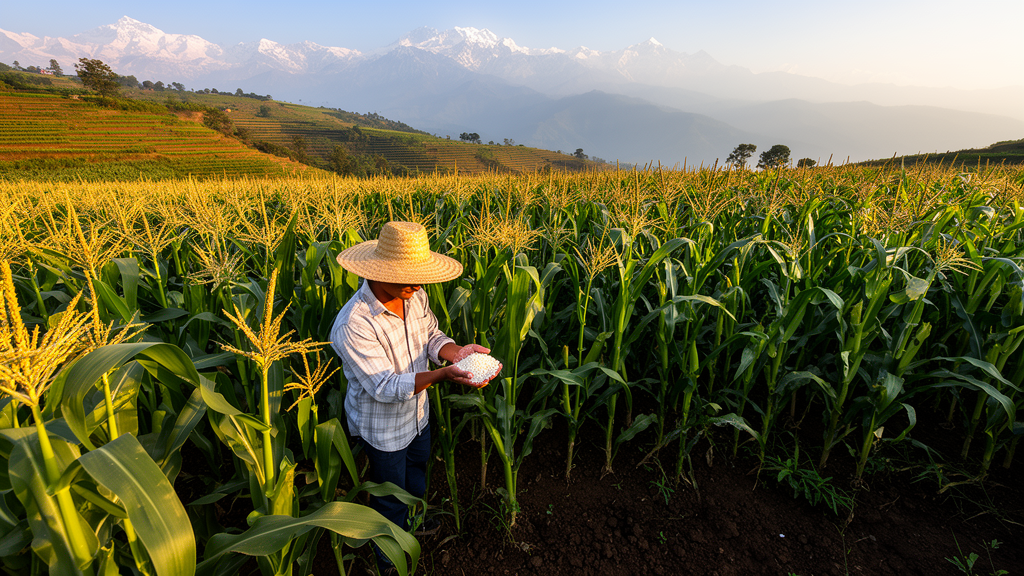
Maize is the backbone of food security in Nepal, and a new field study from the country’s western Terai plains offers farmers a clear, numbers-driven recipe for getting more grain out of every hectare. Researchers at Ultakham in Kanchanpur district spent the 2022 spring season testing two maize varieties under four nitrogen fertilizer regimes, and the results point to a simple conclusion: pairing the hybrid Bioseed 9220 with 180 kilograms of nitrogen per hectare produces the tallest plants, the heaviest grains, and the largest harvests.
The experiment, conducted from February to July 2022 on a farmer’s field at 203 meters above sea level, was designed as a two-factorial randomized complete block trial. The first factor was variety: Bioseed 9220, a medium-duration hybrid, and Arun-2, a short-duration open-pollinated variety. The second factor was nitrogen, applied at 0, 60, 120, and 180 kilograms per hectare, with phosphorus and potassium held constant across all plots. Eight treatment combinations, replicated three times, allowed the team to separate the genetic contribution of each variety from the nutritional contribution of each fertilizer dose.
The soil itself told an important part of the story. Analysis revealed a sandy texture with 82.25 percent sand, an acidic pH of 6.22, and low organic matter at 1.90 percent. Total nitrogen was below 0.10 percent, classifying the field as nitrogen-poor, while available phosphorus was high and potassium medium. These conditions mirror the broader fertility decline reported across Nepali farmland, where farmers often apply nitrogen haphazardly because reliable, location-specific dosing guidance is scarce.
Plant height responded strongly to both factors. Bioseed 9220 reached an average of 202.83 centimeters, significantly taller than Arun-2 at 170.25 centimeters. Nitrogen pushed heights upward as well, from 171.83 centimeters in unfertilized plots to 197.83 centimeters at the highest dose. The mechanism is well understood: nitrogen fuels amino acid, protein, and chlorophyll production, driving cell division, internodal elongation, and canopy expansion that together lift the crop skyward.
Phenology, the timing of flowering, also shifted with treatment. Bioseed 9220 took 79.08 days to tassel and 85.50 days to silk, substantially longer than Arun-2’s 58.75 and 65.33 days, a difference rooted in the hybrid’s longer 125-day life cycle compared with Arun-2’s 90-day maturity. Interestingly, higher nitrogen doses shortened the days to tasseling and silking, with unfertilized plots flowering latest. The researchers attribute this to nitrogen’s role in hormone regulation, including gibberellins, cytokinins, and auxins, which coordinate the transition from vegetative to reproductive growth.
Yield components told a consistent story. Bioseed 9220 produced 30.50 kernels per row versus 27.53 for Arun-2, 14.12 kernel rows per cob versus 13.10, 1.38 cobs per plant versus 1.23, and a thousand-grain weight of 232.08 grams against 204.16 grams. Nitrogen at 180 kilograms per hectare delivered the highest values for nearly every component, including the heaviest grains at 221.50 grams per thousand. Ear length differed significantly between varieties, with Bioseed 9220 cobs averaging 19.85 centimeters, while tassel length remained statistically unchanged across all treatments.
The headline result was grain yield. Bioseed 9220 averaged 5.48 tonnes per hectare, a full 1.33 tonnes more than Arun-2’s 4.15 tonnes. Across nitrogen levels, yield climbed from 4.56 tonnes per hectare with no fertilizer to 4.78 at 60 kilograms, 4.81 at 120, and 5.11 at 180 kilograms per hectare. The harvest index, which measures the fraction of total biomass partitioned into grain, rose from 36.70 percent in unfertilized plots to 44.05 percent at the highest nitrogen dose, indicating that added nitrogen steers more of the plant’s photosynthetic output into the cob rather than stems and leaves.
Biological yield, by contrast, was unaffected by nitrogen dose, though the hybrid outperformed the open-pollinated variety at 12.34 versus 11.60 tonnes per hectare. The authors explain that adequate nitrogen optimizes the uptake and assimilation of other nutrients, promotes grain filling through protein and starch synthesis, and reduces barren plants, all of which funnel more resources into harvestable grain. Previous studies cited in the work report nitrogen fertilization boosting maize grain yield by 43 to 68 percent and biomass by 25 to 42 percent.
The demand context makes these findings urgent. Nepal’s maize demand is projected to grow 4 to 6 percent annually over the next two decades, driven by expanding livestock and poultry industries, population growth, and rising incomes. The country currently produces around 3.1 million tonnes of maize, much of it in the Terai, where the crop serves as the primary feed source for commercial feed companies. Closing the gap between demand and supply depends heavily on closing yield gaps at the field level.
The study’s practical recommendation is straightforward: farmers in comparable agroecological zones should prioritize Bioseed 9220 and apply 180 kilograms of nitrogen per hectare alongside appropriate phosphorus and potassium. The researchers caution that the optimal dose ultimately depends on soil type, variety, and local conditions, but their data provide a concrete benchmark for the sandy, nitrogen-poor soils of Kanchanpur. As fertilizer costs and environmental concerns mount, the finding that yield gains plateau modestly between 120 and 180 kilograms suggests farmers have room to fine-tune applications for both profit and sustainability.
Subject of Research: Effects of nitrogen fertilizer levels and maize variety on spring maize growth and yield in Kanchanpur, Nepal
Article Title: Quantifying the impact of nitrogen levels on spring maize varieties ( Zea mays L.) in Kanchanpur, Nepal
Article References: Bhatt, S., & Ghimire, S. (2024). Quantifying the impact of nitrogen levels on spring maize varieties (Zea mays L.) in Kanchanpur, Nepal. Innovations in Agriculture, 7, 1-10. https://doi.org/10.3897/ia.2024.124217
Image Credits: AI Generated
Keywords: maize, nitrogen fertilizer, Bioseed 9220, Arun-2, Nepal, grain yield, hybrid varieties, crop physiology, soil fertility, harvest index, Terai agriculture, food security
Cite Scienmag News
Alan Morgan. (October 18, 2026). Nitrogen Doses and Hybrid Choice Drive Spring Maize Yields in Nepal. Scienmag. https://scienmag.com/nitrogen-doses-and-hybrid-choice-drive-spring-maize-yields-in-nepal/
Alan Morgan. "Nitrogen Doses and Hybrid Choice Drive Spring Maize Yields in Nepal." Scienmag, 18 October 2026, https://scienmag.com/nitrogen-doses-and-hybrid-choice-drive-spring-maize-yields-in-nepal/. Accessed 18 October 2026.
Alan Morgan. "Nitrogen Doses and Hybrid Choice Drive Spring Maize Yields in Nepal." Scienmag. October 18, 2026. https://scienmag.com/nitrogen-doses-and-hybrid-choice-drive-spring-maize-yields-in-nepal/


