


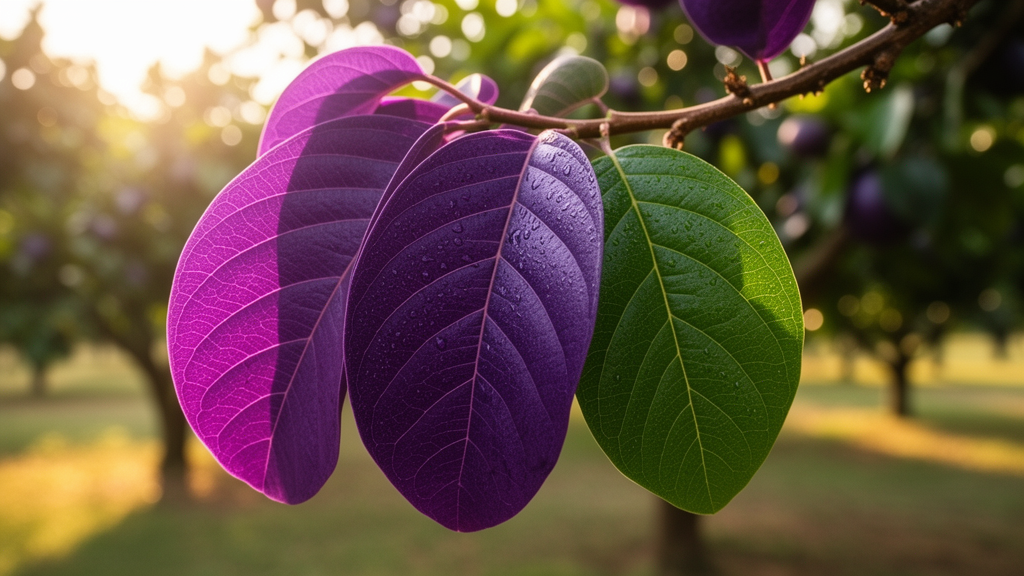
The striking purple leaves of certain guava trees are not just a cosmetic curiosity. According to a new study published in BMC Plant Biology, the deep coloration of the purple-leaved guava cultivar “Ziguo” arises from a coordinated shift in the plant’s flavonoid metabolism, one that channels resources away from one class of compounds and toward another. Researchers used integrated metabolomic and transcriptomic profiling to compare “Ziguo” with the green-leaved cultivar “Zhenzhu,” and their findings point to a delicate balancing act between two related biosynthetic pathways that ultimately determines whether a leaf appears green or purple.
Guava (Psidium guajava L.) is a tropical fruit tree grown widely across Asia, Africa, and the Americas. While most people know it for its sweet fruit, the plant also exhibits natural variation in leaf color, with some cultivars producing purple foliage and others producing the more typical green. The biological basis for this difference had not been systematically explored until now. The research team, led by scientists from Shihezi University and the Guangdong Academy of Agricultural Sciences, set out to characterize both the chemical composition and the gene expression patterns underlying the two leaf phenotypes.
The researchers employed targeted metabolomics to profile the flavonoid-related compounds present in the leaves of each cultivar. Flavonoids are a large family of plant secondary metabolites that include anthocyanins, which provide red, purple, and blue pigmentation, as well as proanthocyanidins, which are condensed tannins that contribute to astringency and defense. By quantifying these metabolites in both purple and green leaves, the team could determine which compounds accumulate preferentially in each phenotype.
The results revealed a clear divergence. In the green-leaved cultivar “Zhenzhu,” proanthocyanidins constituted a larger proportion of the measured flavonoid pool. In contrast, the purple-leaved “Ziguo” showed a predominance of anthocyanins, with cyanidin derivatives identified as the major pigment class. This finding indicates that the two cultivars are not simply differing in the total amount of flavonoids they produce but rather in how those flavonoids are partitioned between alternative end products of the same core pathway.
To understand the genetic basis of this metabolic shift, the researchers performed transcriptomic sequencing on the leaves of both cultivars. Transcriptomics allows scientists to measure the activity levels of thousands of genes simultaneously, revealing which genes are turned up or down in one condition relative to another. In this case, the comparison between purple and green leaves highlighted a set of differentially expressed genes involved in flavonoid biosynthesis.
One of the most striking observations concerned the proanthocyanidin branch of the pathway. The genes responsible for converting common flavonoid precursors into proanthocyanidins, including key structural enzymes such as ANR (anthocyanidin reductase) and LAR (leucoanthocyanidin reductase), were expressed at significantly lower levels in the purple-leaved cultivar. This downregulation suggests that “Ziguo” actively suppresses the proanthocyanidin pathway, leaving more substrate available for the competing anthocyanin branch.
The researchers also identified candidate genes involved in the transport and storage of these compounds within plant cells. Anthocyanins and proanthocyanidins must be moved from their site of synthesis in the cytoplasm to their final destinations, typically the vacuole, where they accumulate to visible concentrations. A glutathione S-transferase gene designated PgGSTF9 was expressed at notably higher levels in the purple cultivar, consistent with a role in shuttling anthocyanins to the vacuole. Conversely, a gene called PgDTX, implicated in proanthocyanidin transport, showed reduced expression in the purple leaves, potentially limiting the accumulation of proanthocyanidins in that compartment.
Beyond structural genes and transporters, the study also examined transcription factors, the regulatory proteins that control the expression of multiple biosynthetic genes at once. The researchers found that certain candidate regulatory genes showed differential expression between the two cultivars, suggesting that the shift in flavonoid partitioning is coordinated at the transcriptional level rather than arising from changes in a single enzyme. This type of coordinated regulation is common in plant secondary metabolism, where transcription factor complexes control entire biosynthetic branches in response to developmental or environmental cues.
The findings carry practical implications for guava breeding and ornamental horticulture. Purple-leaved guava varieties are valued for their visual appeal in landscaping, and understanding the molecular basis of leaf coloration could help breeders develop new cultivars with enhanced pigmentation. More broadly, the study contributes to a growing body of knowledge about how plants allocate flux through the flavonoid pathway, a question with relevance to fruit quality, nutritional value, and stress tolerance in many crop species.
From a scientific perspective, the work illustrates the power of combining metabolomics with transcriptomics to dissect complex metabolic phenotypes. Neither approach alone would have been sufficient to reveal the full picture. The metabolite profiling identified what compounds differ between the two cultivars, while the gene expression data pointed to the enzymatic and regulatory mechanisms responsible for those differences. Together, they provide a coherent model in which suppressed proanthocyanidin biosynthesis, enhanced anthocyanin transport, and altered transcriptional regulation jointly produce the purple leaf phenotype. Future research will likely focus on validating the candidate genes identified in this study through functional characterization, potentially using transgenic approaches or gene editing to confirm their roles in vivo.
Subject of Research: Flavonoid metabolism underlying purple leaf coloration in guava
Article Title: Integrated metabolomics and transcriptomics characterize anthocyanin accumulation in purple-leaved guava (Psidium guajava L.)
Article References: Xue, S., Lai, D., Chen, J., Hu, S., & Shao, X. (2026). Integrated metabolomics and transcriptomics characterize anthocyanin accumulation in purple-leaved guava (Psidium guajava L.). BMC Plant Biology. https://doi.org/10.1186/s12870-026-09972-y
Image Credits: AI Generated
DOI: 10.1186/s12870-026-09972-y
Keywords: guava, anthocyanins, proanthocyanidins, flavonoid biosynthesis, leaf coloration, metabolomics, transcriptomics, Psidium guajava, cyanidin, plant pigmentation, gene expression, horticulture
Cite Scienmag News
Juliet Wilcox. (October 18, 2026). Purple Guava Leaves Trace Their Color to a Molecular Switch Between Pigment Branches. Scienmag. https://scienmag.com/purple-guava-leaves-trace-their-color-to-a-molecular-switch-between-pigment-branches/
Juliet Wilcox. "Purple Guava Leaves Trace Their Color to a Molecular Switch Between Pigment Branches." Scienmag, 18 October 2026, https://scienmag.com/purple-guava-leaves-trace-their-color-to-a-molecular-switch-between-pigment-branches/. Accessed 18 October 2026.
Juliet Wilcox. "Purple Guava Leaves Trace Their Color to a Molecular Switch Between Pigment Branches." Scienmag. October 18, 2026. https://scienmag.com/purple-guava-leaves-trace-their-color-to-a-molecular-switch-between-pigment-branches/


