


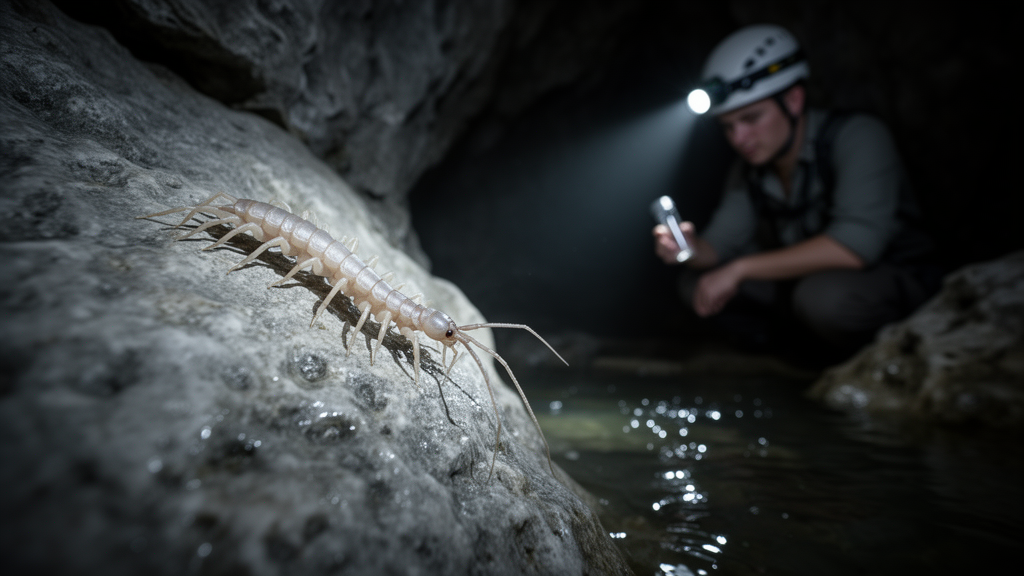
Deep beneath the limestone caves of western Georgia, in the shadows of the Caucasus Mountains, a hidden world of predatory arthropods has been quietly accumulating scientific records for nearly two centuries. Now, for the first time, researchers have compiled a comprehensive checklist of every centipede species ever documented in this biodiversity-rich country, revealing a fauna that is far more diverse — and far more mysterious — than previously appreciated. The new synthesis, published in the journal Caucasiana, catalogs 59 taxa (57 species and two subspecies) known from Georgia, belonging to 16 genera, seven families, and four orders, and highlights how much of this legacy remains unexplored.
Centipedes are among the most successful predatory soil invertebrates on Earth. These elongated, flattened creatures spend their days hidden beneath stones, bark, and leaf litter, emerging at night to hunt smaller invertebrates with venomous forcipules — modified legs that function as pincers. Their cryptozoic lifestyle means they are rarely seen in daylight, yet they occupy an extraordinary range of biomes, from humid forests to arid deserts. Despite their ecological importance as top predators in soil food webs, centipedes in many regions remain poorly documented, and Georgia is a prime example of this knowledge gap.
The scientific history of Georgian centipede research stretches back to 1841, when the naturalist Eichwald recorded three species from the territory: Geophilus electricus, Scolopendra cingulata, and Scutigera coleoptrata. Over the following decades, a handful of pioneering zoologists — most notably Sseliwanoff in 1881, who described six taxa including three new to science, and Muralevitch and Zalesskaja in the twentieth century — gradually built up a picture of the country’s centipede fauna. Because Georgia was part of the Soviet Union, much of the relevant literature was scattered across publications dealing with the Caucasus and the broader USSR, making a comprehensive synthesis long overdue.
To construct the new checklist, the researchers systematically reviewed all published literature dealing with centipedes in Georgia and the wider Caucasus region. They used the online taxonomic database Chilobase as the authoritative reference for classification, valid names, and synonymies. Geographic data from historical papers rarely included precise coordinates, so the team georeferenced 57 sampling localities using Google Earth Pro and QGIS software, coding each site by number from west to east across the country. The resulting distribution map reveals a striking pattern: large portions of Georgian territory remain entirely unexplored for centipedes.
The checklist reveals a fauna dominated by the order Lithobiomorpha, with 38 taxa recorded, followed by Geophilomorpha with 14, Scolopendromorpha with six, and a single species of Scutigeromorpha — the familiar house centipede Scutigera coleoptrata, native to the Mediterranean but synanthropic throughout much of the world. Among the Lithobiomorpha, the genus Lithobius alone accounts for the majority of species, reflecting the group’s remarkable radiation across European and Caucasian landscapes. Several species, such as the widespread Lithobius forficatus and L. crassipes, are found across much of Europe, while others are known from only one or two localities within Georgia.
Perhaps the most striking finding is the level of endemism. Nineteen of the 59 taxa — roughly 32 percent — are endemic to the Caucasus ecoregion, and eight of those are found nowhere else but Georgia. These Georgian endemics include Cryptops datviensis, described only in 2022 from Datvi Cave in western Imereti; Harpolithobius birsteini, known from Avidzba Cave near Sokhumi in Abkhazia; and several surface-dwelling Lithobius species first described by Muralevitch and Sseliwanoff more than a century ago. Notably, no endemic genera or families have been found among Georgian centipedes, suggesting that the endemic species represent relatively recent evolutionary divergences rather than ancient relict lineages.
Two of the Georgian endemics are troglobiotic — fully adapted to life in caves. Cryptops datviensis and Harpolithobius birsteini are the only confirmed troglobionts among the country’s centipede fauna, although 11 species in total have been recorded from cave habitats. The cave systems of Imereti, Abkhazia, and Adjara have yielded numerous unidentified Lithobius and Harpolithobius specimens over the years, hinting that additional cave-adapted species await formal description. The recent description of C. datviensis — the first new centipede species described from Georgia in decades — underscores how much remains to be discovered in these subterranean environments.
The checklist also performs some important taxonomic housekeeping. The researchers formally synonymize Lithobius fasciatus Muralevitch, 1929 with Lithobius striatus Muralevitch, 1926, resolving a long-standing confusion. Muralevitch, it turns out, described several Lithobius species twice — first in 1926 in the German journal Zoologischer Anzeiger, and again in 1929 in a Russian-language journal. The two descriptions of L. striatus and L. fasciatus are identical in morphology, and the researchers conclude that L. fasciatus is a junior objective synonym. They suggest that Muralevitch may have shifted the name after recognizing that L. fasciatus was already occupied by a homonymous species described from Italy by Newport in 1844.
Not every historical record survives scrutiny. The checklist flags four species as doubtful: Lithobius caucasicus Sseliwanoff, 1881; Lamyctes coeculus (Brölemann, 1889); Lithobius semperi (Haase, 1887); and Scolopocryptops nigridus McNeill, 1887. In the case of L. semperi, the species is known only from Southeast Asia, making its reported occurrence in Abkhazia almost certainly a misidentification. Even more remarkably, S. nigridus is common in the United States — leading the researchers to suggest that the American state of Georgia and the country of Georgia were simply confused in the literature. Such errors illustrate the challenges of working with historical records compiled across different languages, political boundaries, and centuries.
The new synthesis is more than a bookkeeping exercise. By consolidating nearly two centuries of scattered records into a single, georeferenced framework, the researchers have created a baseline for future biodiversity assessment in one of the world’s most important ecoregions. The Caucasus is recognized as a global biodiversity hotspot, and centipedes — as sensitive predators of soil ecosystems — serve as valuable indicators of habitat quality. With much of Georgia’s landscape still unsampled, and with unidentified specimens already hinting at undiscovered diversity, the authors argue that additional field research is urgently needed. Given the country’s extraordinary landscape diversity, they suggest there is a real probability of finding not just new species, but potentially even new genera of centipedes in Georgian territory in the years ahead.
Subject of Research: First comprehensive checklist of centipede species (Chilopoda) recorded in Georgia, Caucasus, documenting 59 taxa including endemic and troglobiotic species
Article Title: Checklist of Georgian centipedes ( Myriapoda : Chilopoda )
Article References: Kiria, E., Barjadze, S., & Tuf, I. H. (2023). Checklist of Georgian centipedes (Myriapoda: Chilopoda). Caucasiana, 2, 177-188. https://doi.org/10.3897/caucasiana.2.e108535
Image Credits: AI Generated
DOI: 10.3897/caucasiana.2.e108535
Keywords: centipedes, Chilopoda, Georgia, Caucasus, biodiversity, endemic species, troglobionts, cave fauna, taxonomy, species checklist, Lithobiomorpha, Geophilomorpha
Cite Scienmag News
Margaret Porter. (October 18, 2026). Georgia’s Hidden Centipedes: First Full Checklist Reveals Cave-Dwelling Endemics. Scienmag. https://scienmag.com/georgias-hidden-centipedes-first-full-checklist-reveals-cave-dwelling-endemics/
Margaret Porter. "Georgia’s Hidden Centipedes: First Full Checklist Reveals Cave-Dwelling Endemics." Scienmag, 18 October 2026, https://scienmag.com/georgias-hidden-centipedes-first-full-checklist-reveals-cave-dwelling-endemics/. Accessed 18 October 2026.
Margaret Porter. "Georgia’s Hidden Centipedes: First Full Checklist Reveals Cave-Dwelling Endemics." Scienmag. October 18, 2026. https://scienmag.com/georgias-hidden-centipedes-first-full-checklist-reveals-cave-dwelling-endemics/


