


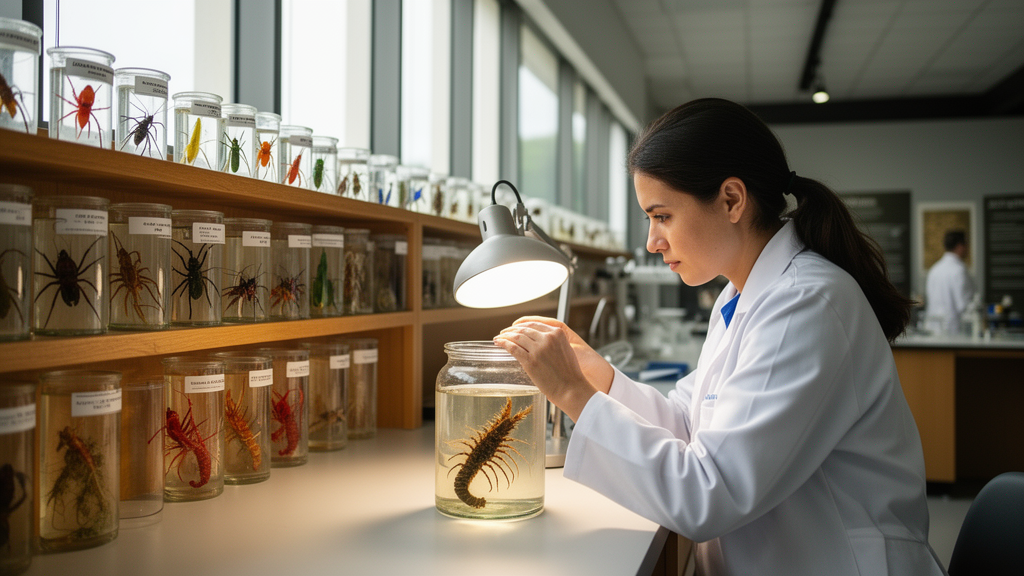
Deep in the southern Ecuadorian city of Loja, a young museum division is quietly rewriting the biodiversity map of one of the planet’s most species-rich countries. The Invertebrate Division of the Museum of Zoology at the Universidad Nacional de Loja, known by its acronym LOUNAZ, has assembled a collection of more than 20,000 specimens since its founding in 2020, and in just four years it has become the leading research hub for a region that scientists had largely overlooked for decades. A new study published in the journal Natural History Collections and Museomics documents how this institution has grown from a handful of pandemic-era student specimens into a scientific and educational engine for southern Ecuador.
The story begins with a glaring geographic bias. Ecuador ranks among the most biodiverse nations on Earth, yet the vast majority of its biodiversity inventories have been concentrated in the north, around Quito and the northern Amazon, where accessible roads and established museums made fieldwork and curation far easier. Southern Ecuador, remote from the capital and long lacking natural history institutions, remained a blank spot on the scientific map. The consequences were tangible: published studies on scarab beetles and ants reported few or no records from the southern provinces, and even well-studied groups such as mammals registered artificially low diversity there simply because exhaustive inventories had never been carried out.
LOUNAZ itself was founded in March 2007 in Loja City, initially focused on vertebrates. The museum obtained its official patent from Ecuador’s Ministry of Environment in 2019, and in 2020 the Invertebrate Division was established under curator Paucar-Cabrera. What followed was remarkable growth: starting from a small number of specimens drawn from student theses completed during the pandemic, the collection expanded to more than 20,000 specimens from southern Ecuador. In 2024, university officials granted the division a dedicated facility, allowing it to split into two branches, a scientific collection and an educational and outreach collection, furnished with cabinets, drawers and unit trays funded by university research grants.
The scientific branch operates under international museum standards and expands its holdings under research permits from the Ministry of Environment. Its specimens come from ecosystems spanning Amazonian lowland forests, premontane and montane cloud forests, and high-elevation paramo habitats across the provinces of El Oro, Loja and Zamora Chinchipe. Field teams have sampled protected areas such as Madrigal del Podocarpus, Numbami and Tapichalaca, as well as urban zones, watersheds and grazed landscapes, using standardized protocols with interception traps, light traps, Malaise traps, pitfall traps and manual sampling.
Research flowing from the collection already covers an impressive range. Published studies based on museum data include work on the diversity of dynastine scarabs of Ecuador, the relationship between body mass and forewing length in Neotropical ichneumonid wasps, the richness and abundance of dung beetles in a periurban conservation area in Loja, the effect of ecosystem type on parasitoid biodiversity, the microbiota associated with soil and dung beetle intestines, and crop production and restoration efforts. Student theses have tackled the ecology of dung beetles and fireflies, insect microbiota, and the impact of light pollution on insect populations, building a valuable baseline for insect conservation in a region facing deforestation, agricultural expansion, soil degradation and chemical pollution.
The museum’s data infrastructure is growing in parallel. Occurrence datasets covering more than 8,000 specimens with complete collection records have been published on the Global Biodiversity Information Facility under the LOUNAZ-UNL collection, and additional specimens are being digitized into a Darwin Core-compliant database for future upload. The datasets have already supported studies on spatial distribution modelling of dung beetles under climate change scenarios and on the global impact of COVID-19 lockdowns on biodiversity data collection. As the collection expands, the museum acknowledges it will soon need specialized software, dedicated technical support and secure server storage to protect its data long-term.
Perhaps most significantly for global taxonomy, LOUNAZ now holds type material, the name-bearing specimens that define new species, for several recent discoveries. These include the holotype and allotype of the scarab beetle Chrysina mercedesae, the holotype and paratypes of the antlike flower beetle Macratria conlei, the holotype and paratypes of the gastropod Adelopoma gracile, and holotypes and paratypes of four ichneumonid wasp species in the genera Exochus, Leurus and Grotea. Under Ecuador’s Environmental Organic Code, international researchers must sign agreements ensuring that type specimens of new species collected in national territory are deposited in authorized repositories within the country, a regulation that improves access for Latin American researchers who often face high travel costs, visa restrictions and unreliable international loans when types are held in European or U.S. collections. One of LOUNAZ’s key commitments is imaging its holotypes to broaden international access.
The educational branch tells a different but equally compelling story. In 2024 the division received two major donations: 80 drawers containing 1,000 specimens from the Ministry of Environment, and an insect collection of 150 drawers from the university’s Agronomy Department, representing roughly 40 years of collecting and spanning nearly all Neotropical insect orders. Specimens with label data were folded into the scientific collection, while those lacking data enriched the educational collection, which is being organized into thematic boxes by invertebrate ecosystem role for didactic teaching. The division positions itself as a center for invertebrate education in Loja, offering exhibits, workshops and guided tours for visitors from primary school to university level.
Community engagement has produced some memorable moments. During the XIV Latin American Scarabaeoidology Reunion, the division hosted a Scarabs for Kids workshop in which 20 children observed specimens, learned about the ecological importance of scarab beetles, sculpted beetle life stages from clay, and colored a maze guiding scarabs past obstacles such as deforestation, soil degradation, insecticides and light pollution. The play-based approach was designed specifically for children, whose perception of the world differs from that of adults, and it proved so successful that the international conference will now include a public outreach event wherever it travels. The division has also integrated art into science, hosting an internship for an artist from the Art and Product Design Program at the Hogeschool van de Kunsten Utrecht in the Netherlands and organizing a well-received public workshop on insect scientific illustration.
Behind the scenes, both collections follow integrated pest management protocols tailored to their different challenges. The research collection, with nearly 18,000 specimens plus type material, requires strict monitoring, disinfection and restricted access, while the educational collection of roughly 2,000 specimens faces added preservation pressures from regular public contact. All incoming material undergoes an eight-day freezing protocol before integration, and the pest management plan includes scheduled inspections, deep freezing at minus 24 degrees Celsius for five to eight days, debris removal, disinfection with 96 percent alcohol, and application of 2 percent organic thymol dissolved in 70 percent alcohol, a strategy designed to protect specimens without compromising the health of staff or visitors. Looking ahead, the division aims to acquire 15 to 20 stereomicroscopes for visitor use, update educational materials regularly and host quarterly workshops, though these ambitions may strain its current capacity of 30 visitors and will depend on continued support from university authorities, external funding and community involvement. In a country where species are, as researchers have put it, barely hanging on to their endangered habitats, the specimens preserved at LOUNAZ may one day be all that remains of southern Ecuador’s invertebrate heritage, and the museum is determined that this heritage will not vanish undocumented.
Subject of Research: The scientific and educational role of a university invertebrate museum collection in southern Ecuador
Article Title: The scientific and educational role of the Invertebrate Division at the LOUNAZ Museum of Zoology in Loja, Ecuador
Article References: Paucar-Cabrera, A., Rojas-Ruilova, X., Quezada-Cueva, L., & Escudero-Armijos, V. (2025). The scientific and educational role of the Invertebrate Division at the LOUNAZ Museum of Zoology in Loja, Ecuador. Natural History Collections and Museomics, 2, 1-12. https://doi.org/10.3897/nhcm.2.154248
Image Credits: AI Generated
Keywords: LOUNAZ Museum of Zoology, invertebrate collection, Ecuador biodiversity, natural history museum, scarab beetles, type specimens, GBIF, insect conservation, science education, southern Ecuador, entomology, museum curation
Cite Scienmag News
Margaret Porter. (October 18, 2026). Inside Ecuador’s LOUNAZ Museum: How 20,000 Invertebrates Are Rewriting the South’s Biodiversity Map. Scienmag. https://scienmag.com/inside-ecuadors-lounaz-museum-how-20000-invertebrates-are-rewriting-the-souths-biodiversity-map/
Margaret Porter. "Inside Ecuador’s LOUNAZ Museum: How 20,000 Invertebrates Are Rewriting the South’s Biodiversity Map." Scienmag, 18 October 2026, https://scienmag.com/inside-ecuadors-lounaz-museum-how-20000-invertebrates-are-rewriting-the-souths-biodiversity-map/. Accessed 18 October 2026.
Margaret Porter. "Inside Ecuador’s LOUNAZ Museum: How 20,000 Invertebrates Are Rewriting the South’s Biodiversity Map." Scienmag. October 18, 2026. https://scienmag.com/inside-ecuadors-lounaz-museum-how-20000-invertebrates-are-rewriting-the-souths-biodiversity-map/


