


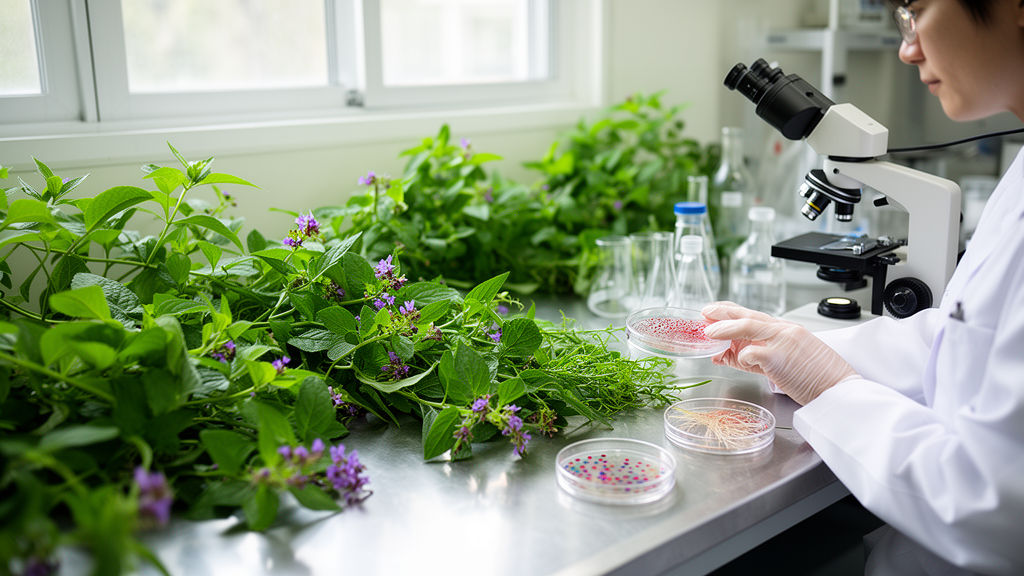
Deep in the tropical and subtropical forests of southern China, a modest genus of flowering plants called Rungia has been quietly harboring one of the richest cytological portfolios ever documented in the Acanthaceae family. A new study published in the journal PhytoKeys has now pulled back the curtain on this hidden diversity, reporting chromosome numbers for 30 populations representing 14 Rungia species from China. For eleven of those species, the chromosome counts are reported for the very first time, transforming what was once a nearly blank cytological record into a dataset with genuine power to reshape how botanists classify the genus.
Rungia belongs to the family Acanthaceae and the tribe Justicieae, a group best known for its close relationship to the sprawling genus Justicia. The genus comprises roughly 50 species distributed across tropical and subtropical regions of the Old World, and in China, recent taxonomic revisions have brought the total number of recognized species to nineteen. Those revisions have been dramatic: Rungia monetaria was revealed to be a misidentification of R. flaviflora and excluded from China, R. axilliflora and R. densiflora were sunk into synonymy under R. stolonifera, R. burmanica was reported as a new record for the country, and three new species — R. sinothailandica, R. flaviflora and R. fangdingiana — were described in rapid succession. Two additional species, R. khasiana and R. apiculata, have also been discovered as new records in China, bringing the national tally to nineteen.
Despite this flurry of morphological activity, cytological knowledge of Rungia had remained strikingly limited. Before this study, chromosome numbers had been documented for only five species — less than 10 percent of the genus — leaving the remaining members cytologically unexplored. Chromosomal data, however, are of great significance in plant systematics and species delimitation, offering an independent line of evidence that can confirm or challenge classifications built purely on external appearance. The new research, led by botanists working with living collections cultivated at the South China Botanical Garden of the Chinese Academy of Sciences and at Shaoguan University, set out to close that gap with an extensive survey of Chinese Rungia.
The technical work behind the counts was meticulous. Root tips collected from greenhouse-grown plants were pretreated in a 1:1 mixture of 0.1 percent colchicine and 0.002 M 8-hydroxyquinoline for about 2.5 hours, a step that arrests cell division at metaphase and spreads the chromosomes for clear observation. The roots were then fixed in Carnoy’s fluid — a 1:3 mixture of glacial acetic acid and absolute ethanol — for at least 2 hours, macerated in 1 M hydrochloric acid at 37 degrees Celsius for 45 minutes, and stained with Carbol fuchsin before being squashed onto microscope slides. At least 30 mitotic metaphase cells from 3 to 5 individuals were counted and photographed for each population, ensuring the numbers reported are robust rather than anecdotal.
The results reveal a genus of extraordinary cytological richness. Across the 30 populations studied, the researchers documented somatic chromosome numbers of 2n = 20, 22, 26, 28, 40, 42, 50, 52 and 56. When integrated with previous reports, these counts yield five distinct basic chromosome numbers for the 16 species with available data: x = 10, 11, 13, 14 and 25. Among these, x = 11 and x = 13 are the most common, each occurring in five species, while x = 10 appears in three species, x = 14 in two, and x = 25 in only one. Such a wide range of variation in base numbers strongly suggests that Rungia is cytologically highly evolved, likely as a result of aneuploidy — the gain or loss of individual chromosomes — a process that may have driven the evolution of the genus’s morphological variation.
Polyploidy, the multiplication of entire chromosome sets, emerged as a prevalent phenomenon in the genus. It was observed in ten populations representing six species, accounting for approximately 33 percent of the studied populations. The pattern is intricate: within the x = 10 group, R. apiculata exhibits a tetraploid cytotype with 2n = 40. Within the x = 13 group, R. pectinata comprises both diploid (2n = 26) and tetraploid (2n = 52) cytotypes, while R. chinensis — stable across four populations from four provinces — and R. hirpex are consistently tetraploid with 2n = 52. Among species with x = 14, R. pungens includes both diploid (2n = 28) and triploid (2n = 42) cytotypes, and R. yunnanensis contains both diploid (2n = 28) and tetraploid (2n = 56) cytotypes. Notably, all species with x = 11 maintain a strictly diploid cytotype of 2n = 22, suggesting that polyploidy has likely played an important role in the speciation of Rungia at both interspecific and intraspecific levels.
Two additional cytological curiosities surfaced during the survey. B chromosomes — supernumerary chromosomes that exist outside the regular complement — were observed exclusively in four populations of R. stolonifera, which showed 2n = 26 plus 2Bs. These B chromosomes were markedly smaller than the autosomes and were numerically stable across all four populations studied, as well as within populations. Crucially, the populations examined included material collected from the type localities of R. axilliflora in Guangxi and R. densiflora in Guangdong, two species recently synonymised under R. stolonifera. The consistent cytological signature of 2n = 26 + 2Bs across all populations provides independent confirmation of that synonymisation, and the researchers predict that R. evrardii, a Vietnamese species recently merged into R. stolonifera, may likewise possess the same chromosome number. Separately, a satellite — a small chromosomal segment connected by a constriction — was detected in R. hirpex, the only observation of a satellite among all Rungia species examined. Although R. chinensis and R. hirpex share similar chromosome numbers and macromorphology, the presence of the satellite in R. hirpex offers additional cytological evidence supporting their distinction as separate species.
The systematic implications of these findings are profound. The current infrageneric classification of Rungia, established in 2007, divides the genus into two sections based on inflorescence symmetry and bract fertility: sect. Stoloniferae, characterised by symmetrical spikes with four-ranked, entirely fertile bracts, and sect. Rungia, defined by secund spikes with four-ranked bracts of which two are fertile and two sterile. When the researchers compared this classification with the distribution of basic chromosome numbers, the picture became complicated. Sect. Rungia comprises species with four distinct basic chromosome numbers — the x = 10 group including R. repens, R. khasiana and R. apiculata; the x = 11 group including R. bisaccata, R. burmanica, R. flaviflora, R. pinpienensis and R. sinothailandica; the x = 13 group including R. laeta, R. pectinata, R. chinensis and R. hirpex; and the x = 14 group including R. pungens and R. yunnanensis. Sect. Stoloniferae contains only two species, R. stolonifera with x = 13 and R. mina with x = 25.
Yet the cytological assemblages align remarkably well with key morphological traits. All species with x = 13 — and x = 25 — possess an ovoid, unstipitate capsule, whereas those with x = 10, 11 and 14 consistently have clavate, stipitate capsules. All species with x = 11 possess larger anthers of roughly 3 millimeters in length, while those with other base numbers have smaller anthers of less than 2 millimeters. Seed testa structure provides further corroboration. The species with x = 25 is morphologically very similar to those with x = 13, and the two groups are considered most closely related based on morphology. Under the current system, however, the five species with x = 13 analysed here are split between two sections based on inflorescence and bract characters — a treatment that conflicts with both chromosomal and capsule morphological data. Similarly, the current classification does not segregate the x = 11 group from the other cytological assemblages despite the striking anther-size distinction. From a cytological perspective, the species of Rungia can be divided into five assemblages — the x = 10, x = 11, x = 13, x = 14 and x = 25 groups — a division supported by key morphological characters of the anther, capsule and seed.
The findings also cast serious doubt on several older chromosome reports. For R. pectinata, earlier literature recorded an extraordinarily wide array of counts, including n = 8, 13, 15 and 26 and 2n = 16, 26, 30, 50, 52 and 60. The researchers examined four populations and consistently observed only 2n = 26 and 52, leading them to suspect that the anomalous earlier reports are attributable to misidentification or counting errors. For R. repens, previous reports included n = 10 and 2n = 20, 34 and 36, but neither 2n = 34 nor 36 has ever been recorded elsewhere in Rungia. The close relatives R. khasiana and R. apiculata show 2n = 20 and 40 respectively, making 2n = 20 the most likely genuine count for R. repens. Based on morphological affinities correlated with chromosome numbers, the team predicts base numbers for the five Chinese species not yet cytologically examined: R. taiwanensis likely has x = 13, while R. fangdingiana, R. napoensis, R. longipes and R. guangxiensis are predicted to have x = 11. The researchers recommend that future classifications integrate molecular and micromorphological evidence alongside chromosomal data to establish a more natural system for the genus, and note that a limitation of the present study is its restricted geographic sampling, which included only Chinese species and two from India. Further investigations incorporating chromosome counts from other regions would provide a more comprehensive perspective on this cytologically dazzling genus.
Subject of Research: Genetics
Article Title: Cytological studies of Rungia ( Acanthaceae ) from China and its systematic implications
Article References: Lin, Z.-L., Wang, S., & Deng, Y.-F. (2026). Cytological studies of Rungia (Acanthaceae) from China and its systematic implications. PhytoKeys, 277, 197-208. https://doi.org/10.3897/phytokeys.277.199752
Image Credits: AI Generated
DOI: 10.3897/phytokeys.277.199752
Keywords: Rungia, Acanthaceae, cytology, chromosome numbers, polyploidy, B chromosomes, plant systematics, China, PhytoKeys, taxonomy, Cytological, studies
Cite Scienmag News
Juliet Wilcox. (October 18, 2026). Chromosome Counts Reveal Hidden Diversity in Chinese Rungia Plants. Scienmag. https://scienmag.com/chromosome-counts-reveal-hidden-diversity-in-chinese-rungia-plants/
Juliet Wilcox. "Chromosome Counts Reveal Hidden Diversity in Chinese Rungia Plants." Scienmag, 18 October 2026, https://scienmag.com/chromosome-counts-reveal-hidden-diversity-in-chinese-rungia-plants/. Accessed 18 October 2026.
Juliet Wilcox. "Chromosome Counts Reveal Hidden Diversity in Chinese Rungia Plants." Scienmag. October 18, 2026. https://scienmag.com/chromosome-counts-reveal-hidden-diversity-in-chinese-rungia-plants/


