


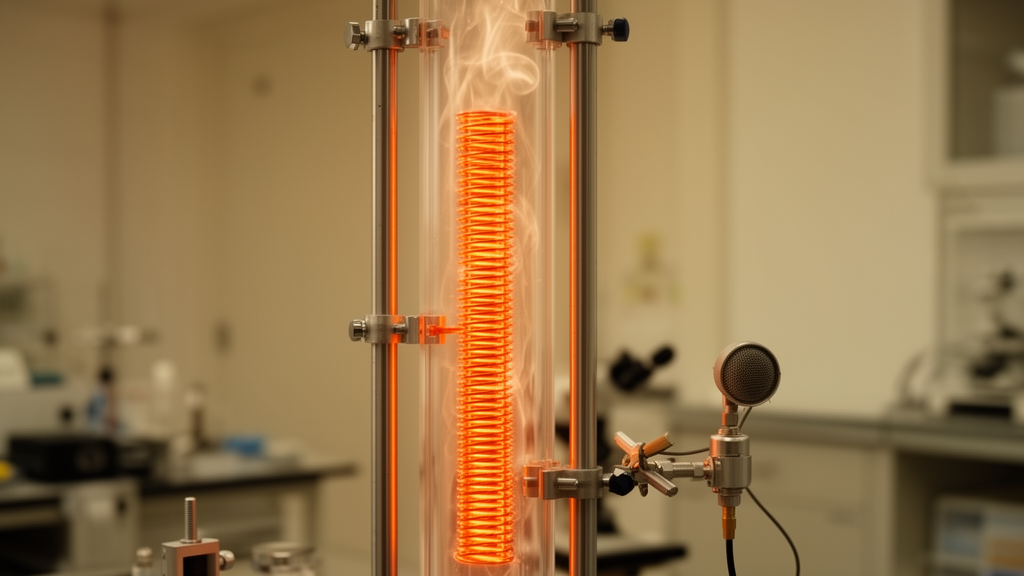
The Rijke tube occupies a special place in the history of acoustics because it is one of the simplest systems in which heat can sustain a self-oscillation. A vertical tube open at both ends, a concentrated heat source somewhere along its axis, and a natural convective draft are sufficient to produce a loud, pure tone. Yet the apparent simplicity conceals a coupled problem: the heat source both drives the acoustic field and sets the mean flow that carries sound and heat through the tube. The study by Basok and Gotsulenko in Results in Engineering addresses this coupling head-on by generalising a Lagrangian framework so that the heater may be placed at any interior cross-section rather than being tied to the tube inlet, and by working out the consequences for stability, optimal excitation, and configurations with more than one source.
A central conceptual distinction in the work is between the mean flow and the acoustic field. In the classical horizontal Rijke tube with a blower, the mean velocity is an externally imposed parameter, and the acoustic stability problem can be solved with that velocity held fixed. In the vertical, naturally convecting configuration of the original Rijke experiment, no such independence exists. The upward draft is produced by buoyancy acting on the column of heated, less dense air above the heater, and it is resisted by wall friction, by throttle losses at the open ends, and by the momentum flux associated with the density change across the heat-input zone. The mean velocity therefore emerges from a force balance that involves the heater power and position, which in turn feed back into the acoustic problem through the temperature field and the heat-release dynamics. Solving the two problems self-consistently is one of the main technical achievements of the paper.
The mathematical machinery rests on a three-dimensional formulation in which a localised heat input is represented by a surface of discontinuity. Across this surface, the hydrodynamic and thermodynamic variables jump: density drops because the gas expands on heating, velocity rises to conserve mass flux, and the momentum equation acquires a singular source term. The normal component of the thermal energy dissipation tensor, denoted Γ, encodes the force exerted by the heat-input zone on the gas and admits an explicit physical interpretation in the one-dimensional reduction. In the earlier work of the same authors, the discontinuity surface was identified with the inlet cross-section of the tube; the present generalisation allows the surface to sit at an arbitrary interior station, which is essential for studying heater placement as a design variable.
With the jump conditions and the steady force balance in hand, the authors turn to the question of when the mean flow itself becomes unstable. Using a power-law model for the temperature dependence of dynamic viscosity, with an exponent of about 0.76 for air, they prove that the critical temperature ratio at which the effective friction function attains its minimum exists, is unique, and varies strictly monotonically with the normalised heater position. Below the corresponding critical mean velocity, the effective hydraulic resistance becomes negative: the flow, rather than dissipating acoustic energy, feeds energy into it. The paper derives a closed-form expression for the electrical power at which this negative-resistance regime is entered, and shows that the negative-resistance condition is a necessary condition for static instability of the mean flow. This gives experimenters a sharp, computable boundary separating a quietly convecting state from one prone to oscillation.
The acoustic side of the problem is treated with equal rigour. Because the heater divides the tube into two regions of uniform but different temperature, the speed of sound is piecewise constant, and the acoustic eigenproblem can be solved exactly rather than approximately. The eigenfunctions and eigenfrequencies of the composite tube follow from matching pressure and velocity at the heat-input plane, and the norms of the eigenfunctions enter the modal energy balance. From this solution the authors obtain, in closed form, the upper boundary of the driving zone of the fundamental mode: the range of heater positions for which the first mode is amplified rather than damped. They also quantify how the Rayleigh-optimal position, the placement that maximises the modal growth rate, shifts as the temperature ratio above the heater increases. In the limit of vanishing temperature jump, the classical quarter-length rule is recovered exactly: the heater at one quarter of the tube length from the open lower end drives the fundamental mode most effectively, a result consistent with Rijke’s original observation and with the later analysis of Carvalho and co-workers, who also predicted positions for the second harmonic.
The Rayleigh criterion, which underlies these placement results, states that heat addition drives an acoustic mode when the heat release is sufficiently in phase with the pressure fluctuation at the source and damps it when it is out of phase. Its modern quantitative form is the Rayleigh index, a volume integral over the product of pressure and heat-release fluctuations. In the present framework this index is normalised by the modal norm and evaluated for each eigenmode, so that the driving or damping of every mode can be assessed separately. The phase relation is governed by the heat-release delay: the heated wire does not respond instantaneously to velocity fluctuations but with a lag set by its thermal time constant and by the first-order heat-transfer dynamics of the gas. This delayed response is captured by a King-law description, in which the heat release from a hot wire varies with the square root of the flow velocity, a law long used in hot-wire anemometry and in reduced-order models of electrically heated Rijke tubes.
Losses are treated with unusual care. Acoustic energy in the tube is dissipated in the viscous and thermal Stokes layers that coat the walls, where the oscillatory flow is retarded and heat is exchanged with the boundary, and at the open ends, where acoustic radiation carries energy away. The exact characteristic equation of the acoustic eigenproblem, including these loss mechanisms and the self-consistent mean state, is solved to obtain the acoustic threshold of each mode: the heater power at which the modal growth rate just balances the loss-induced decay. Comparing this threshold with the negative-resistance-entry boundary reveals how the two instability mechanisms, static instability of the mean flow and dynamic instability of the acoustic modes, relate to each other and which one is encountered first as the heater power is raised.
Beyond the linear threshold, the fate of the oscillation is decided by nonlinearities. Using single-mode averaging on the King-law reduced-order model, the authors predict whether the Andronov–Hopf bifurcation at the acoustic threshold is supercritical, producing a small stable limit cycle, or subcritical, producing an unstable cycle that coexists with the quiet state and permits triggering of large-amplitude oscillations below the linear threshold. The prediction is checked by direct simulation of a Galerkin model, and the hysteretic behaviour that Matveev and Culick observed experimentally at the stability boundaries, and that Mariappan and co-workers reported for a subcritical bifurcation, is reproduced. The non-normality of the acoustic–heat-release operator, emphasised in earlier reduced-order studies, implies that transient growth can amplify disturbances even in linearly stable configurations, although the present analysis deliberately restricts itself to the asymptotic, normal-mode notion of stability.
The extension to two heat sources is one of the most practically interesting parts of the work. With two heaters the force balance acquires additional terms, the temperature field is piecewise uniform in three regions, and the possible regimes multiply: the sources may cooperate in driving a common mode, one may drive while the other damps, or the mean-flow stability may be altered altogether. The paper classifies these regimes, solves the two-source force balance, and computes the nonlinear two-mode response, providing a template for the multi-source configurations that arise in staged combustion and in distributed heating of industrial equipment.
The practical motivation is substantial. Unwanted thermoacoustic oscillations in heat exchangers, combustion chambers and pipelines cause mechanical fatigue, noise and degraded heat transfer, and the Rayleigh criterion remains the standard diagnostic tool. Conversely, heat-driven oscillations are deliberately exploited in standing-wave and travelling-wave thermoacoustic engines and in thermoacoustic electric generators, where the placement of the heat-exchange region relative to the pressure and velocity antinodes of the working mode is a primary design parameter. Recent developments, such as a standing-wave engine built around a printed circuit heat exchanger operating with supercritical carbon dioxide, and comparative numerical studies of looped, Stirling-type and standing-wave engines, show that the field is active, although the geometries and operating conditions of these engines differ from the open Rijke tube studied here.
For the naturally convecting vertical tube, the role of buoyancy deserves emphasis. Experiments with an electrically heated tube at adjustable pitch angle have shown that when natural convection is comparable to the forced flow, the instability map changes significantly with orientation. The present framework, in which gravity enters the momentum equation and the mean velocity is solved for rather than prescribed, is naturally suited to capturing such effects, and the dependence of the critical velocity and the instability boundaries on heater power and position follows directly from the force balance.
Several dimensionless groups organise the physics. The Mach number of the mean flow is small in typical laboratory tubes, justifying the acoustic approximation. The Strouhal number, formed from the fundamental frequency, the heater wire diameter and the mean velocity, characterises the unsteady heat transfer from the wire and enters the describing function of the King law. The Prandtl number relates the viscous and thermal Stokes-layer thicknesses that control wall losses. The temperature ratio between the regions above and below the heater, together with the fraction of electrical power actually transferred to the gas, sets the strength of the thermal source and the density jump across it.
Taken together, the paper offers a complete, self-consistent theory of the vertical Rijke tube with an interior heater: jump conditions and force balance for the mean state, exact acoustic eigenmodes for the piecewise-uniform temperature, closed-form criteria for the onset of negative resistance and for the acoustic threshold, a bifurcation analysis validated against simulation, and a systematic treatment of two-source configurations. The generalisation from an inlet heater to arbitrary placement transforms a classical but special case into a design-capable framework, one that connects the original nineteenth-century demonstration of singing flames to modern questions of combustion instability and thermoacoustic energy conversion.
Subject of Research: Thermoacoustic self-oscillations with arbitrary heat source placement: Generalisation of the Lagrangian framework, optimal excitation conditions, and multi-source configurations
Article Title: Thermoacoustic self-oscillations with arbitrary heat source placement: Generalisation of the Lagrangian framework, optimal excitation conditions, and multi-source configurations
Article References: Basok, B. I., & Gotsulenko, V. V. (2026). Thermoacoustic self-oscillations with arbitrary heat source placement: Generalisation of the Lagrangian framework, optimal excitation conditions, and multi-source configurations. Results in Engineering, 32, Article 113451. https://doi.org/10.1016/j.rineng.2026.113451
Image Credits: AI Generated
DOI: 10.1016/j.rineng.2026.113451
Keywords: thermoacoustics, Rijke tube, self-oscillations, Lagrangian framework, heat source placement, optimal excitation conditions, multi-source configurations, Thermoacoustic, arbitrary, heat, source, placement
Cite Scienmag News
Denise Maddox. (October 18, 2026). Thermoacoustic self-oscillations with arbitrary heat source placement: Generalisation of the Lagrangian framework, optimal excitation conditions, and multi-source configurations. Scienmag. https://scienmag.com/thermoacoustic-self-oscillations-with-arbitrary-heat-source-placement-generalisation-of-the-lagrangian-framework-optimal-excitation-conditions-and-multi-source-configurations/
Denise Maddox. "Thermoacoustic self-oscillations with arbitrary heat source placement: Generalisation of the Lagrangian framework, optimal excitation conditions, and multi-source configurations." Scienmag, 18 October 2026, https://scienmag.com/thermoacoustic-self-oscillations-with-arbitrary-heat-source-placement-generalisation-of-the-lagrangian-framework-optimal-excitation-conditions-and-multi-source-configurations/. Accessed 18 October 2026.
Denise Maddox. "Thermoacoustic self-oscillations with arbitrary heat source placement: Generalisation of the Lagrangian framework, optimal excitation conditions, and multi-source configurations." Scienmag. October 18, 2026. https://scienmag.com/thermoacoustic-self-oscillations-with-arbitrary-heat-source-placement-generalisation-of-the-lagrangian-framework-optimal-excitation-conditions-and-multi-source-configurations/


