


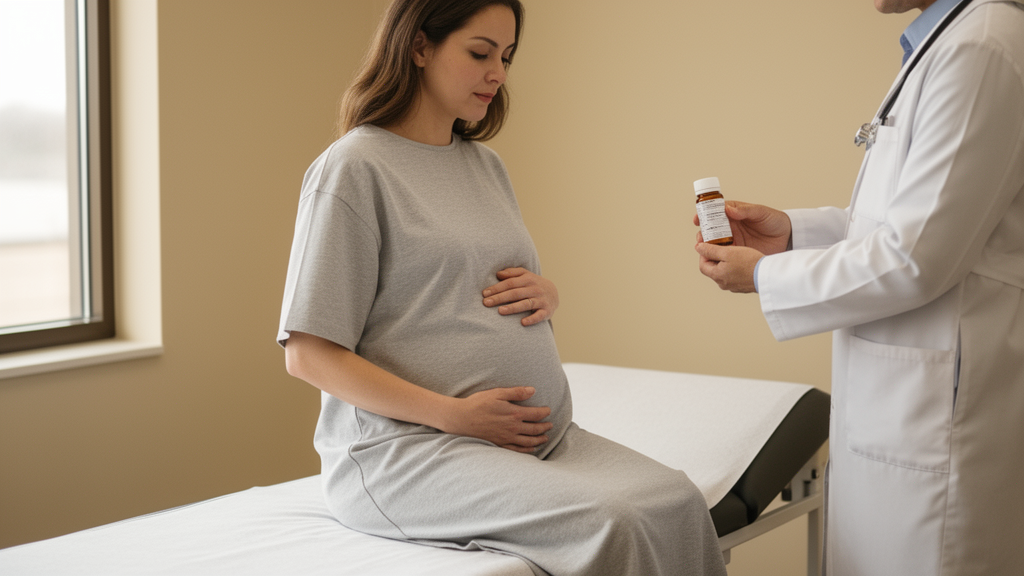
Children whose mothers filled opioid prescriptions during pregnancy face a measurably higher risk of being admitted to the hospital throughout childhood, according to one of the largest studies ever conducted on the question. The research, published on October 13 in the open-access journal PLOS Medicine, followed nearly three million children born in South Korea between 2010 and 2017 for up to fourteen years, and its sheer scale allowed investigators to probe questions that smaller studies could not reliably answer, including how the risk varies with dose, with the child’s age, and with the underlying cause of admission.
The team, led by co-corresponding authors Dong Keon Yon of Kyung Hee University College of Medicine and Jiseung Kang, classified children as prenatally exposed if their mothers received two or more opioid prescriptions during pregnancy. That threshold was chosen to distinguish sustained exposure from a single, isolated dispensing event. The exposed children were compared in two ways: against unexposed children from the general population, and, in a more stringent test, against their own unexposed siblings, a design that partially controls for the family environment and shared genetics.
The headline result was striking. Compared with unexposed children, those with prenatal opioid exposure had a 28 percent higher rate of hospital admission, with an adjusted incidence rate ratio of 1.28 and a 95 percent confidence interval of 1.28 to 1.29. When the comparison was restricted to siblings within the same family, the association shrank to an adjusted rate ratio of 1.08, with a confidence interval of 1.07 to 1.10, but it did not disappear. That pattern, the authors argue, is consistent with a genuine contribution of the drug itself alongside a substantial contribution from factors shared within households.
The study also uncovered a clear dose-response relationship, one of the criteria epidemiologists look for when weighing whether an association is causal. Children whose mothers received low doses of opioids showed an adjusted rate ratio of 1.19, while those whose mothers received high doses showed a ratio of 1.40. In other words, the more opioid exposure a fetus experienced, the greater the subsequent risk of hospital admission in childhood. The elevated rates spanned multiple categories of illness, including infections as well as respiratory, gastrointestinal, and genitourinary conditions, a breadth that points toward possible effects on the developing immune system rather than damage confined to a single organ system.
Perhaps the most consequential finding was temporal. The association between prenatal opioid exposure and hospital admission was strongest in the earliest years of life and was most pronounced up to age five. Joint first author Yesol Yim described the fading of the signal as the study’s biggest surprise. The excess risk was clearest in the first year of life and had largely disappeared after age five, a pattern she interpreted as evidence of a window of vulnerability in early infancy rather than a lifelong effect, and one in which pediatric follow-up can make a real difference. For clinicians, that time-limited risk profile transforms an abstract statistical association into an actionable surveillance strategy.
The biological rationale for such a link is plausible, though not yet proven. Prenatal opioid exposure has been associated in prior research with disruptions to infant development and to immune system function, mechanisms that could plausibly increase susceptibility to the infections and respiratory illnesses that dominated the admission data. Opioid prescriptions and doses have risen considerably in clinical practice over recent decades, and the scale of prenatal exposure is far from trivial. In the United States, data have shown that between 14 and 22 percent of women filled an opioid prescription during pregnancy, making even a modest relative increase in childhood hospitalizations a meaningful public health concern.
What sets the South Korean study apart is the unusual cleanliness of its exposure data. As co-corresponding author Jiseung Kang explained, opioids in South Korea are obtained almost entirely by prescription, so the researchers could examine prescribed opioid exposure in pregnancy with unusual precision. Following nearly three million children for up to fourteen years gave the team the statistical power to examine dose, timing, and specific causes of admission separately, and Kang argued that the consistency of the pattern across all of these analyses is what makes the finding difficult to dismiss. Prior studies in this field have been hampered by confounding factors, limited sample sizes, or restricted follow-up durations, shortcomings this cohort was designed to overcome.
The authors themselves urge caution, and their caveats deserve as much attention as the headline numbers. The study relied on electronic health records, which record prescriptions written and dispensed but may not reflect the medication a patient actually took. Unmeasured factors shared within families, such as parental health behaviors, socioeconomic stressors, or genetic predispositions, may still partly explain the observed associations, and the narrowing of the effect in the sibling comparison is direct evidence of how much such factors matter. The sibling analysis, while powerful, cannot eliminate influences that vary between siblings born at different times or under different circumstances.
The research team was careful to frame its findings as a call for better care rather than a prohibition. Joint first author Hyeon Jin Kim emphasized that the message is not that pregnant women should never receive opioids, since for some patients pain relief is essential. Instead, the recommendation is that opioids in pregnancy be prescribed at the lowest effective dose for the shortest possible time, and that children born after such exposure may benefit from closer routine health checks, particularly during infancy when the risk was found to be highest. Co-corresponding author Dong Keon Yon echoed that framing, noting that the dose-dependence points to a possible biological effect while acknowledging that shared family factors clearly explain part of what the study observed.
The study, an observational analysis of nationwide health insurance data rather than a randomized trial, was funded by South Korea’s Ministry of Science and ICT, Ministry of Health and Welfare, National Research Foundation, and Ministry of Education, none of which had a role in the study design, data collection, analysis, or manuscript preparation. The authors declared no competing interests. For families and clinicians, the practical takeaway is measured: prenatal opioid exposure, as captured by two or more maternal prescriptions, is associated with a modestly elevated, dose-dependent, and age-limited risk of childhood hospital admission, concentrated in infancy and driven largely by infections and respiratory illness. That risk, while real, is neither uniform nor permanent, and it appears most amenable to mitigation through vigilant postnatal monitoring in the first years of life, when the window of vulnerability is open and pediatric care can respond.
Subject of Research: The association between prenatal opioid prescription exposure and childhood hospital admission rates in a nationwide South Korean birth cohort.
Article Title: Opioid prescriptions during pregnancy linked to higher rates of childhood hospital admission
Article References: Opioid prescriptions during pregnancy linked to higher rates of childhood hospital admission. (n.d.). Original publication
Image Credits: AI Generated
DOI: Not provided
Keywords: opioids, pregnancy, prenatal exposure, hospital admission, pediatrics, PLOS Medicine, South Korea, birth cohort, epidemiology, childhood infections, dose-response, electronic health records
Cite Scienmag News
Harold Sullivan. (October 18, 2026). Prenatal Opioid Prescriptions Tied to 28% Higher Childhood Hospital Admission Risk. Scienmag. https://scienmag.com/prenatal-opioid-prescriptions-tied-to-28-higher-childhood-hospital-admission-risk/
Harold Sullivan. "Prenatal Opioid Prescriptions Tied to 28% Higher Childhood Hospital Admission Risk." Scienmag, 18 October 2026, https://scienmag.com/prenatal-opioid-prescriptions-tied-to-28-higher-childhood-hospital-admission-risk/. Accessed 18 October 2026.
Harold Sullivan. "Prenatal Opioid Prescriptions Tied to 28% Higher Childhood Hospital Admission Risk." Scienmag. October 18, 2026. https://scienmag.com/prenatal-opioid-prescriptions-tied-to-28-higher-childhood-hospital-admission-risk/


