


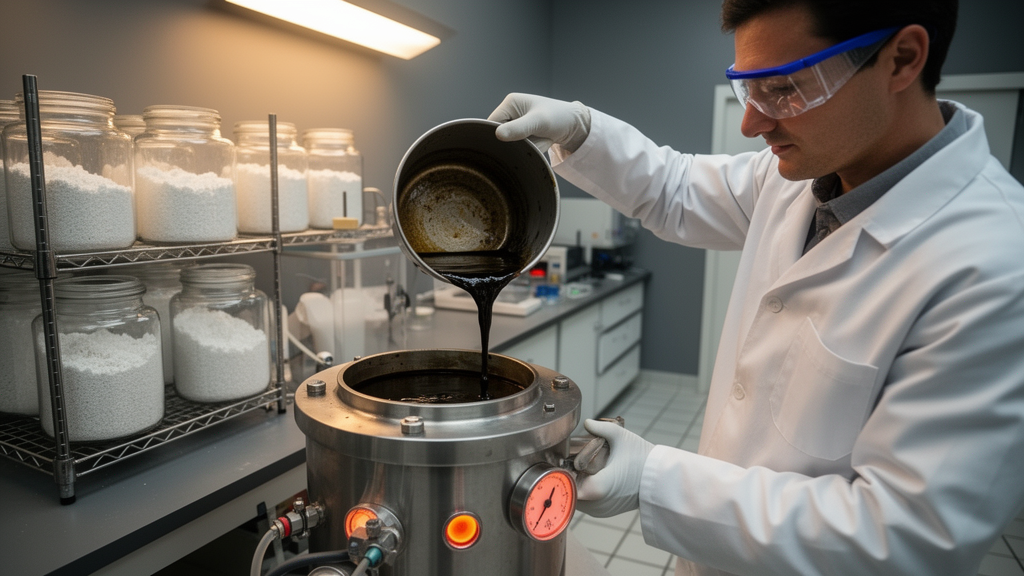
Every year, shale gas drilling operations generate enormous quantities of oil-based drilling cuttings, a dark, pungent waste sludge laced with residual petroleum hydrocarbons, polycyclic aromatic hydrocarbons, and heavy metals. Managing this material safely has become one of the more pressing environmental challenges of large-scale gas transmission projects, including the massive pipeline network that carries natural gas from Sichuan to eastern China. Now, a team of researchers has demonstrated a strikingly elegant alternative to disposal: converting the waste itself into a valuable industrial material, with the help of two custom-built artificial intelligence models.
The study, published in the journal Results in Engineering, was led by Wei Leng, Zihan Zhao, Jiaxiang Chen, and Lei Wang of Sichuan University of Science and Engineering, working with cuttings supplied by the Oilfield Engineering Services Branch of Sinopec in Zigong, China. Rather than treating the cuttings as mere refuse, the team exploited their hidden chemistry. X-ray fluorescence analysis revealed that the dried waste is rich in silicon dioxide, at roughly 40 percent by weight, and aluminum oxide, at about 11 percent, precisely the two ingredients needed to synthesize zeolites, the porous aluminosilicate crystals that underpin applications from water softening to catalysis and pollutant adsorption.
The researchers adopted an alkali fusion-hydrothermal route to activate the otherwise inert mineral phases in the cuttings. But the process is governed by a tangle of interacting variables: the solid-to-liquid ratio, the silicon-to-aluminum ratio, the alkali-fusion temperature, and the slag-to-alkali ratio. Exhaustively testing every combination at seven levels of each factor would have required 2,401 experiments, a prohibitively expensive undertaking. Instead, the team first ran single-factor screening experiments to bracket plausible ranges, then applied a uniform design, an experimental strategy that spreads a handful of representative runs evenly across the entire factor space, cutting the workload to just seven trials.
Those seven experiments produced a modest dataset, far too small to train a neural network reliably. The researchers therefore turned to data augmentation, generating synthetic training samples by adding zero-mean Gaussian noise around the original observations. To guard against information leakage and overfitting, they wrapped the whole procedure in a nested leave-one-out cross-validation scheme: in each round, one experimental observation was held out for testing, one served as an unaugmented validation point, and the remaining five were expanded into a synthetic training set. This disciplined structure allowed the team to extract honest estimates of how their models would perform on data they had never seen.
At the heart of the work lies a well-known weakness of the back-propagation neural network, the workhorse algorithm the team chose for modeling the synthesis process. Standard back-propagation is notoriously sensitive to initialization and training parameters, and it can stall in local optima or converge erratically on noisy inputs. The classic remedies are hybrid schemes in which evolutionary algorithms tune the network’s weights and hyperparameters. Genetic algorithms, inspired by natural selection, search the solution space through selection, crossover, and mutation, while particle swarm optimization, proposed by Kennedy and Eberhart in 1995, mimics the collective movement of bird flocks to explore parameter landscapes efficiently.
The innovation in this study is that both hybrid schemes were made adaptive. In the conventional versions, crossover and mutation probabilities, or the swarm’s inertia weight and learning coefficients, are held fixed, which often causes premature convergence and the loss of high-quality solutions. The researchers’ adaptive genetic algorithm instead raises these probabilities early in evolution to maximize exploration, then lowers them later to refine the best solutions, while elite retention and tournament selection preserve the strongest candidates. The adaptive particle swarm variant similarly decreases its inertia weight and cognitive coefficient over time while increasing the social coefficient, steering the swarm cooperatively toward promising regions. Early stopping during network training further stabilized both frameworks.
The results were evaluated with a battery of statistical tools, including Bland-Altman plots, parity plots, error distributions, and violin plots of relative error. Both adaptive models outperformed their non-adaptive counterparts, showing tighter error distributions and better agreement with the ideal one-to-one prediction line. Between the two, the AGA-BP model edged ahead, achieving a coefficient of determination of 0.9088 on the training set and 0.8264 on the test set, with relative errors confined within plus or minus 0.2 across all data partitions. Stability analysis confirmed that predictions from both models clustered tightly around the reference values across the entire range of synthesis parameters, with no systematic drift.
The decisive test came when the models’ recommended synthesis conditions were put into practice. The AGA-BP network prescribed a solid-liquid ratio of 1:3.38, a silicon-to-aluminum ratio of 1.80:1, an alkali-fusion temperature of 336 degrees Celsius, and a slag-alkali ratio of 1:1.240, while the APSO-BP model suggested a somewhat different recipe. Zeolites synthesized under all three optimized conditions, including those from the conventional regression approach, showed the characteristic X-ray diffraction peaks of Na-X zeolite, confirming that the target crystalline phase had formed in every case. But the adsorption experiments told a sharper story: material made under AGA-BP conditions achieved an ammonia-nitrogen adsorption capacity of 4.8852 milligrams per gram, significantly higher than both the APSO-BP result of 4.6782 and the regression-based 4.5800, according to Tukey’s honestly significant difference testing.
Scanning electron microscopy revealed just how dramatic the transformation was. The raw cuttings appeared as a disordered jumble of bulk, granular, and needle-like particles, while the AGA-BP-optimized product was dominated by densely intergrown, interlaced lamellar crystallites riddled with interparticle voids and crevices, exactly the kind of open architecture that gives zeolites their adsorptive power. The images capture, in effect, hazardous waste being remade into a functional environmental material capable of stripping ammonia nitrogen from contaminated water.
Beyond the immediate result, the study points to a broader shift in how complex materials synthesis is conducted. By pairing frugal experimental designs with adaptive machine learning, the researchers extracted near-optimal process conditions from a dataset that would have been hopeless for conventional modeling, and their framework could in principle be applied to other waste-derived precursors, scaled to industrial production, or tested against real wastewater matrices. For an industry searching for ways to close the loop on its own waste streams, the message is compelling: the cuttings left behind by drilling for clean-burning gas may themselves become part of the solution, one carefully optimized crystal at a time.
Subject of Research: Machine learning optimization of Na-X zeolite synthesis from oil-based drilling cuttings
Article Title: Optimization of synthesis parameters for Na-X zeolite using AGA-BP and APSO-BP neural network
Article References: Leng, W., Zhao, Z., Chen, J., & Wang, L. (2026). Optimization of synthesis parameters for Na-X zeolite using AGA-BP and APSO-BP neural network. Results in Engineering, 32, Article 113386. https://doi.org/10.1016/j.rineng.2026.113386
Image Credits: AI Generated
DOI: 10.1016/j.rineng.2026.113386
Keywords: Na-X zeolite, oil-based drilling cuttings, neural network, genetic algorithm, particle swarm optimization, data augmentation, ammonia adsorption, waste valorization, hydrothermal synthesis, machine learning, X-ray diffraction, shale gas waste
Cite Scienmag News
Cassandra Pierce. (October 18, 2026). Neural Networks Turn Toxic Oil Drilling Waste into High-Performance Zeolite. Scienmag. https://scienmag.com/neural-networks-turn-toxic-oil-drilling-waste-into-high-performance-zeolite/
Cassandra Pierce. "Neural Networks Turn Toxic Oil Drilling Waste into High-Performance Zeolite." Scienmag, 18 October 2026, https://scienmag.com/neural-networks-turn-toxic-oil-drilling-waste-into-high-performance-zeolite/. Accessed 18 October 2026.
Cassandra Pierce. "Neural Networks Turn Toxic Oil Drilling Waste into High-Performance Zeolite." Scienmag. October 18, 2026. https://scienmag.com/neural-networks-turn-toxic-oil-drilling-waste-into-high-performance-zeolite/


