


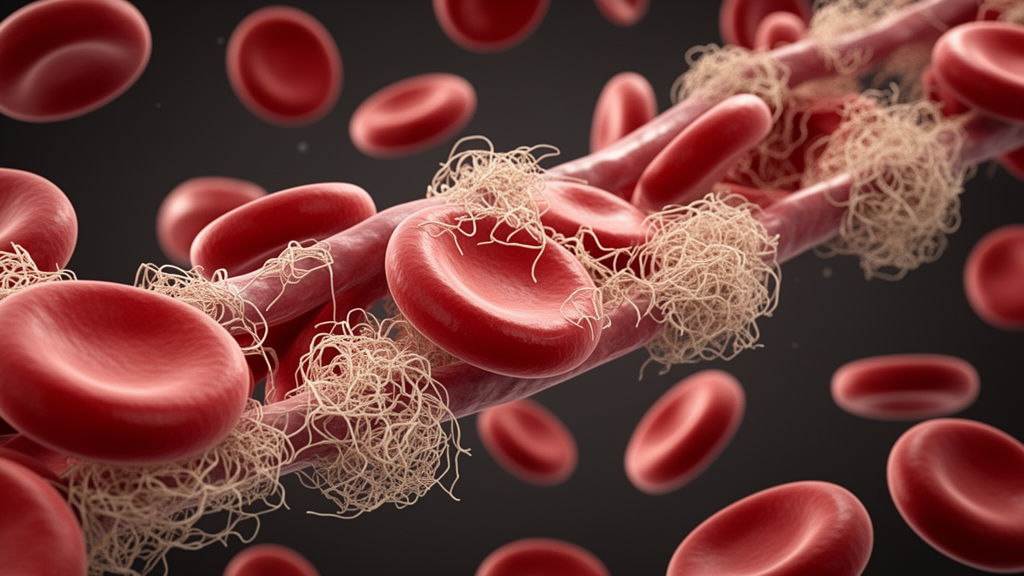
Scientists have uncovered a surprising new way that Alzheimer’s disease may starve the brain of oxygen: by hijacking the body’s own oxygen delivery system. In a study published in Cell Death Discovery, a team led by Irina Petrushanko and Alexander Makarov of the Engelhardt Institute of Molecular Biology in Moscow, working with Anna Bogdanova of the University of Zurich, shows that amyloid beta peptides — the notorious protein fragments that accumulate in Alzheimer’s brains — bind to red blood cells and fundamentally alter how hemoglobin picks up and releases oxygen. The finding offers a concrete molecular mechanism for a clinical mystery that has puzzled physicians for years: patients with Alzheimer’s disease show reduced cerebral venous oxygen saturation, a deficit that worsens as the disease progresses and correlates with cognitive decline. Until now, the causes of this hypoxia remained unclear.
Red blood cells are far more than passive oxygen containers. Hemoglobin, the tetrameric protein that fills these cells, binds oxygen in the lungs and releases it in tissues, and the affinity with which hemoglobin holds oxygen is finely tuned by the cell’s internal chemical environment. Petrushanko’s team reasoned that because red blood cells are the primary carrier of amyloid beta in the bloodstream — and because amyloid loading of these cells increases with both age and Alzheimer’s disease — the peptides might directly interfere with oxygen transport. The researchers focused on two forms of the peptide: the canonical 42-amino-acid amyloid beta (Aβ42) and a pathological isoform in which the aspartate residue at position 7 has been isomerized (isoAβ42), a spontaneous chemical conversion that accumulates in aged brains and is considered a key pathological factor in Alzheimer’s disease.
The experiments produced a result that the field had never documented before. When the researchers loaded human red blood cells with elevated amounts of either peptide, hemoglobin’s oxygen affinity dropped, and the rate at which oxygen was released from the cells slowed down. In practical terms, amyloid-coated red blood cells hold onto oxygen more stubbornly in the lungs and then surrender it more sluggishly in the tissues — precisely the wrong behavior for an organ already struggling to clear metabolic waste and maintain neuronal health. The effect was not a subtle perturbation of a single parameter but a coordinated shift in the cell’s entire oxygen-handling machinery.
The mechanism traces back to reactive oxygen species, the chemically reactive molecules that red blood cells generate continuously as byproducts of oxygen metabolism. Counterintuitively, the study found that amyloid binding lowered rather than raised the level of ROS inside the cells. This decrease in ROS proved to be the causal link to hemoglobin’s altered behavior: ROS levels regulate hemoglobin glutathionylation, a post-translational modification in which glutathione — a tripeptide antioxidant — is covalently attached to hemoglobin’s cysteine residues. Glutathionylation of hemoglobin is known to modulate its oxygen affinity and structural dynamics. When amyloid peptides suppressed ROS, hemoglobin glutathionylation decreased, and the protein’s alpha-helical content — the coiled structural elements that define its functional conformation — diminished as well. In effect, amyloid peptides chemically remodel hemoglobin from the outside in, using the cell’s own redox system as the lever.
The two peptide forms diverged in their downstream effects, revealing that the pathological isoform carries additional chemical consequences. While Aβ42 primarily reduced hemoglobin glutathionylation and alpha-helical structure, isoAβ42 went further: it reduced nitric oxide levels inside the cells and altered the heme state of hemoglobin — the iron-containing porphyrin rings that actually bind oxygen. Nitric oxide is a critical regulator of vascular tone and of hemoglobin’s own conformational transitions, so its depletion adds a second layer of dysfunction. The heme-state alteration suggests that isoAβ42 may directly perturb the oxygen-binding site itself, not merely the protein’s overall architecture. This distinction matters because isoAβ42 is the form that accumulates preferentially in the aging brain, meaning the most pathological peptide variant may also be the most damaging to oxygen transport.
To pin down the upstream source of the ROS changes, the researchers turned to NADPH oxidase, the membrane-bound enzyme complex that red blood cells use as their principal source of controlled ROS production. When the team inhibited NADPH oxidase pharmacologically, the impact of amyloid beta on ROS levels, on hemoglobin oxygen affinity, and on alpha-helical content was abolished entirely. The conclusion is striking in its simplicity: amyloid peptides impair erythrocyte oxygen affinity primarily by suppressing NADPH oxidase activity. Rather than generating oxidative damage through runaway radical production — the scenario most often assumed in amyloid toxicity — the peptides instead throttle the cell’s controlled ROS-generating machinery, and it is this throttling that cascades into hemoglobin’s structural and functional changes.
The team did not stop at isolated cells in a dish. Using a transgenic APP/PS1 mouse model of Alzheimer’s disease — animals engineered to carry human amyloid precursor protein and presenilin mutations that drive amyloid accumulation — the researchers measured both the amount of Aβ42 on the surface of circulating red blood cells and the level of intracellular ROS. The two quantities were negatively correlated: the more amyloid sat on the cell surface, the lower the ROS inside. This in vivo correlation transforms the cell-culture findings from a laboratory curiosity into a plausible physiological process operating in a living animal model of the disease, and it suggests that the same mechanism could be at work in human patients whose red blood cells become progressively amyloid-loaded with age and disease.
The clinical implications reach back to a measurement that neurologists have documented but struggled to explain. Reduced cerebral venous oxygen saturation in Alzheimer’s patients — the observation that opened the study — has long been treated as a downstream consequence of reduced cerebral blood flow or metabolic decline. The new work raises the possibility that the blood itself is part of the problem: that amyloid-laden red blood cells, chemically remodeled by the peptides they carry, transport oxygen less efficiently and release it more reluctantly, contributing directly to the tissue hypoxia that accelerates neuronal death. If confirmed in human studies, this mechanism would reframe amyloid beta not solely as a brain-localized toxin but as a circulating agent that compromises the body’s oxygen logistics, potentially explaining why cognitive decline in Alzheimer’s tracks so closely with oxygen saturation deficits.
The study also adds red blood cells to the growing list of cell types that amyloid beta subverts through redox manipulation. The finding that NADPH oxidase inhibition abolishes the amyloid effect points to a specific enzymatic target whose pharmacological modulation might protect oxygen transport even in the presence of circulating amyloid. It suggests that therapies aimed at preserving red blood cell function — rather than solely at clearing amyloid from the brain — could complement existing therapeutic strategies. And it hints that the red blood cell, long regarded as a simple oxygen courier, may deserve renewed attention as both a victim and a vector of Alzheimer’s pathology, carrying the disease’s molecular signature through every vessel of the body while quietly losing its ability to do the one job it exists to perform.
For a field that has spent decades focused on neurons, plaques, and synapses, the redirection of attention to the bloodstream represents a conceptual expansion with immediate testable consequences. The molecular chain the Moscow and Zurich teams traced — amyloid binding, NADPH oxidase suppression, ROS depletion, reduced hemoglobin glutathionylation, diminished alpha-helical structure, lowered oxygen affinity, slowed oxygen release — is a complete mechanistic pathway from a circulating peptide to a systemic physiological deficit. Each link in that chain is now a potential intervention point, and the negative correlation between surface amyloid and intracellular ROS in the APP/PS1 model provides a measurable biomarker that could be assessed in human cohorts. The possibility that one mechanism underlying reduced blood oxygen saturation in Alzheimer’s disease has been identified gives the study a significance that extends well beyond the laboratory bench, offering both an explanation for a long-standing clinical observation and a roadmap for future therapeutic exploration.
Subject of Research: Amyloid β peptides alter redox status and oxygen transport function of red blood cells
Article Title: Amyloid β peptides alter redox status and oxygen transport function of red blood cells
Article References: Petrushanko, I. Y., Zaripov, P. I., Kozyreva, P. A., Bogdanova, A. Y., Barkovskaya, V. I., Lisitskii, D. R., Dalina, A. A., Kaluzhny, D. N., Kuleshova, I. D., Strelkova, M. A., Grigorova, I. L., Varshavskaya, K. B., Parshina, E. Y., Bochkova, Z. V., Maksimov, G. V., Indeykina, M. I., Bugrova, A. E., Nikolaev, N. A., Merzlyak, E. M., … Makarov, A. A. (2026). Amyloid β peptides alter redox status and oxygen transport function of red blood cells. Cell Death Discovery. https://doi.org/10.1038/s41420-026-03413-3
Image Credits: AI Generated
DOI: 10.1038/s41420-026-03413-3
Keywords: Amyloid, peptides, alter, redox, status, oxygen, transport, function, blood, cells, scientific research
Cite Scienmag News
Diana Fleming. (October 18, 2026). Amyloid beta peptides disrupt oxygen transport in red blood cells, study finds. Scienmag. https://scienmag.com/amyloid-beta-peptides-disrupt-oxygen-transport-in-red-blood-cells-study-finds/
Diana Fleming. "Amyloid beta peptides disrupt oxygen transport in red blood cells, study finds." Scienmag, 18 October 2026, https://scienmag.com/amyloid-beta-peptides-disrupt-oxygen-transport-in-red-blood-cells-study-finds/. Accessed 18 October 2026.
Diana Fleming. "Amyloid beta peptides disrupt oxygen transport in red blood cells, study finds." Scienmag. October 18, 2026. https://scienmag.com/amyloid-beta-peptides-disrupt-oxygen-transport-in-red-blood-cells-study-finds/


