


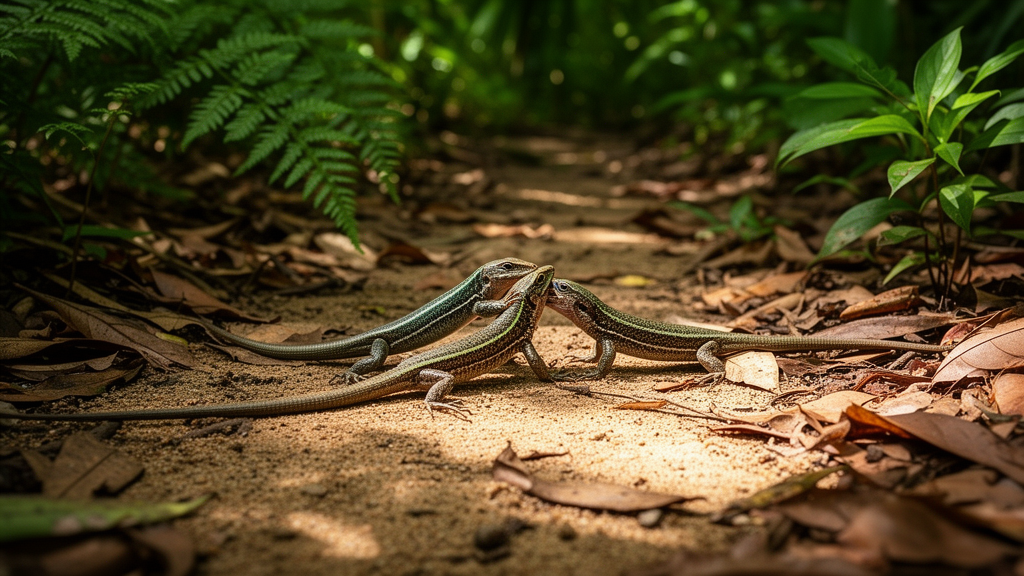
In a busy residential neighborhood of Cáceres, in the Panamanian province of Panamá Oeste, a brief but revealing encounter between three lizards has given scientists their first detailed look at the mating behavior of the Amazon racerunner, Ameiva praesignis. The observation, documented on 28 May 2024 with photographs and video, is the first formal description of courtship and copulation in this species in Panama, and it adds fresh evidence to a growing picture of how behavior, body size, and coloration shape reproductive success in Neotropical lizards.
Ameiva praesignis is a medium-sized, diurnal lizard of the family Teiidae, a group of active foragers that roam forest floors, clearings, and disturbed habitats across Central and South America. The species was elevated to full species status by Ugueto and Harvey in 2011, when taxonomic work split it from its close relatives, and it is now recognized as the only member of the genus Ameiva recorded in Panama. Its range extends through Panama into southwestern Costa Rica and parts of South America, where it occupies forests, small clearings, and human-mod landscapes. Juveniles are easy to recognize by their bright blue tails, a feature they lose as they mature into the gray, bluish-gray, or gray-brown adults that dominate open ground in populated areas.
The mating event unfolded at 11:17 in the morning, in an open area within the densely populated community of Cáceres, where patches of remnant vegetation persist amid signs of contamination. The observer, positioned roughly five meters away, recorded fourteen photographs and three videos with a Canon Powershot SX70HS camera while four people working nearby looked on. Remarkably, the presence of humans and even neighbors’ pets did not interrupt the lizards, and the entire sequence, from copulation to the pair’s departure, lasted about seven minutes.
When observation began, the male was already mounted on the female, his left front and rear limbs gripping her body while she kept her tail raised. The pair remained motionless for approximately thirty seconds in this position, with the male’s body arched and partially rotated, a posture that appears to facilitate copulation. After roughly three minutes, the male released the female, and the dynamic of the encounter shifted abruptly.
Following copulation, the female moved away and the male pursued her in a visibly dominant posture, arching the first third of his body so that he appeared larger and more corpulent. He performed repeated up-and-down head movements and exhibited slight vibrations or spasms in his pelvic girdle and hind limbs, which he partially dragged as he chased her. The female sought refuge in a hole, which the male guarded for ninety seconds. She then emerged, entered a second hole where she remained for just over two minutes, and finally both lizards left the area together.
A third lizard added an intriguing layer to the scene. A smaller male, estimated at 170 millimeters in snout-vent length, watched the entire mating from about 1.5 meters away without ever intervening. Once the pair approached the second hole, the bystander male departed. Based on visual estimates, the mating male measured about 220 millimeters in snout-vent length and the female about 160 millimeters, suggesting that all three individuals were sexually mature and fully capable of reproduction when compared with published body size data for related species.
The behavior of the watching male speaks directly to one of the central dynamics of lizard mating systems. Mate guarding, in which a male stays close to a female after or around copulation, is considered common among teiids, and its function is straightforward: by keeping rivals at a distance, a male reduces the opportunity for the female to mate with other males, potentially increasing his own reproductive success. The non-intervention of the smaller male, combined with the dominant posture and pursuit behavior of the larger one, is consistent with the idea that size and status influence access to mates in this species.
Sexual dimorphism was striking throughout the encounter. The male was considerably larger and more robust than the female, and he displayed an intense turquoise coloration in the inguinal and ventral regions, a morphotype that stands out against the muted tones of the female. Previous work by Ugueto and Harvey established that males of A. praesignis are significantly longer than females and have relatively longer heads, and the new observation reinforces the picture of a species in which male size and coloration are prominent, visible signals. Such traits are closely tied to female sexual selection in lizards, where polygyny is the most common mating system and females may assess potential mates based on body size and color intensity.
The courtship and mating repertoire documented in Cáceres closely mirrors what has been described for Ameiva ameiva, the racerunner’s closest well-studied relative. In both species, males display head movements, chase females, and rub their cloacas against the ground during mating. The resemblance is not surprising from an evolutionary standpoint, since the two species are phylogenetically related within the A. ameiva species group, and the author of the new report suggests that these ritualized behaviors may be characters fixed at the genus level, passed down from a common ancestor rather than evolved independently in each lineage.
Although mating events are relatively common in lizard populations, they remain poorly documented for many species, and detailed behavioral descriptions like this one fill important gaps in understanding how sexual selection operates in the wild. The fact that the encounter took place in a populated, human-modified landscape, and proceeded undisturbed despite nearby people and pets, also offers a small glimpse into how these adaptable lizards persist alongside human activity. For Ameiva praesignis, the blue-tailed juveniles darting through Panamanian neighborhoods are now known to grow into adults whose courtship follows a script shared with their Amazonian relatives, one written in head bobs, arched postures, and the quiet arithmetic of mate guarding.
Subject of Research: Mating behavior and sexual dimorphism of the Amazon racerunner lizard Ameiva praesignis observed in Panama
Article Title: Mating of the Amazon racerunner ( Ameiva praesignis ) ( Squamata , Teiidae ) in Panama
Article References: Fuentes, R. (2024). Mating of the Amazon racerunner (Ameiva praesignis) (Squamata, Teiidae) in Panama. Neotropical Biology and Conservation, 19(3), 405-409. https://doi.org/10.3897/neotropical.19.e128704
Image Credits: AI Generated
DOI: 10.3897/neotropical.19.e128704
Keywords: Ameiva praesignis, Amazon racerunner, Teiidae, lizard mating behavior, mate guarding, sexual dimorphism, Panama, Neotropical lizards, courtship, sexual selection, herpetology, Ameiva ameiva
Cite Scienmag News
Drew Townsend. (October 18, 2026). Amazon Racerunner Lizards Filmed Mating in Panama for the First Time. Scienmag. https://scienmag.com/amazon-racerunner-lizards-filmed-mating-in-panama-for-the-first-time/
Drew Townsend. "Amazon Racerunner Lizards Filmed Mating in Panama for the First Time." Scienmag, 18 October 2026, https://scienmag.com/amazon-racerunner-lizards-filmed-mating-in-panama-for-the-first-time/. Accessed 18 October 2026.
Drew Townsend. "Amazon Racerunner Lizards Filmed Mating in Panama for the First Time." Scienmag. October 18, 2026. https://scienmag.com/amazon-racerunner-lizards-filmed-mating-in-panama-for-the-first-time/


