


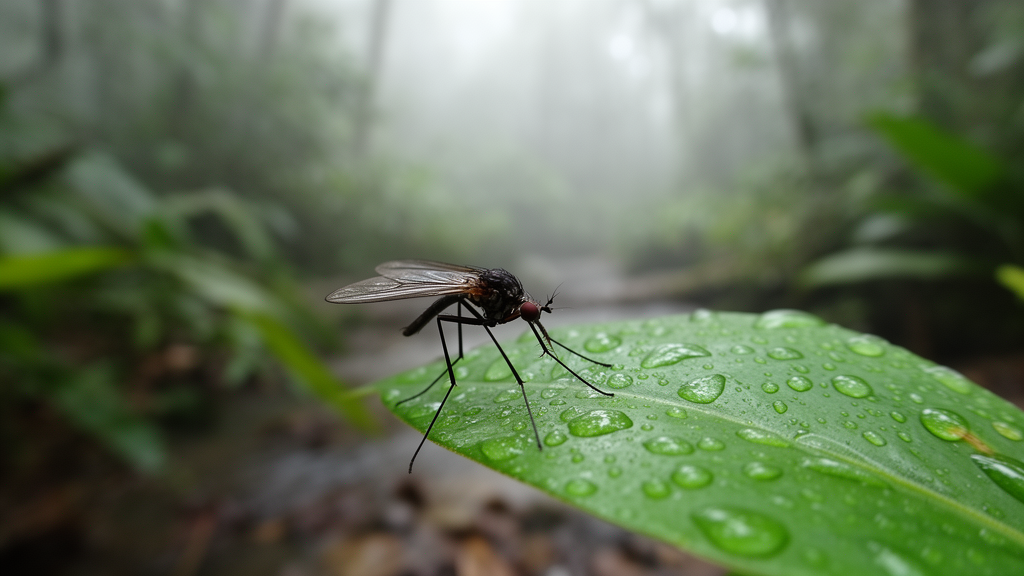
Deep in the streamside bush of Mpumalanga Province, South Africa, a small brown fly collected more than half a century ago has finally received a name. In a new revision published in African Invertebrates, entomologist B. S. Muller reclassifies the Afrotropical members of Atrichops Verrall, a haematophagous genus of water snipe flies whose females are known to feed on the blood of frogs. The work formally transfers the enigmatic species Atherix adamastor Stuckenberg, 1960 into Atrichops, and describes a new species, Atrichops intermedius sp. nov., from Mpumalanga, bringing the number of recognised Afrotropical species in the genus to three.
Atrichops belongs to the family Athericidae, the athericine water snipe flies, a group whose larvae develop in flowing freshwater and whose adult females possess well-developed mandibles used for blood-feeding. The genus currently comprises 11 extant species and one fossil species worldwide. Most of these were described from the Palaearctic and Oriental regions, with Yang and colleagues adding three new species from China in 2016. The African story began only in 1982, when Thomas and Gagneur described A. numidicus from Algeria, followed in 1984 by Nagatomi’s description of the first Afrotropical species, A. stuckenbergi, from Kenya. Until now, however, the Afrotropical fauna remained poorly understood, with five species of Athericidae from South Africa left unplaced, informally still referred to the catch-all genus Atherix.
One of those unplaced species, Atherix adamastor, was described by Brian Stuckenberg in 1960 from a single female collected on the Cape Peninsula at Hout Bay during the Swedish South African Expedition. Stuckenberg himself noted that its wings were unlike those of any other South African species, and in his later contributions to the Field Guide to Insects of South Africa he informally categorised it as an Atrichops. That informal placement, echoed on data aggregators, never received a formal taxonomic treatment until the present revision. Muller’s analysis confirms the classification on the basis of a suite of morphological characters and the species’ feeding ecology, and the transfer is now published as Atrichops adamastor comb. nov.
The evidence for the transfer is compelling. Atrichops adamastor possesses a ventrally projecting knob-like proepimeral process, albeit much reduced, a character typical of the genus. Its face is narrower than the frons in the female, and its antennal bases are closely set, nearly touching, in contrast to the widely spaced antennal bases of the similar genus Suragina. Perhaps most tellingly, wing vein R4+5 is setulose dorsally, a characteristic Muller notes is present only in Atrichops among Afrotropical genera. The male terminalia are also typical of the genus, with the gonostylus inserted medially on the dorsal surface of the gonocoxite rather than apically as in other genera. Crucially, the species has been observed blood-feeding on frogs, behaviour characteristic of Atrichops females.
That behavioural evidence came from an unexpected quarter. The species was observed and photographed feeding on the Cape River Frog, Amieta fuscigula, in the Garden Route Botanical Garden in George, South Africa, by naturalist Colin Ralston, in an observation documented on iNaturalist. While the behaviour had been informally observed before, this is the first published photographic record of A. adamastor exhibiting the typical Atrichops feeding behaviour. Muller highlights the episode as a demonstration of the importance of citizen science in revealing species interactions that might otherwise go unrecorded, noting that an attempt to sample material from the botanical garden for study was unsuccessful, possibly due to heavy rains earlier in the season.
The revision also describes the previously unknown male of A. adamastor, based on two males and ten females collected in Gamkaskloof, the remote Karoo valley known as Die Hel, in the Western Cape Province. The males were taken in Malaise traps set in Karoo and valley Acacia woodland. Morphologically, the male has narrowly dichoptic eyes densely covered in ommatrichia, a dark brown frons almost as wide as the anterior ocellus, and uniformly brown-suffused wings with a much darker pterostigma. One detail of the male description diverges from the original female description: Stuckenberg recorded pale yellowish halter knobs on the holotype, whereas the newly described males and additional females have dark knobs on yellow stalks.
The new species, Atrichops intermedius, is described from the Gladdespruit River near the Mbombela airfield in Mpumalanga, at roughly 907 metres above sea level, where B. R. Stuckenberg collected the holotype and paratypes in streamside bush in February 1971. A further female paratype came from Graskop in 2000. The species name, from the Latin intermedius meaning in the middle, refers both to its known occurrence lying roughly between the distributions of A. adamastor and A. stuckenbergi, and to its mixture of characteristics found in both of those species. The holotype male has narrowly dichoptic eyes, a frons slightly narrower than the anterior ocellus, nearly unicolorous yellowish legs with yellow tibiae, and wings bearing darker brown suffusions over the base and apex of the discal cell.
Distinguishing the three Afrotropical species requires careful attention to fine morphological detail. Atrichops stuckenbergi, known from Kenya, Malawi and Tanzania, has male eyes that appear holoptic and sparsely covered in ommatrichia, a shiny black female frons with silver-white pruinosity above the antennae, and a short, blunt proepimeral process. Atrichops adamastor has densely ommatrichia-covered eyes in both sexes, a dark brown frons, and uniformly suffused wings. Atrichops intermedius sits between them: its male frons is narrower than the anterior ocellus, its fore tibia bears sparse widely spaced setulae at most as long as the tibial diameter, its female face and clypeus are separated by a transverse emargination with a clearly visible darkened transverse line, and its wings show apparent dark markings over both the base and apex of the discal cell. The male terminalia differ too, with the gonocoxite more rounded and less tapering toward the base than in either of the other species, and the parameral apodeme shorter. The revision provides a formal identification key to the three species, along with descriptions of the previously unknown males of both A. adamastor and A. stuckenbergi.
The known distribution of the three species spans only four African countries and at least three distinct ecosystems. Atrichops adamastor inhabits Afromontane forest pockets within the Fynbos biome, and also adjacent Albany thicket and Succulent Karoo, even in the absence of forest. Atrichops intermedius inhabits Savanna and Grassland environments, often featuring similar Afromontane forest pockets. Atrichops stuckenbergi has thus far been found only in the Afromontane forest of the Eastern Arc Mountains of Kenya and Tanzania, and in the forests of the Mulanje massif and other mountains in southern Malawi, with new country records for Malawi and Tanzania documented in the revision.
Beyond taxonomy, Muller argues that the biology and distribution of these flies carry broader ecological significance. The larvae of the genus are presumed to have a biennial lifecycle, supported by observations of the European species A. crassipes, which means the overall health of water systems and associated environmental conditions in rivers and streams likely play a crucial role in determining suitable habitat, including the availability of prey for larvae and the presence of frog hosts for adult females. Water snipe flies are regarded as vital indicators of river health, and a better understanding of the group’s tolerances could inform conservation management and planning across Africa, particularly in light of increasing habitat loss in the region. As the Afrotropical Atrichops fauna becomes better known, these frog-feeding flies may prove to be as much sentinels of ecosystem change as they are curiosities of dipteran diversity.
Subject of Research: Taxonomy
Article Title: Afrotropical Atrichops Verrall ( Diptera , Athericidae ) with description of a new species
Article References: Muller, B. S., Swart, V. R., & Snyman, L. P. (2023). Afrotropical Atrichops Verrall (Diptera, Athericidae) with description of a new species. African Invertebrates, 64(3), 303-322. https://doi.org/10.3897/afrinvertebr.64.113133
Image Credits: AI Generated
DOI: 10.3897/afrinvertebr.64.113133
Keywords: Afrotropical, Atrichops, Verrall, Diptera, Athericidae, description, species, scientific research
Cite Scienmag News
Gavin Prescott. (October 18, 2026). Afrotropical Atrichops Verrall (Diptera, Athericidae) with description of a new species. Scienmag. https://scienmag.com/afrotropical-atrichops-verrall-diptera-athericidae-with-description-of-a-new-species/
Gavin Prescott. "Afrotropical Atrichops Verrall (Diptera, Athericidae) with description of a new species." Scienmag, 18 October 2026, https://scienmag.com/afrotropical-atrichops-verrall-diptera-athericidae-with-description-of-a-new-species/. Accessed 18 October 2026.
Gavin Prescott. "Afrotropical Atrichops Verrall (Diptera, Athericidae) with description of a new species." Scienmag. October 18, 2026. https://scienmag.com/afrotropical-atrichops-verrall-diptera-athericidae-with-description-of-a-new-species/


