


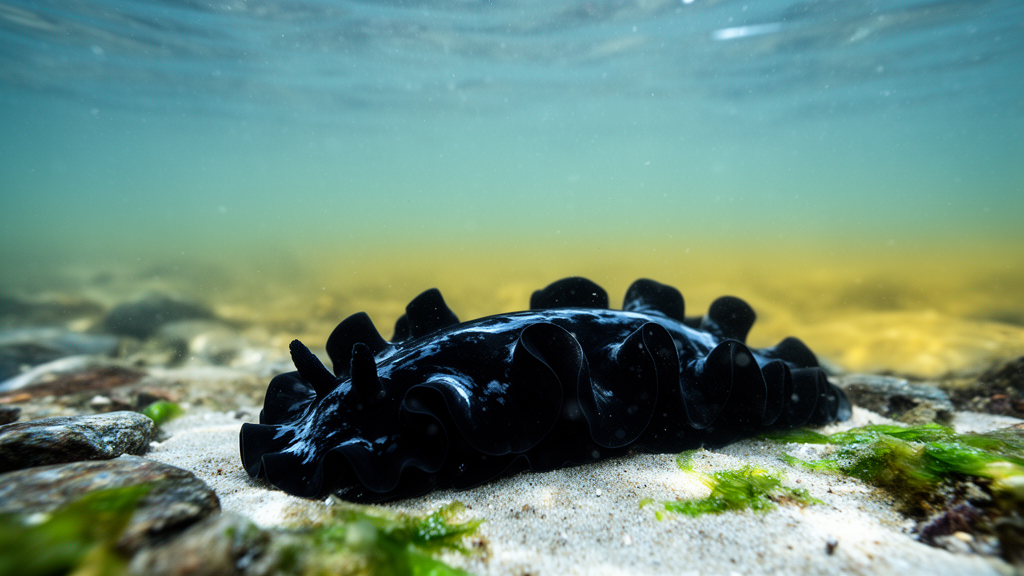
On a cold December morning on the Dalian coastline, a team surveying the lower intertidal zone at Heishijiao turned over a rock and found something that should not have been there: a jet-black sea slug edged with a vivid orange fringe, resting among snails and chitons far north of where this species had ever been confirmed. The animal was Dendrodoris arborescens, a sponge-eating nudibranch first described from the East China Sea in 1881, and its discovery in the northern Yellow Sea now stands as the first record of both the species and its entire genus in temperate northern Chinese waters.
The find, published in the Biodiversity Data Journal, is based on twenty specimens collected at Heishijiao in Dalian, Liaoning Province, at coordinates 38.86499°N, 121.54843°E. The first individual was gathered on 28 December 2023, with further collections through February 2024 and additional specimens in September 2024. All were found under rocks at low tide, co-occurring with the gastropod Gigahomalopoma nocturnum and the chiton Acanthochitona rubrolineata. The specimens were photographed in situ, examined alive in the laboratory, preserved in 95% ethanol and deposited in the reference collection of the Key Laboratory of Mariculture & Stock Enhancement in the North China Sea at Dalian Ocean University under registration numbers DLOUDA01 through DLOUDA20.
What makes the discovery remarkable is geography. Dendrodoris arborescens was originally described from the Haitan Strait off Fujian Province, and subsequent records have come from the South China Sea, South Korea, Japan, the Philippines, Australia and southern Africa. The nearest previously known locality was Jeju Island, South Korea. The Dalian population therefore extends the species’ confirmed northern distributional limit by roughly 800 kilometres, pushing it into a marginal sea whose relatively cold waters host a molluscan fauna dominated by warm-temperate species. Previous inventories of the region, including major molluscan surveys from 1989 and 2016, had never documented any Dendrodoris species there.
Identification was not a matter of colour alone, and this is where the story becomes technically interesting. Members of Dendrodoris are notoriously variable: a single species can show strikingly different body patterns, and overall anatomical similarity among congeners has historically produced significant confusion and misidentification. D. arborescens itself was long treated either as a dark form of D. fumata or as a synonym of D. nigra. Its taxonomic status was only clarified through a synthesis of external morphology, colour pattern, gill structure and, crucially, larval characteristics, which led Brodie and Calado in 2006 to formally reinstate it as a valid species.
The Dalian specimens matched the diagnostic external morphology precisely: a uniformly jet-black mantle with a smooth surface, a distinctive bright orange or yellow marginal band, a grey foot, black feather-like gills arranged in a circle around the anal papilla, and black rhinophores with papillate tips. Adults are oval-shaped, relatively low and elongate, with smooth, often undulating margins. All twenty specimens were hermaphroditic adults, consistent with the reproductive biology of nudibranchs, and the animals were observed spawning under natural water temperature conditions.
Molecular evidence sealed the case. Total genomic DNA was extracted from the foot tissue of three specimens using a marine animal DNA kit, with tissue minced and incubated overnight at 56°C in lysis buffer. DNA purity was assessed by spectrophotometry, with A260/280 ratios between 1.8 and 2.0. The mitochondrial cytochrome c oxidase subunit I gene, the standard barcoding locus for animals, was amplified with the universal primer pair LCO1490/HCO2198 in 25 microlitre PCR reactions, verified on 1.5% agarose gels and sequenced bidirectionally. The resulting full-length COI sequence, 1533 base pairs long and deposited in GenBank as PV759423, showed 98.4% similarity to reference sequences attributed to D. arborescens.
Phylogenetic analysis then placed the Dalian animals firmly within the species. Published COI sequences from Dendrodorididae and closely related heterobranch taxa were retrieved from GenBank, aligned with MAFFT and trimmed of ambiguous positions using Gblocks. Because complete mitochondrial genomes are scarce for this group, the researchers mapped all sequences to a common coordinate system using their full-length sequence as the reference. Maximum Likelihood inference in IQ-TREE, with substitution models selected independently for each codon partition and node support evaluated through 1000 bootstrap replicates, produced a tree in which the Dalian sequence clustered with multiple D. arborescens references, forming a distinct clade separate from closely related species. The researchers note that most database references are short barcode fragments of roughly 660 to 700 base pairs, which limited BLAST query coverage to about 45% against their 1533-base-pair sequence, but this reflects reference length rather than any weakness in the homology of the aligned region.
The biology of the species offers the best clue to how it reached the Yellow Sea. Like other dendrodorids, D. arborescens lacks a radula and skeletal spicules, instead using a highly modified suctorial feeding apparatus to prey on sponges. More importantly for dispersal, it produces planktotrophic veliger larvae, plankton-feeding larvae with two extraordinary features: a large cephalopedal region that replaces the operculum and cannot be retracted into the shell, and an early shedding of the shell during the pelagic phase. These larval traits were so unusual that Goddard hypothesised in 2005 that the species represented an independently evolving lineage, a view later confirmed molecularly. Long-lived, feeding larvae are excellent candidates for transport over long distances by ocean currents.
The authors discuss several non-exclusive explanations for the Dalian population. The most plausible is transport of planktotrophic larvae by the northward-flowing warm extension of the Kuroshio Current, which could carry larvae from established populations in Korea or southern Japan. Increased sampling effort in temperate regions is another possibility, as is a previously overlooked resident population that has adapted to local conditions, hidden by the species’ cryptic habits under rocks and its resemblance to other dark-coloured nudibranchs. A recent range expansion linked to warming ocean temperatures cannot be ruled out either, a scenario that would resonate with broader patterns of tropical and subtropical species shifting polewards as seas warm.
Whatever the mechanism, the finding updates the marine biodiversity inventory of northern Chinese waters in a significant way and underscores how much remains unknown even along well-studied coastlines. The authors argue that continued biodiversity surveys in temperate regions are essential, and that further molecular work following established COI protocols would confirm identifications and reveal population connectivity between the Dalian population and other Indo-Pacific populations. For now, a slug described 145 years ago from southern Chinese seas has quietly announced itself in the north, carried, most likely, on a current that connects the tropics to one of the coldest seas on China’s coast.
Subject of Research: First record of the nudibranch Dendrodoris arborescens in the northern Yellow Sea near Dalian, China
Article Title: The first record of the Dendrodoris arborescens (Collingwood, 1881) ( Gastropoda , Nudibranchia ) in the Yellow Sea (Dalian, Liaoning, China)
Article References: Tian, Y., Li, W., Han, Y., Wen, Y., Liu, Y., Cai, L., & Hao, Z. (2026). The first record of the Dendrodoris arborescens (Collingwood, 1881) (Gastropoda, Nudibranchia) in the Yellow Sea (Dalian, Liaoning, China). Biodiversity Data Journal, 14, Article e199742. https://doi.org/10.3897/bdj.14.e199742
Image Credits: AI Generated
Keywords: nudibranch, Dendrodoris arborescens, Yellow Sea, marine biodiversity, sea slugs, Kuroshio Current, COI barcoding, Dalian, larval dispersal, taxonomy, ocean warming, China
Cite Scienmag News
Drew Townsend. (October 18, 2026). Jet-Black Sea Slug Surprises Scientists With an 800 km Leap Into the Cold Yellow Sea. Scienmag. https://scienmag.com/jet-black-sea-slug-surprises-scientists-with-an-800-km-leap-into-the-cold-yellow-sea/
Drew Townsend. "Jet-Black Sea Slug Surprises Scientists With an 800 km Leap Into the Cold Yellow Sea." Scienmag, 18 October 2026, https://scienmag.com/jet-black-sea-slug-surprises-scientists-with-an-800-km-leap-into-the-cold-yellow-sea/. Accessed 18 October 2026.
Drew Townsend. "Jet-Black Sea Slug Surprises Scientists With an 800 km Leap Into the Cold Yellow Sea." Scienmag. October 18, 2026. https://scienmag.com/jet-black-sea-slug-surprises-scientists-with-an-800-km-leap-into-the-cold-yellow-sea/


