


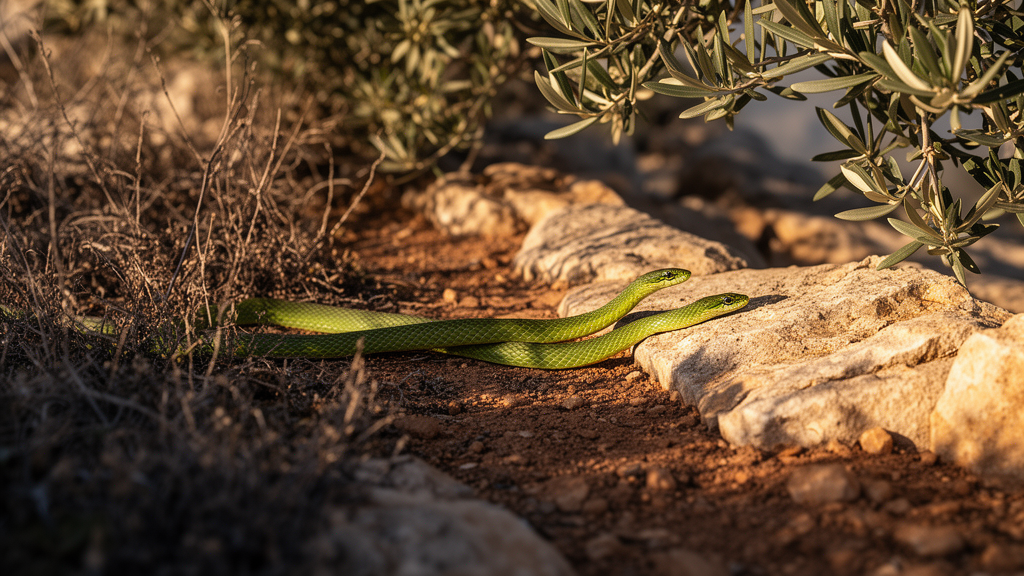
Across the sun-baked landscapes of the Mediterranean Basin, North Africa, the Middle East and Central Asia, a group of slender, fast-moving colubrid snakes known as the horseshoe whip snakes has quietly carved out one of the most geographically sprawling distributions of any reptile genus in the Western Palearctic. A new modeling study published in the journal Herpetozoa suggests that this shared evolutionary heritage offers no guarantee of a shared future. Under high-emission climate scenarios, one species of the genus Hemorrhois is projected to expand its range substantially, while its three closest relatives face dramatic contractions of the habitats they depend on, with some models forecasting losses of nearly ninety percent of currently suitable terrain.
The research, based on ecological niche modeling of all four recognized Hemorrhois species, set out to answer a deceptively simple question: what environmental conditions define the boundaries of each snake’s distribution, and how will those boundaries move as the climate warms? The genus comprises Hemorrhois algirus, the Algerian whip snake of North African arid zones; H. hippocrepis, the horseshoe whip snake of the Iberian Peninsula and western Mediterranean; H. nummifer, the coin-marked snake of the Levant and Anatolia; and H. ravergieri, the spotted whip snake of montane and steppe habitats stretching into Central Asia. Despite their broad ranges, these snakes have remained relatively understudied with respect to their ecological requirements and their vulnerability to environmental change.
To build the models, the author assembled thousands of occurrence records from herpetological literature, personal field observations and citizen-science platforms such as GBIF and iNaturalist. Every record passed a rigorous two-step validation: coordinates with fewer than three decimal places were flagged for checking, and locality descriptions were cross-referenced against mapped positions in GIS software, with any discrepant or uncertain records discarded. Spatial thinning then reduced sampling bias by retaining a single locality for every five kilometers of linear distance, leaving 109 validated points for H. algirus, 1,071 for H. hippocrepis, 239 for H. nummifer and 161 for H. ravergieri. This careful data curation matters, because occurrence records with geographic errors can silently distort the climatic envelopes that models infer.
The environmental backbone of the analysis came from the CHELSA climate database at a resolution of 30 arc-seconds, covering the baseline period from 1970 to 2000. Eight bioclimatic variables survived a correlation filter that removed any variable correlated with another at a coefficient of 0.8 or higher, spanning measures of temperature range, seasonality, extreme heat, and precipitation patterns. Crucially, the study defined a species-specific calibration area for each snake, masked to regions the species could plausibly have reached given known distributions and dispersal barriers. This step, grounded in niche modeling theory, prevents the model from sampling background conditions in places a species simply cannot access, which would otherwise inflate apparent niche differences.
Rather than relying on a single algorithm, the study built an ensemble from six methods: generalized linear models, generalized additive models, surface range envelopes, domain models, random forests and maximum entropy. For the maximum entropy component alone, 341 candidate models were tested across combinations of feature classes and regularization multipliers, and the final configuration for each species was chosen using a multi-criteria framework combining the area under the receiver operating curve, the corrected Akaike Information Criterion, partial ROC significance tests and a five percent omission-rate threshold. The resulting models performed strongly: AUC values reached 0.955 for H. algirus, 0.943 for H. hippocrepis, 0.959 for H. nummifer and 0.915 for H. ravergieri, all comfortably in the range considered excellent for species distribution models.
Future projections drew on five global circulation models from the CMIP6 generation, spanning GFDL-ESM4, IPSL-CM6A-LR, MPI-ESM1-2-HR, MRI-ESM2-0 and UKESM1-0-LL, run under both the optimistic SSP126 and the pessimistic SSP585 shared socioeconomic pathways for the period 2081 to 2100. A mobility-oriented parity analysis flagged regions of strict extrapolation where future climates fall outside the calibration range, allowing uncertain projections to be interpreted cautiously. Extrapolation was permitted during model transfer but constrained by response curves to avoid biologically implausible predictions, a safeguard against the kind of runaway forecasts that can plague models pushed into novel climates.
The headline result is a stark divergence in fortunes. Hemorrhois algirus, adapted to harsh arid and semi-arid conditions across North Africa, is projected to expand under nearly every scenario, with the GFDL model under SSP585 predicting a net range increase of roughly fifty percent. Its niche is governed chiefly by isothermality and precipitation of the warmest quarter, variables that appear to favor its spread across Morocco, northern Algeria and beyond. By contrast, H. hippocrepis, concentrated along Iberian and Mediterranean coastal lowlands, faces contraction under most scenarios, with the MPI model under SSP585 forecasting a loss of about seventy percent of suitable habitat. The coastal and insular specialist, hemmed in by the Alps and the Pyrenees to the north and the sea on other flanks, has few avenues of retreat.
The outlook is grimmest for the eastern species. Hemorrhois nummifer, tied to the semi-arid and Mediterranean environments of the Levantine corridor and western Anatolia, is projected to lose up to 87.4 percent of suitable habitat under the MPI model’s high-emission scenario, with contractions predicted under nearly every combination of model and pathway. Its distribution is most sensitive to precipitation seasonality and the temperatures of the wettest quarter, suggesting acute vulnerability to the aridification forecast for the eastern Mediterranean. Hemorrhois ravergieri, occupying montane and steppe terrain from Türkiye and the Caucasus into Central Asia, shows losses of 42.1 percent under MPI and 39.5 percent under UKESM under SSP585, with high-elevation refugia becoming increasingly important even as lowland areas deteriorate.
Niche comparisons add an evolutionary dimension to these forecasts. Using Schoener’s D and Hellinger’s I indices, validated with Monte Carlo background similarity tests of 500 replicates, the study found statistically supported niche overlap in only two of eight pairwise comparisons: between the parapatric pair H. algirus and H. hippocrepis, and between H. nummifer and H. ravergieri. The author interprets this pattern as evidence of partial niche conservatism within the genus, shaped by geographic barriers that have long structured snake evolution. The Sahara Desert, the Alps, the Pyrenees, and the Dardanelles and Istanbul straits emerge as recurring protagonists in the genus’s history, limiting gene flow and driving allopatric divergence. The split between H. algirus and H. hippocrepis dates to the late Miocene or early Pliocene, some four to seven million years ago, and Pleistocene sea-level drops of roughly 130 meters at the Strait of Gibraltar may even have allowed overland dispersal between Africa and Iberia.
The conservation implications are as uneven as the projections themselves. The study argues that climate refugia, areas projected to remain suitable under both current and future conditions, should anchor conservation planning, alongside habitat connectivity and species-specific management. Generalists like H. algirus may need little more than monitoring and room to move, while H. nummifer and H. ravergieri will require active efforts to counter fragmentation in topographically complex, rapidly drying regions. The author is careful to note the limits of correlative models, which omit physiology, dispersal constraints and biotic interactions, and calls for future work integrating mechanistic and genetic approaches. For now, the horseshoe whip snakes offer a vivid illustration of a broader truth emerging from climate change biology: related species sharing a continent can be separated by nothing more than their niches, and those niches will decide which lineages endure.
Subject of Research: Ecological niche modeling and climate-driven range shifts in Hemorrhois whip snakes
Article Title: Ecological niches and climate-driven range shifts in Hemorrhois snakes: implications for biogeography
Article References: Şahin, M. K. (2025). Ecological niches and climate-driven range shifts in Hemorrhois snakes: implications for biogeography. Herpetozoa, 38, 191-204. https://doi.org/10.3897/herpetozoa.38.e151017
Image Credits: AI Generated
DOI: 10.3897/herpetozoa.38.e151017
Keywords: Hemorrhois, ecological niche modeling, climate change, range shifts, reptile biogeography, Mediterranean Basin, species distribution models, niche conservatism, conservation, CMIP6, herpetology, Western Palearctic
Cite Scienmag News
Drew Townsend. (October 18, 2026). Climate Maps Reveal a Split Fate for Mediterranean Whip Snakes. Scienmag. https://scienmag.com/climate-maps-reveal-a-split-fate-for-mediterranean-whip-snakes/
Drew Townsend. "Climate Maps Reveal a Split Fate for Mediterranean Whip Snakes." Scienmag, 18 October 2026, https://scienmag.com/climate-maps-reveal-a-split-fate-for-mediterranean-whip-snakes/. Accessed 18 October 2026.
Drew Townsend. "Climate Maps Reveal a Split Fate for Mediterranean Whip Snakes." Scienmag. October 18, 2026. https://scienmag.com/climate-maps-reveal-a-split-fate-for-mediterranean-whip-snakes/


