


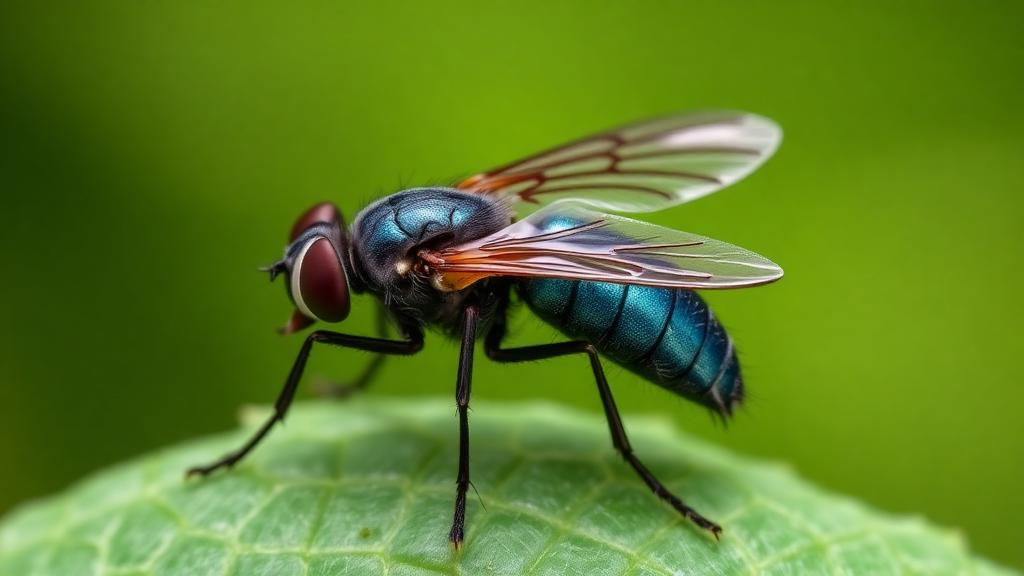
A sweeping audit of Europe’s blackfly fauna has delivered the continent’s most rigorous species inventory to date, cutting the accepted list to 233 species while flagging 28 others as too poorly documented to count. The revision, published in the journal ZooKeys, sifts through more than two centuries of scattered records, catalogues and museum specimens to separate what scientists can genuinely confirm from what has simply been repeated, citation after citation, in the literature. For a family of insects whose females bite livestock, birds and occasionally humans, the difference between a confirmed species and a doubtful one is far from academic.
Blackflies, the family Simuliidae, are among the most consequential blood-feeding arthropods in the temperate world. Female blackflies feed on the blood of mammals and birds, and their bites can trigger severe reactions in people and animals alike. In tropical Africa, South America and Yemen, certain species transmit the parasitic worm that causes human onchocerciasis, better known as river blindness. Europe has so far been spared major human parasites carried by blackflies, but the continent’s species are confirmed vectors of avian haemosporidian parasites and are considered potential carriers of Bartonella bacteria and zoonotic filarial nematodes. Their most notorious impact, however, remains agricultural: historical accounts document cattle mortality during mass outbreaks, with daily biting rates on cattle commonly ranging from ten to more than a thousand bites per animal.
The historical heavyweight of European biting flies was Simulium colombaschense, which once bred in staggering numbers in the middle reaches of the Danube, particularly in the Iron Gates gorge. Its populations collapsed after the Iron Gates Dams were built in the 1970s, and the species has not been detected in that stretch of the river in recent decades. Yet seasonal biting outbreaks persist across Europe, and annual biting rates of 15,000 to 50,000 bites per year were documented on horses in earlier studies. Beyond their nuisance value, blackfly larvae filter organic particles from flowing water and form a significant link in aquatic food webs, especially in boreal streams, a role the authors argue is underestimated even within hydrobiological research.
The new inventory was built through a two-stage workflow that treated every published record as a claim to be tested rather than a fact to be copied. The researchers first compiled a raw data pool of 268 species-level taxa reported from Europe, drawing primarily on three key comprehensive sources: the annually revised world inventory of blackflies, the Fauna Europaea dataset, and the Catalogue of Palaearctic Diptera. Where these secondary compilations conflicted or left ambiguities, the team went back to primary faunistic and taxonomic studies, digitising printed sources and disaggregating them into individual species records tied to defined geographic units.
Filtering then removed everything that could not stand on formal nomenclatural ground. Two morphoforms and five cytoforms, including one hypothetical species, were excluded because they carry only informal designations and lack the formal names required by the International Code of Zoological Nomenclature. Two nomina nuda, names published without adequate description, were also struck out. One of them, Simulium anomalum, described by Eversmann in 1834, was accompanied by no description at all. The other, Simulium laticornis, exists only as an attributed personal communication that was never formally published by its supposed author. Both fail the Code’s requirements and cannot legitimately appear on any species list.
Two species were simultaneously brought back from synonymy. Simulium annulipes and Simulium beckeri, both originally described in the early twentieth century from the Mediterranean and Macaronesian region, had recently been treated as synonyms of the widespread Simulium ruficorne. Chromosomal evidence published in 2018 showed that the European cytoforms of the ruficorne complex form distinct clades from their Afrotropical relatives, supporting their recognition as separate species. The authors acknowledge that the latest evidence recommends caution, but argue that keeping the two named species distinct is pragmatically easier than trying to untangle distributional data later if synonymy is eventually confirmed. In a separate reassessment, the form previously treated as Simulium aff. tuberosum was merged into Simulium janzeni, consistent with earlier morphological work, though the European members of the tuberosum group still await a full revision.
From the resulting core set of 261 species, the audit applied two decisive criteria: nomenclatural validity under the ICZN, and reliably confirmed occurrence in Europe. Species meeting both tests entered the List of accepted species, which now stands at 233 taxa. Sixteen of these are recognised as species complexes, meaning the true number of European species is likely higher than the count suggests. The accepted list is sensitive to where Europe’s eastern boundary is drawn: if the Manych Depression is taken as the limit and the northern Caucasus excluded, the total drops by 14 species, three of them Caucasian endemics whose ranges do not extend further into Europe.
The remaining 28 species form the List of questionable species, and their stories illustrate how taxonomic doubt accumulates. Several rest entirely on a single Romanian record from 1966 whose descriptions were copied from an older Russian monograph rather than based on the author’s own specimens, with pupal characters that either vary too widely among related species or contradict the original descriptions outright. Others hinge on records more than half a century old from the Balkans or northern Russia that have never been reconfirmed. In one striking case, a species described from the semi-desert rivers of Mongolia was reported from both large lowland rivers and small spring streams in Ukraine, an ecological implausibility compounded by morphological discrepancies, leading the authors to exclude it despite its traditional presence in recent national checklists.
The audit also challenges the growing reliance on short mitochondrial DNA barcodes alone. Records of Simulium turgaicum from Slovenia, Bosnia and Herzegovina and Czechia rest solely on partial COI sequences, yet three closely related species in the same group show very similar barcodes, and published phylogenetic trees built from this gene fail to recover the species as distinct lineages. The authors argue that a single mitochondrial gene fragment cannot be accepted as reliable evidence of a species’ presence, particularly given the likelihood of incomplete lineage sorting or hybridisation among closely related blackflies. Molecular evidence, they contend, must be weighed alongside morphology and cytogenetics rather than replacing them.
The broader picture that emerges is one of a predominantly Palaearctic fauna with deep biogeographic roots. Of the 2,415 blackfly species recognised worldwide, Europe hosts less than ten percent. Some 133 accepted species, 57.1 percent, are shared with other continents, while 100 species, 42.9 percent, are endemic to Europe, ranging from widespread continental species to narrow island endemics such as a species confined to Corsica and another known only from Sardinia. Iceland harbours just two species, both shared with Asia. Twenty-five species, 10.7 percent, are shared with North America as remnants of a Holarctic distribution, and 39 species link Europe with Palaearctic Africa. By publishing both the accepted and the questionable lists with explicit criteria and case-by-case rationales, the revision gives ecologists, public health researchers and conservation planners a transparent baseline, while clearly marking where future fieldwork and museum detective work are most needed.
Subject of Research: Taxonomic inventory and revision of European blackfly species (Diptera: Simuliidae)
Article Title: European blackflies: accepted and questionable species ( Diptera , Simuliidae )
Article References: Jedlička, L., Kúdela, M., & Kúdelová, T. (2026). European blackflies: accepted and questionable species (Diptera, Simuliidae). ZooKeys, 1291, 251-281. https://doi.org/10.3897/zookeys.1291.196803
Image Credits: AI Generated
DOI: 10.3897/zookeys.1291.196803
Keywords: blackflies, Simuliidae, taxonomy, species checklist, Europe, biodiversity, ZooKeys, nomina nuda, cytoforms, vector ecology, faunistics, ICZN
Cite Scienmag News
Gavin Prescott. (October 18, 2026). Europe’s blackfly census trimmed to 233 accepted species after sweeping taxonomic audit. Scienmag. https://scienmag.com/europes-blackfly-census-trimmed-to-233-accepted-species-after-sweeping-taxonomic-audit/
Gavin Prescott. "Europe’s blackfly census trimmed to 233 accepted species after sweeping taxonomic audit." Scienmag, 18 October 2026, https://scienmag.com/europes-blackfly-census-trimmed-to-233-accepted-species-after-sweeping-taxonomic-audit/. Accessed 18 October 2026.
Gavin Prescott. "Europe’s blackfly census trimmed to 233 accepted species after sweeping taxonomic audit." Scienmag. October 18, 2026. https://scienmag.com/europes-blackfly-census-trimmed-to-233-accepted-species-after-sweeping-taxonomic-audit/


