


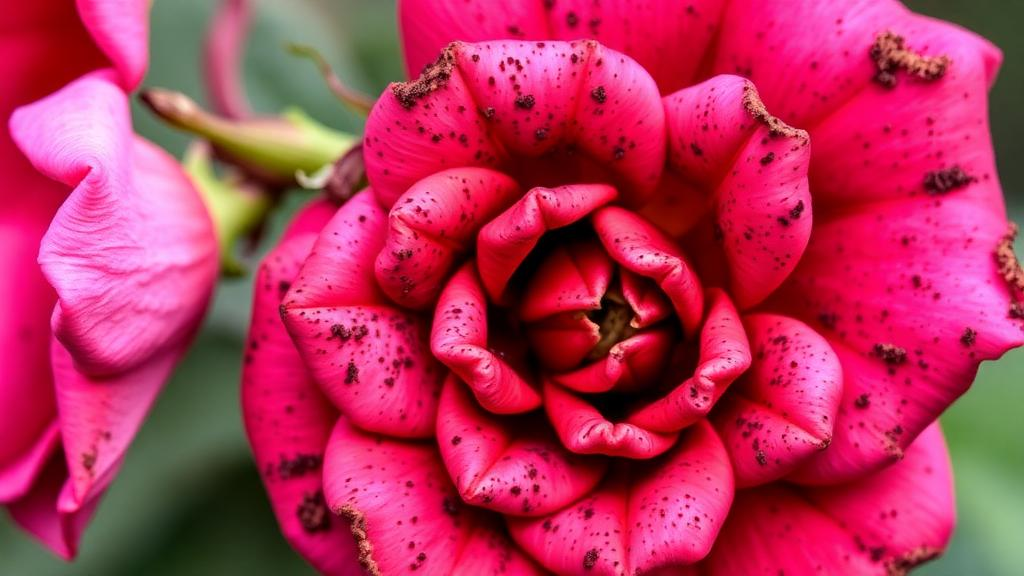
Deep in the mountains of Hubei, on the leaves of a wild rose, a fungus has been quietly living out its life cycle, unnoticed and unnamed. It is not alone. A sweeping new study of rose rust fungi in China has revealed that the country’s roses harbor far more hidden diversity than scientists realized, including two species entirely new to science. The research, published in MycoKeys, combines classical microscopy with DNA-based family trees to untangle one of the most notoriously difficult groups of plant pathogens: the rust genus Phragmidium.
Rust fungi are among the most successful plant parasites on Earth, and Phragmidium is their specialist on the rose family. These obligate biotrophs cannot live apart from their hosts, drawing nutrients from living cells of roses, brambles, and avens. On cultivated roses, severe infections trigger premature defoliation, sapped vigor, and lost ornamental value. On wild roses, rust can shape growth, reproduction, and even population dynamics. With more than 110 described species worldwide, and East Asia long regarded as a center of that diversity, Phragmidium should be well understood. In practice, it has been anything but.
The problem is that rose rusts are masters of disguise. Many species share overlapping teliospore dimensions, similar cell counts, and nearly identical wall ornamentation. Morphological traits can shift with host species, developmental stage, or environment, blurring the boundaries that taxonomists rely on. Earlier Chinese records leaned heavily on host association and herbarium specimens, often without molecular data, leaving species limits uncertain. Roughly two dozen Phragmidium species had been reported on Rosa in China, but their evolutionary relationships remained murky.
To cut through the confusion, the research team mounted an integrative taxonomic assault. They examined extensive specimens from major fungaria and herbaria, including the Mycological Herbarium of Beijing Forestry University, the Herbarium Mycologicum Academiae Sinicae, and the Mycological Herbarium of Ibaraki University in Japan. Field surveys conducted from 2011 to 2019 across Yunnan, Jiangxi, Hubei, and other provinces supplied fresh material. Under light and scanning electron microscopy, the researchers measured at least 30 spores per spore stage for each specimen, capturing the fine details of urediniospores and teliospores that separate lookalike species.
The molecular backbone of the study came from DNA extracted from just 10 to 20 spores per sample. The team amplified two regions of ribosomal DNA: the internal transcribed spacer, or ITS, the universal fungal barcode prized for its high variation between species, and the large subunit, LSU, a more conserved marker that anchors deeper evolutionary relationships. Sequences were aligned and concatenated into a combined dataset of 1,107 characters, of which 397 were parsimony-informative, and analyzed under maximum parsimony, maximum likelihood, and Bayesian inference, with the rust Kuehneola uredinis serving as the outgroup.
The results were striking. The specimens resolved into 22 distinct, well-supported lineages corresponding to 23 species. Twenty-one of these were previously described species whose phylogenetic affinities are now clarified with updated taxonomic accounts. The remaining two were new to science. Phragmidium shennongjiaense, named for Shennongjia in Hubei where its type specimen was collected on Rosa omeiensis, is distinguished by 6 to 9-celled teliospores with coarsely verrucose walls and urediniospores whose echinulae arise from plaque-like bases. In the phylogeny it forms a distinct clade sister to P. rubi-idaei with maximal support across all three analytical methods.
The second newcomer, Phragmidium xinjiangense, was collected on Rosa laxa in Xinjiang’s Bortala Mongol Autonomous Prefecture. It carries 7 to 10-celled teliospores, shorter than those of its morphological relatives P. montivagum and P. chayuensis, and densely echinulate urediniospores. Like its counterpart, it occupies its own strongly supported branch in the combined ITS and LSU tree. Both species were found at additional sites, with P. shennongjiaense turning up in Qinghai and Gansu and P. xinjiangense also recorded in Xizang, hinting at ranges still waiting to be mapped.
Beyond the new species, the study delivered a series of taxonomic corrections that reshuffle the genus’s family tree. Molecular analysis confirmed that Phragmidium japonicum, once shuffled off to the genus Kuehneola, truly belongs in Phragmidium, restoring its original placement. Phragmidium warburgianum, which causes systemic infections producing witches’ brooms on its rose hosts, likewise received a new combination into Phragmidium. The analysis also confirmed that P. rosae-davuricae, long treated by some authors as a synonym of P. tuberculatum, stands as a genuine species, separable by narrower teliospores and distinct urediniospore spines. P. kamtschatkae, with its unusual two-celled teliospores, was confirmed as a true member of the genus despite decades of debate.
The study also probed which morphological characters actually carry taxonomic weight. Teliospore shape and cell number, the traditional workhorses of rust identification, proved useful for preliminary sorting but overlap among several taxa. Wall ornamentation, apical papillae, and pedicel morphology added finer resolution, and in several cases aligned neatly with the molecular lineages. Aecial characters, long underused in Phragmidium taxonomy, showed promise for distinguishing some species but could not be examined in all taxa, including the two new species. Host association, meanwhile, emerged as helpful but unreliable on its own: morphologically similar species can occur on different rose hosts, while distinct lineages can share the same host. The authors stress that host records here represent putative preferences, not confirmed specificity, since no cross-inoculation experiments were performed.
Geographically, the study confirmed that rose rusts span a remarkable swath of China, from Xinjiang and Xizang to Qinghai, Gansu, Hubei, Yunnan, Fujian, Jiangxi, and Beijing. Some species appear restricted, while others such as P. rosae-multiflorae and P. tuberculatum show broader ranges, though uneven collecting intensity may distort the picture. The recognition of two new species in a single study is a clear signal that Phragmidium diversity in China remains incompletely documented, particularly in the topographically complex west and southwest, where wild roses flourish. For a genus that plagues both gardens and wildlands, the message is clear: the rusts on our roses still hold secrets, and only by coupling spore morphology with DNA barcodes can scientists hope to name them all.
Subject of Research: Diversity and taxonomy of the rust fungus genus Phragmidium on Rosa hosts in China
Article Title: Diversity and taxonomy of Phragmidium on Rosa in China, with descriptions of two new species
Article References: Liu, Y., Zhao, Z., Du, Z., Xing, X., Jiang, N., Ono, Y., & Liang, Y. (2026). Diversity and taxonomy of Phragmidium on Rosa in China, with descriptions of two new species. MycoKeys, 138, 163-191. https://doi.org/10.3897/mycokeys.138.201984
Image Credits: AI Generated
DOI: 10.3897/mycokeys.138.201984
Keywords: Phragmidium, rust fungi, Rosa, taxonomy, new species, China, ITS, LSU, phylogenetics, mycology, plant pathology, integrative taxonomy
Cite Scienmag News
Roger Howard. (October 18, 2026). Hidden Rust Fungi on Roses: Two New Species Uncovered in China. Scienmag. https://scienmag.com/hidden-rust-fungi-on-roses-two-new-species-uncovered-in-china/
Roger Howard. "Hidden Rust Fungi on Roses: Two New Species Uncovered in China." Scienmag, 18 October 2026, https://scienmag.com/hidden-rust-fungi-on-roses-two-new-species-uncovered-in-china/. Accessed 18 October 2026.
Roger Howard. "Hidden Rust Fungi on Roses: Two New Species Uncovered in China." Scienmag. October 18, 2026. https://scienmag.com/hidden-rust-fungi-on-roses-two-new-species-uncovered-in-china/


