


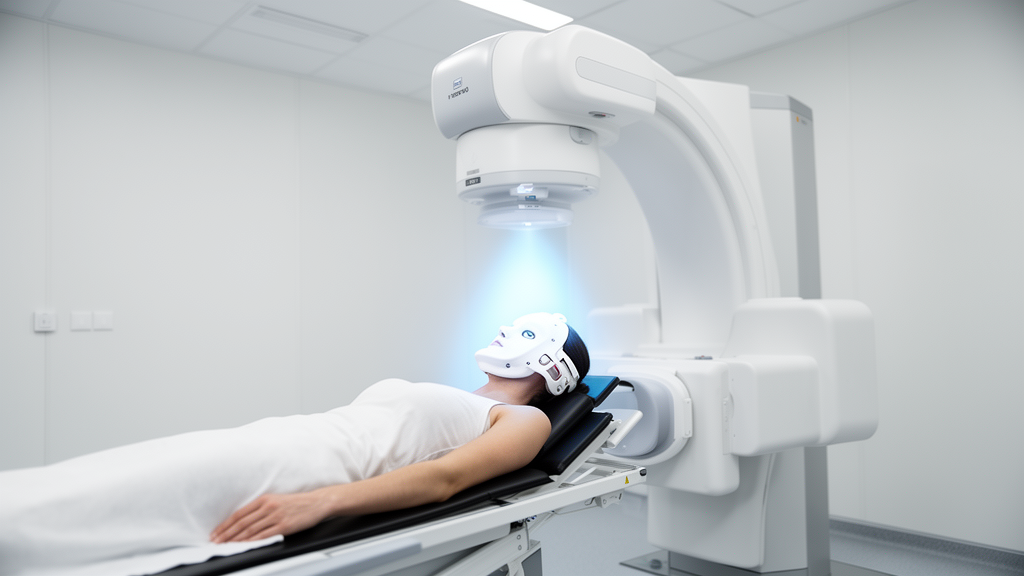
One of the most persistent dilemmas in neuro-oncology has just received a decisive answer. An international phase 3 randomised controlled trial, known as ROAM/EORTC-1308, has demonstrated for the first time that radiotherapy administered after complete surgical removal of an atypical meningioma significantly reduces the likelihood that the tumour will return. The findings, published in The Lancet, come from a collaboration spanning 58 hospitals in eleven countries and were driven in part by the Medical University of Vienna, whose Division of Oncology at the Department of Medicine I played a leading role in the study under the direction of Matthias Preusser. For patients and clinicians who have long faced uncertainty about the value of postoperative radiotherapy in this disease, the trial delivers the strongest evidence yet that the treatment can meaningfully change outcomes.
Meningiomas are tumours that arise from the meninges, the protective membranes that envelop the brain and spinal cord. They account for roughly one-third of all primary brain tumours in adults, meaning tumours that originate in the central nervous system rather than arriving as metastases from cancers elsewhere in the body. While many meningiomas are benign and slow-growing, a subset classified as atypical, corresponding to World Health Organization grade 2, behaves far more aggressively. Even when surgeons achieve what appears to be a complete resection, removing all visible tumour tissue, atypical meningiomas carry a high risk of recurrence. This biological stubbornness has made them one of the more challenging entities in neurosurgical and oncological practice, because a tumour that regrows near critical brain structures can cause serious neurological harm and may require repeat surgery with diminishing options each time.
The clinical question that the ROAM/EORTC-1308 trial set out to resolve was deceptively simple: after a surgeon has completely removed an atypical meningioma, does adding a course of radiotherapy actually help? Before this study, no randomised trial had established whether patients benefit from adjuvant radiotherapy in this setting. Practice varied widely across centres and countries. Some clinicians recommended immediate postoperative irradiation to eliminate any microscopic tumour cells that might remain after surgery, while others preferred a strategy of watchful waiting, monitoring patients with regular imaging scans and reserving radiotherapy for the moment a recurrence appeared. Each approach carried trade-offs. Immediate radiotherapy exposes patients to potential side effects and long-term consequences even if their tumour would never have returned, whereas observation risks allowing a recurrence to establish itself before treatment begins.
To settle the question, the investigators enrolled 157 patients who had undergone complete surgical resection of an atypical meningioma. Participants were randomly assigned to one of two groups in a design that represents the gold standard of clinical evidence. Seventy-eight patients received a course of radiotherapy delivered over 30 sessions, while 79 patients entered an observation arm in which they were monitored regularly through imaging. The trial was conducted as an international, multicentre, open-label, phase 3 study across hospitals in Austria, Australia, Belgium, Ireland, France, Germany, New Zealand, Italy, Spain, Switzerland and the United Kingdom. The breadth of participation across such a geographically and clinically diverse network strengthens the generalisability of the results, suggesting that the findings are not an artefact of any single health system or treatment protocol.
The results were striking. After a median follow-up period of approximately five years, 11 of the 78 patients in the radiotherapy group, or 14 per cent, experienced a meningioma recurrence. In the observation group, the figure was 24 of 79 patients, or 30 per cent. In other words, patients who received postoperative radiotherapy were roughly half as likely to see their tumour return compared with those who were simply monitored. The difference was also reflected in disease-free survival, a measure of the proportion of patients remaining free of tumour regrowth over time. At the five-year mark, 79.9 per cent of patients in the radiotherapy group were recurrence-free, compared with 64.3 per cent of those under imaging surveillance. That gap of more than fifteen percentage points represents a substantial clinical benefit in a disease where every recurrence carries the potential for further surgery, additional treatment and neurological risk.
From a methodological standpoint, the trial’s randomised design is what elevates these findings above the observational evidence that had accumulated previously. Earlier studies comparing patients who received radiotherapy with those who did not were vulnerable to selection bias, because clinicians may have tended to offer irradiation to patients perceived as higher risk, muddying any apparent benefit. By randomly allocating patients to treatment or observation, the ROAM/EORTC-1308 investigators eliminated that confounding, allowing the difference in recurrence rates to be attributed with confidence to the radiotherapy itself. This is why the study authors describe their results as the best available evidence for the use of adjuvant radiotherapy in patients who have undergone complete resection of an atypical meningioma, and why the findings are expected to be incorporated into national and international treatment guidelines.
Matthias Preusser of the Medical University of Vienna, who led the study together with Michael Jenkinson and Carrol Gamble of the Liverpool Clinical Trials Centre in the United Kingdom and Damien C. Weber of the Paul Scherrer Institute and Inselspital, University Hospital of Bern in Switzerland, emphasised the significance of the result. According to the study team, the ROAM/EORTC-1308 trial has demonstrated a significant reduction in the recurrence rate and thereby provides the strongest foundation to date for recommending adjuvant radiotherapy after complete surgical resection of an atypical meningioma. The translation of trial evidence into clinical guidelines is a critical step, because guidelines shape what insurers reimburse, what training programmes teach and, ultimately, what thousands of patients worldwide are offered in the crucial weeks following their surgery.
At the same time, the study authors are careful to frame the decision as one to be made jointly with each patient. Radiotherapy is not without cost. A course of 30 sessions requires weeks of daily hospital visits, and radiation to the brain can carry side effects and potential long-term consequences that vary from patient to patient depending on tumour location, dose distribution and individual sensitivity. Reassuringly, serious radiation-related events occurred rarely during the study, suggesting that the treatment was generally well tolerated in this population. Nevertheless, the authors stress that the balance between the demonstrated reduction in recurrence risk and the possibility of treatment-related harm must be weighed individually, taking into account the patient’s age, overall health, personal preferences and the specific characteristics of their tumour. Shared decision-making, in which patients are fully informed of both the benefits and the burdens, remains central to applying these findings responsibly.
The broader significance of the trial extends beyond the immediate clinical question. Atypical meningiomas sit in an awkward middle ground in brain tumour classification: they are more aggressive than the common benign grade 1 meningiomas but less malignant than the rare anaplastic grade 3 tumours. Treatment standards for this intermediate category have lagged behind those for many other tumour types, partly because the disease is uncommon enough that large randomised trials have been difficult to mount. The success of ROAM/EORTC-1308 in recruiting 157 patients across 58 hospitals in eleven countries demonstrates that international collaboration can overcome the challenges of studying rare tumours, and it provides a template for future cooperative studies in neuro-oncology.
Important questions remain open. The median follow-up of around five years captures the period during which most recurrences of atypical meningioma tend to emerge, but some tumours can recur later. Further studies will now seek to clarify, among other things, whether the benefit of radiotherapy persists beyond the five-year horizon, and whether longer observation reveals any late effects that could alter the risk-benefit calculus. Researchers will also continue to explore which patients benefit most, since not every individual in the observation group experienced a recurrence, and identifying biological markers that predict recurrence could eventually allow treatment to be targeted to those at highest risk. For now, however, the message from this landmark trial is clear and consequential: for patients whose atypical meningioma has been completely removed, adjuvant radiotherapy offers a proven, substantial reduction in the risk that the tumour will come back, and that evidence is poised to reshape standard care around the world.
Subject of Research: Adjuvant radiotherapy following complete resection of WHO grade 2 atypical meningioma
Article Title: Radiotherapy significantly reduces the risk of recurrence in atypical meningiomas
Article References: Radiotherapy significantly reduces the risk of recurrence in atypical meningiomas. (n.d.). Original publication
Image Credits: AI Generated
DOI: Not provided
Keywords: atypical meningioma, radiotherapy, ROAM/EORTC-1308, The Lancet, brain tumours, randomised controlled trial, tumour recurrence, adjuvant therapy, neuro-oncology, Medical University of Vienna, disease-free survival, clinical guidelines
Cite Scienmag News
Nathaniel Bowman. (October 18, 2026). Adjuvant Radiotherapy Cuts Recurrence Risk in Atypical Meningioma Patients. Scienmag. https://scienmag.com/adjuvant-radiotherapy-cuts-recurrence-risk-in-atypical-meningioma-patients/
Nathaniel Bowman. "Adjuvant Radiotherapy Cuts Recurrence Risk in Atypical Meningioma Patients." Scienmag, 18 October 2026, https://scienmag.com/adjuvant-radiotherapy-cuts-recurrence-risk-in-atypical-meningioma-patients/. Accessed 18 October 2026.
Nathaniel Bowman. "Adjuvant Radiotherapy Cuts Recurrence Risk in Atypical Meningioma Patients." Scienmag. October 18, 2026. https://scienmag.com/adjuvant-radiotherapy-cuts-recurrence-risk-in-atypical-meningioma-patients/


