


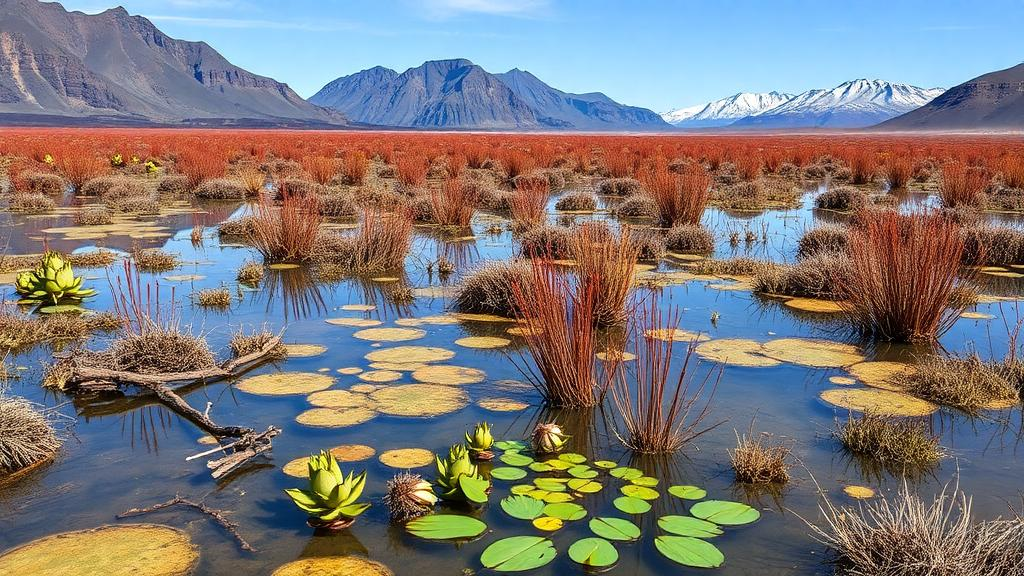
High above 4,000 meters in the Peruvian Andes, where the air is thin and nights dip below freezing, lie patchy wetlands known as bofedales. These water-saturated ecosystems, scattered like green islands across vast dry puna grasslands, have long been treated by scientists and policymakers as a single, broadly defined habitat. A new three-year study along a 68-kilometer east-to-west transect in southern Peru now shows that these wetlands are far more heterogeneous than the four broad plant formation types previously recognized at the national level, a finding with direct consequences for how these carbon-rich, water-regulating ecosystems are managed, restored, and conserved.
The research, published in the journal Vegetation Classification and Survey, was carried out within the Biodiversity Monitoring and Assessment Program, a collaboration between the Smithsonian Institution and the PERU LNG company. The study area spans the zone of influence of a natural gas pipeline crossing the departments of Ayacucho and Huancavelica, encompassing 31 bofedales between roughly 4,265 and 4,855 meters above sea level. Precipitation in the region is strongly seasonal, with 60 to 90 percent of total rainfall falling between December and March, and annual totals ranging from 480 to 817 millimeters at most sites, with one site reaching 1,232 millimeters. Mean air temperatures range from 9.7 to 19.7 degrees Celsius, and the wetlands overlap with rural Andean communities where alpacas, llamas, and introduced sheep are traditionally herded.
To capture the structure of these plant communities, the team established 127 permanent plots, each one square meter, in homogeneous patches of dominant vegetation and surveyed them annually during the austral dry season from 2017 to 2019, for a total of 378 plot assessments. Plant cover was measured with the point intercept method using a grid quadrat frame with 100 crossing points per plot, allowing precise estimates of cover for every species as well as ground cover categories such as moss, bare soil, dead vegetation, rock, water, and animal dung. The researchers also deployed soil moisture sensors configured for organic soils in 71 plots and installed water table monitoring wells at 11 sites, inserting PVC tubes into holes made with a peat sampler and measuring water levels every one to two months between July 2017 and December 2019.
The analytical toolkit was deliberately multivariate. A one-way Analysis of Similarities using the Bray-Curtis index tested whether plant communities differed in composition and abundance, while Kruskal-Wallis non-parametric tests identified significant differences in species richness, Pielou’s evenness, vegetation cover, cover of moisture indicator species, soil moisture, and water table depth. Non-metric multidimensional scaling on Hellinger-transformed cover values visualized compositional variability across years, and a Principal Component Analysis explored how communities distributed themselves along five structural descriptors. Sample-based rarefaction curves based on Hill numbers complemented the characterization of richness patterns.
The results are striking. Based on dominance and compositional patterns, the team identified 13 plant communities, with mean species richness per square meter ranging from 3.5 to 11.7. Seven of these communities were statistically distinct and remained consistent in their structural and compositional characteristics throughout the three-year study: communities dominated by Distichia muscoides, Rockhausenia pygmaea, Plantago rigida, Plantago tubulosa, Lachemilla diplophylla, Aciachne pulvinata, and Juncus stipulatus. The remaining six were rare, each recorded in a single plot per year, and lacked statistical support, meaning additional surveys are needed to confirm whether they represent independent communities or variants of their neighbors.
The Distichia muscoides community emerged as the undisputed centerpiece of the landscape. This hard cushion-forming community, usually associated with pools and very high soil moisture, was found in 90 percent of the sites, 55 percent of the plots, and along nearly the entire elevational range studied, from 4,292 to 4,850 meters. Its mean water table was the shallowest recorded, and its vegetation cover reached 95 percent. Yet the study makes clear that Distichia muscoides is not the only dominant species in bofedales, as is commonly assumed. Rockhausenia pygmaea, a peat-forming carpet species distributed from Venezuela to Argentina, anchored the second most common community, present in 42 percent of sites, and the data suggest it thrives in drier conditions than Distichia muscoides. Plantago rigida, a hard cushion species associated with drier wetland edges, formed a community with the lowest mean richness and the lowest evenness value of all thirteen communities, while Plantago tubulosa communities, found in 23 percent of sites, recorded the highest soil moisture values in the study.
Three species proved to be the ecological backbone of the region’s bofedales: Distichia muscoides, Plantago tubulosa, and Rockhausenia pygmaea occurred in 30 of the 31 sites. Because these species are cushion or carpet forming, average plant cover was high in most communities where they occurred, generally between 89 and 98 percent. The lowest cover values were recorded in the Aciachne pulvinata community, which had the highest percentage of dead cushions at 11 percent, and in a mixed community of sedges and cushions, which had the highest bare soil cover at 33 percent. Notably, Aciachne pulvinata, previously reported only as a companion species and associated with overgrazing, was dominant in a single site with low plant cover and a deeply recorded water table, suggesting its coverage increases where water levels decline.
The hydrological measurements, the first of their kind reported per plant community for bofedales, reveal a strongly seasonal water regime. The deepest water table records occurred in September and October, reaching depths greater than 90 centimeters in the dry season in at least one year in four of the five monitored communities, while the shallowest records came in February and December. According to the recent national classification by Peru’s National Institute for Research on Glaciers and Mountain Ecosystems, the monitored wetlands are considered seasonal because the water table sits deeper than 20 centimeters for several months of the year. The authors suggest that rainfall seasonality is probably not the only water source, since hillslope groundwater flowing from lateral moraines, talus, colluvium, or bedrock aquifers can also sustain these wetlands, especially in a landscape where streams, lakes, and glaciers are uncommon. A La Niña event between November 2017 and March 2018, usually associated with droughts in southern Peru, provided a natural test of community resilience, and the results showed stable values over time, with no permanent shifts in dominance or cover within the study sites.
In total, the team recorded 68 species belonging to 15 families and 45 genera, with Poaceae the most species-rich family at 24 species, followed by Asteraceae with 10. Species richness per square meter ranged from 1 to 15, but 75 percent of plots held only 1 to 8 species, and communities shared most of their species, between 85 and 100 percent, meaning differentiation rests more on abundance and dominance patterns than on wholesale floristic turnover. The communities with the highest mean richness were a mixed herbaceous community and the Lobelia oligophylla community, while the Plantago rigida community had the lowest. Pielou’s evenness ranged from 0.38 to 0.78 among the well-defined communities, and the Principal Component Analysis showed that the cover of moisture indicator species, overall plant cover, and bare soil percentage define the main axis of variability, clearly separating the drier communities from the wetter ones.
The broader implication is that bofedal heterogeneity operates at local site levels, with 84 percent of the studied wetlands containing two to three distinct plant communities, but also at landscape and regional scales. Recognizing this vegetational heterogeneity, the authors argue, is essential for setting realistic and site-specific goals for conservation, ecosystem management, and restoration, and for distinguishing the contributions of ecosystem services such as carbon storage, water regulation, and grazing. The study identifies three key knowledge gaps for Peru: the need to characterize floristic variation across latitudinal and longitudinal gradients through a comprehensive national analysis of plot-based studies, the need to improve the accuracy of remote-sensor mapping, since the official map misrepresents the size or location of several wetlands and omits others entirely, and the most complex challenge of understanding the factors that define the structure and functioning of these unique ecosystems in a context of rapid land-use and climatic change. As the high Andes warm and water regimes shift, these findings offer the first steps toward biological baselines and monitoring indicators that could determine whether these hidden wetland worlds endure.
Subject of Research: Plant communities of high-Andean bofedal wetlands across a trans-Andean transect in southern Peru
Article Title: Plant communities of high-Andean bofedal wetlands across a trans-Andean transect in southern Peru
Article References: Maldonado-Fonkén, M., Chuquillanqui, H., Vildoso, B., & Linares-Palomino, R. (2024). Plant communities of high-Andean bofedal wetlands across a trans-Andean transect in southern Peru. Vegetation Classification and Survey, 5, 203-218. https://doi.org/10.3897/vcs.115726
Image Credits: AI Generated
DOI: 10.3897/VCS.115726
Keywords: Plant, communities, high-Andean, bofedal, wetlands, across, trans-Andean, transect, southern, Peru, scientific research
Cite Scienmag News
Margaret Porter. (October 18, 2026). Hidden wetland worlds of the high Andes reveal surprising plant diversity. Scienmag. https://scienmag.com/hidden-wetland-worlds-of-the-high-andes-reveal-surprising-plant-diversity/
Margaret Porter. "Hidden wetland worlds of the high Andes reveal surprising plant diversity." Scienmag, 18 October 2026, https://scienmag.com/hidden-wetland-worlds-of-the-high-andes-reveal-surprising-plant-diversity/. Accessed 18 October 2026.
Margaret Porter. "Hidden wetland worlds of the high Andes reveal surprising plant diversity." Scienmag. October 18, 2026. https://scienmag.com/hidden-wetland-worlds-of-the-high-andes-reveal-surprising-plant-diversity/


