


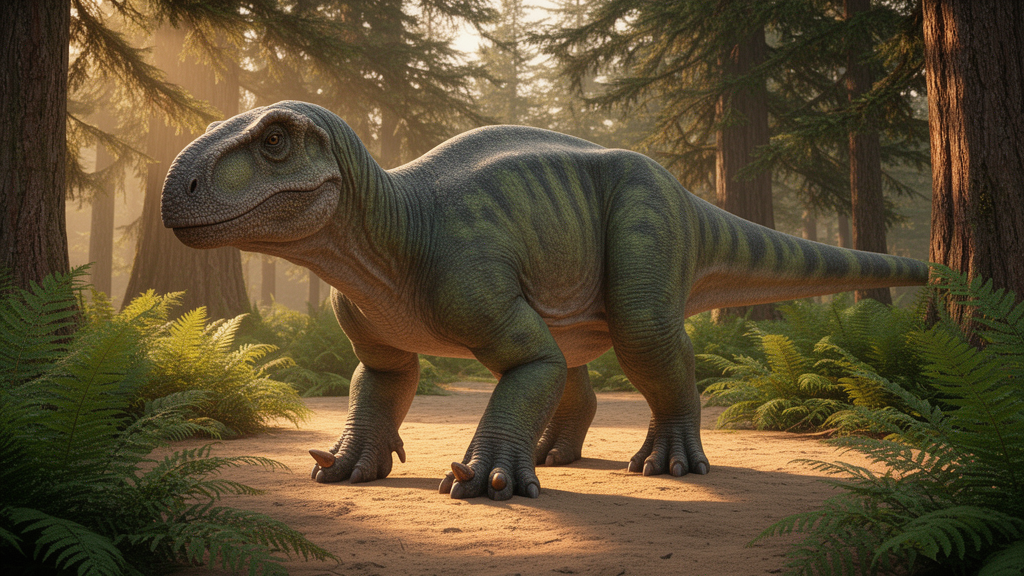
For nearly a century and a half, Iguanodon has stood upright in museum halls around the world, propped on its tail like a gigantic kangaroo, an image cemented after dozens of nearly complete skeletons were pulled from the coal mines of Bernissart, Belgium in the late nineteenth century. That iconic bipedal pose, it turns out, may be fundamentally wrong. A new study published in Fossil Record has applied a rigorous statistical framework to the limb bones of three large plant-eating dinosaurs—Iguanodon, Ouranosaurus and the bizarrely heavy Lurdusaurus—and concluded that all three were most likely obligate quadrupeds, animals that walked habitually on all fours rather than occasionally rising onto their hindlimbs. The finding overturns one of the most persistent assumptions in dinosaur palaeontology: that the early members of the ornithopod lineage retained a capacity for bipedalism that their descendants, the duck-billed hadrosaurs, later lost.
The research, led by Jordan Gônet of the Muséum national d’Histoire naturelle in Paris together with Ronan Allain and Alexandra Houssaye, tackles a debate that has raged since Iguanodon became one of the very first dinosaurs ever named in 1825. Early reconstructions from the mid-nineteenth century showed the animal as a four-legged creature, but the Belgian palaeontologist Louis Dollo reimagined it as a biped after the Bernissart discovery, a posture still presented to the public in many museums today. Almost a century later, in 1980, David Norman re-examined the same bones and argued that Iguanodon was primarily quadrupedal but could still stand on its hindlimbs to run or defend itself. That image of a so-called facultative biped—an animal switching between two and four legs—was gradually extended to all large ornithopods, becoming the textbook consensus.
To test whether these dinosaurs were truly capable of such locomotor versatility, the team turned to osteological correlates: measurable features of the skeleton that statistically track with either bipedal or quadrupedal locomotion across dinosaur phylogeny. The approach builds on a landmark 2014 analysis by Susannah Maidment and Paul Barrett, but expands the toolkit to eleven characters, adding three novel correlates including the distal placement of the fourth trochanter on the femur and the eccentricity of the humeral and femoral shafts. The researchers scored each character in the three ankylopollexians and compared the results to a reference dataset of 44 dinosaurs with unambiguous locomotor habits—12 saurischians, split between bipedal theropods and graviportal sauropods, and 32 ornithischians spanning armoured thyreophorans, horned ceratopsids and ornithopods.
The continuous characters alone tell a striking story. In bipedal dinosaurs, the forelimb rarely exceeds half the length of the hindlimb, with ratios ranging from 0.23 to 0.50, whereas quadrupeds show ratios from 0.56 to 1.04. Iguanodon, Ouranosaurus and Lurdusaurus all fall squarely within the quadrupedal range, with forelimb-to-hindlimb ratios of 0.62, 0.60 and 0.58 respectively—values closely matching those of hadrosaurs such as Lambeosaurus and Edmontosaurus. Similarly, the relative length of the metatarsus, the foot segment that shortens as animals shift weight-bearing duties to the forelimbs, places all three taxa among the quadrupeds. Lurdusaurus, remarkably, shows the lowest metatarsal ratio in the entire sample at 0.05, even shorter than the largest duck-billed dinosaurs and markedly more reduced than in armoured stegosaurs or long-necked sauropods.
The discrete characters reinforce the pattern. All three ankylopollexians possess a well-developed anterolateral process on the ulna, a bony flange that appears in every quadrupedal dinosaur in the sample and in no biped, and hoof-shaped manual unguals—hoof-like terminal finger bones that signal the forelimbs bore weight at least occasionally. Their femora are straight in lateral view rather than curved, their tibiae are shorter than their femora, and their fourth trochanters, the muscle attachment scars that anchor the caudofemoralis retractor, are both crest-like and positioned at mid-shaft on the femur, a combination found in quadrupedal ornithischians but never in bipeds. Taken together, Iguanodon and Ouranosaurus score as quadrupeds for nine of the eleven correlates, while Lurdusaurus scores as a quadruped for all eleven.
The eccentricity of the limb shafts—the ratio of mediolateral to anteroposterior width at mid-diaphysis—proved more nuanced. Statistical tests confirmed that quadrupeds show significantly greater eccentricity than bipeds in both the femur and the humerus, but several quadrupedal ornithischians, including armoured nodosaurs, ceratopsids and most hadrosaurids, overlap with bipeds. Iguanodon and Ouranosaurus show intermediate femoral eccentricity values of 1.10 and 1.30, falling in the zone between unambiguous bipeds and quadrupeds, and their humeral eccentricity similarly straddles the boundary. The authors tentatively attribute this to a more upright limb posture than that of the flexed-limbed hadrosaurs, whose low eccentricity values likely reflect a shift of peak stresses from a mediolateral to an anteroposterior orientation. Importantly, the study establishes clear empirical thresholds: no biped in the sample exceeds a femoral eccentricity of 1.19 or, aside from one taphonomically deformed specimen, a humeral eccentricity of 1.26.
Lurdusaurus, by contrast, leaves no room for ambiguity. Its femoral eccentricity of 1.88 rivals that of graviportal sauropods such as Tazoudasaurus, and its humeral eccentricity of 1.75 is the fourth highest in the entire dataset. Combined with its exceptionally short metatarsus and a pelvis broader than that of any other ornithopod, these features point to a wide-gauge stance with the feet positioned far from the body’s midline, comparable to that of titanosaur sauropods. The team concludes that Lurdusaurus was not merely a quadruped but a graviportal one—the first known among ornithopods—an animal whose skeleton was adapted to support enormous body mass through columnar, load-bearing limbs. Its extreme proportions have previously led palaeontologists to compare it to giant ground sloths or even to depict it as semi-aquatic, but the new analysis grounds it firmly as a terrestrial, slow-moving giant.
The evolutionary implications are considerable. If Iguanodon from the Barremian and Ouranosaurus and Lurdusaurus from the Aptian were already obligate quadrupeds, then quadrupedalism in ornithopods arose at least 30 million years before it became established in many hadrosaurs. The study also acknowledges a sensitivity in the analysis: when hadrosaurs are coded as facultative bipeds rather than obligate quadrupeds, the number of correlates supporting quadrupedalism in Iguanodon and Ouranosaurus drops from nine to seven, producing a more balanced signal that would support a predominantly quadrupedal animal retaining some capacity for bipedalism. The authors stress that this ambiguity hinges on how the reference taxa themselves are defined, underscoring the need for further integrative studies of locomotion within the clade.
Ontogeny, too, was considered. Because forelimb allometry has been proposed as a trigger for shifts from bipedalism to quadrupedalism during growth in various dinosaurs, the team restricted its analysis to adult specimens of Iguanodon, Ouranosaurus and Lurdusaurus, interpreted as skeletally mature based on size and fusion. Subsequent work on Iguanodon, Maiasaura and Edmontosaurus found no significant change in forelimb-to-hindlimb proportions between subadults and adults, suggesting the limb proportions observed in the adult specimens are fully consistent with habitual quadrupedalism rather than a growth-related artefact.
The study positions osteological correlates as powerful tools for reconstructing the transition to quadrupedalism in ornithopods, and the authors argue that applying them more broadly to taxa whose locomotion remains debated would allow a far more comprehensive reconstruction of postural evolution across the clade. For the museums still displaying Iguanodon on two legs, the message is clear: the kangaroo pose may finally be due for retirement, and one of palaeontology’s most familiar icons may need to be reimagined once again—this time on all fours.
Subject of Research: Locomotor reassessment of Iguanodon, Ouranosaurus and Lurdusaurus (Dinosauria, Ornithopoda) using osteological correlates
Article Title: Locomotor reassessment of Iguanodon , Ouranosaurus and Lurdusaurus ( Dinosauria , Ornithopoda ) using osteological correlates
Article References: Gônet, J., Allain, R., & Houssaye, A. (2026). Locomotor reassessment of Iguanodon, Ouranosaurus and Lurdusaurus (Dinosauria, Ornithopoda) using osteological correlates. Fossil Record, 29(1), 71-86. https://doi.org/10.3897/fr.29.173614
Image Credits: AI Generated
DOI: 10.3897/fr.29.173614
Keywords: Locomotor, reassessment, Iguanodon, Ouranosaurus, Lurdusaurus, Dinosauria, Ornithopoda, osteological, correlates, scientific research
Cite Scienmag News
Gavin Prescott. (October 18, 2026). Iguanodon may have walked on all fours, rewriting dinosaur locomotion history. Scienmag. https://scienmag.com/iguanodon-may-have-walked-on-all-fours-rewriting-dinosaur-locomotion-history/
Gavin Prescott. "Iguanodon may have walked on all fours, rewriting dinosaur locomotion history." Scienmag, 18 October 2026, https://scienmag.com/iguanodon-may-have-walked-on-all-fours-rewriting-dinosaur-locomotion-history/. Accessed 18 October 2026.
Gavin Prescott. "Iguanodon may have walked on all fours, rewriting dinosaur locomotion history." Scienmag. October 18, 2026. https://scienmag.com/iguanodon-may-have-walked-on-all-fours-rewriting-dinosaur-locomotion-history/


