


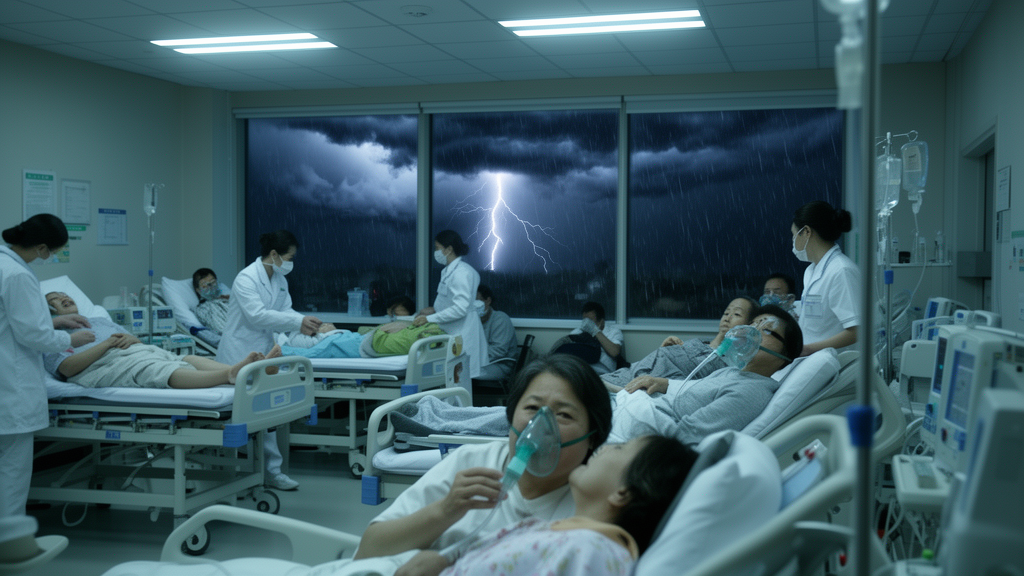
On the night of September 8, 2025, a thunderstorm swept across Shanxi Province in northern China, and within hours the emergency department of the Shanxi Provincial Integrated Traditional Chinese Medicine and Western Medicine Hospital in Taiyuan faced an unusual medical surge. Between 8:00 p.m. and 3:00 a.m. the following morning, 39 patients arrived with acute asthma exacerbations, nearly all of them within four hours of a storm accompanied by high winds. The episode, now documented in a retrospective observational study published in Frontiers in Medicine, offers one of the clearest clinical portraits yet of epidemic thunderstorm asthma in northern China, a phenomenon long associated with grass pollen in Australia and Europe but increasingly recognized as an Artemisia pollen-driven event in East Asia.
Thunderstorm asthma lacks a universally standardized definition, but it is widely understood as a sudden cluster of asthma attacks or bronchospasm symptoms, including coughing and dyspnea, that follows a thunderstorm and results from the interaction between storm conditions and airborne allergens. The first documented outbreak occurred in Birmingham, United Kingdom, in 1983, affecting 106 individuals. Since then, incidents have been reported across Australia, Europe, the Middle East, and China. The most severe event took place in Melbourne, Australia, on November 21, 2016, when more than 1,000 people flooded into emergency rooms and roughly 500 required hospitalization. Although individual outbreaks are rare and often overlooked, a large-scale event can overwhelm healthcare systems with unpredictable consequences and impose a substantial socioeconomic burden, making thunderstorm asthma a genuine public health threat rather than a meteorological curiosity.
The Shanxi study enrolled all 39 patients who presented on the night of the outbreak, drawing clinical data from electronic medical records and subsequent telephone follow-up, and analyzed the findings with descriptive statistics. The demographic picture was strikingly consistent with international precedents. Men accounted for a slightly higher proportion of cases than women, with 20 male and 19 female patients, a pattern echoed in previous reports, one of which found that males made up as much as 58 percent of cases. The mean age of the cohort was 31.62 plus or minus 12.86 years, a figure that the authors note was remarkably close to the mean age of patients during the 2016 Melbourne event. The researchers suggest that this age concentration may reflect a relatively active immune system in young adults, rendering them more susceptible to the allergic airway inflammation that thunderstorm asthma triggers.
Perhaps the most consequential clinical finding concerned allergy history. A review of the patients’ medical histories revealed that 94.87 percent, or 37 of the 39 individuals, had allergic rhinitis, a figure that closely matches earlier research by Nur-Shirin Harun and colleagues, who found that over 90 percent of thunderstorm asthma patients had the condition. This convergence underscores a central risk factor: people with pollen-sensitized airways, even those who have never experienced a full asthma attack, are the primary targets of these epidemics. Laboratory data, though limited, reinforced the allergic picture. Blood tests were performed on only 8 patients, and 5 of them, or 62.5 percent, showed elevated peripheral blood eosinophil counts above 0.52 times 10 to the ninth per liter, a hallmark of type 2 allergic inflammation. The authors acknowledge that the small number of tested patients represents a gap, and they call for future research to identify specific diagnostic biomarkers that could aid clinicians in diagnosis and prognostic evaluation.
The mechanism behind thunderstorm asthma is a story of atmospheric physics colliding with immunology. During a thunderstorm, strong winds carry allergenic pollen grains into the humid cloud layer, where they absorb moisture and rupture, releasing allergen-carrying particles ranging from 0.03 to 4 micrometers in size. These micro-particles are then driven back to ground level by downdrafts, creating a high concentration of respirable allergens exactly where sensitized people are breathing. Studies have confirmed a significant increase in these fragmented pollen particles after thunderstorms. The high concentration of positive ions in the air during storms may also interact with negatively charged pollen grains, potentially facilitating their rupture and further increasing airborne allergen loads. In northern China, early autumn is the peak season for Artemisia pollen, which interacts with thunderstorm conditions to form the respirable particles that set off the attacks. A separate outbreak reported in Hohhot on September 1, consistent with the timing of the Shanxi event, reinforces the conclusion that these epidemics in northern China cluster in early autumn and center on Artemisia species.
Once the microscopic particles are inhaled, the immune cascade unfolds with textbook precision. Particles smaller than 10 micrometers can reach the bronchi, where dendritic cells act as antigen-presenting cells, phagocytosing the pollen proteins and processing them into fragments recognizable by T cells. These antigens are presented to CD4-positive T cells via MHC Class II molecules, activating them to differentiate into T-helper 2 cells. The activated Th2 cells release cytokines including IL-4, IL-5, and IL-13. IL-4 stimulates goblet cells in the airways to produce excess mucus and promotes B cell differentiation and the production of IgE antibodies, which bind to receptors on mast cells, eosinophils, and airway smooth muscle cells. Upon re-exposure, the allergen cross-links the bound IgE, triggering these cells to release mediators that cause airway smooth muscle contraction and further mucus secretion, culminating in the irritating cough and dyspnea that brought the Shanxi patients to the hospital. The initial exposure to Artemisia pollen particles may sensitize the immune system and form a memory response, so the storm essentially delivers a massive re-exposure dose to a population already primed for reaction.
On the treatment side, the emergency department activated its contingency plan, recalling off-duty first-line medical staff to manage the rapid surge of patients presenting with chest tightness, cough, wheezing, and dyspnea. Life-threatening cases would have required immediate resuscitation, but fortunately none of the 39 patients developed life-threatening conditions. The pharmacological backbone of care consisted of nebulized medications: budesonide inhalation suspension, an inhaled corticosteroid that suppresses the activation of inflammatory cells and the release of allergic mediators, thereby reducing airway hyperresponsiveness; terbutaline sulfate inhalation solution, a short-acting beta-2 adrenergic agonist that selectively stimulates beta-2 adrenoceptors on airway smooth muscle, inducing bronchial relaxation and rapidly relieving acute bronchospasm; and ipratropium bromide inhalation solution, a short-acting muscarinic antagonist that competitively blocks airway muscarinic receptors, attenuating vagally mediated bronchoconstriction and reducing mucus hypersecretion.
The medication distribution revealed the practical logic of the response. The most common regimen, combining budesonide inhalation suspension with terbutaline sulfate inhalation solution, was administered to 23 patients, or 58.97 percent of the cohort, while 10 patients, or 25.64 percent, received budesonide combined with ipratropium bromide. Four patients received budesonide alone and four received formoterol. For more severe cases, methylprednisolone sodium succinate for injection was used in 2 patients. Notably, 32 patients, or 82.05 percent, received oral montelukast sodium therapy, a leukotriene receptor antagonist. The authors point out that pharmacological management of thunderstorm asthma still shows considerable heterogeneity in clinical practice, and that exploration and consensus regarding standardized preventive medication strategies remain inadequate and require further supplementation. Combined application of inhaled medications, they note, may help alleviate acute symptoms and reduce the persistence of acute exacerbations.
One month after the event, telephone follow-up found that the patients reported no recurrence-related discomfort after discharge and had gained an understanding of the disease and its preventive measures. The authors were strongly advising patients to seek immediate medical help if breathing difficulties persisted. Beyond individual care, the study draws a lesson from Australia: after the 2016 Melbourne epidemic, the country established an environmental monitoring system with a multi-level public alert system disseminated via media, allowing sensitized individuals to take preventive measures such as staying indoors and using bronchodilators while alerting healthcare systems to prepare. The Shanxi team recommends that health authorities develop integrated early warning systems combining environmental monitoring and public communication, and suggests that monitoring instruments targeting allergen concentrations could be engineered to forecast ambient allergen loads and generate early alerts, enabling patients to implement appropriate preventive strategies.
The broader message from Taiyuan is that thunderstorm asthma is no longer a phenomenon confined to Melbourne’s grass pollen springs. Northern China’s early autumn Artemisia season, coinciding with late-summer thunderstorms, creates a recurring window of risk that health systems must now anticipate. The authors argue that hospitals must develop specific thunderstorm asthma emergency response plans, with adequate material reserves as the foundation, supported by robust training on standardized management protocols and workflows. They also call for enhanced health education and public science promotion during the early autumn season to prevent future outbreaks. As climate change alters pollen seasons and storm frequency, as Beggs argued in JAMA in 2024, the intersection of violent weather and airborne allergens may become less rare, making the Shanxi episode both a warning and a template for emergency departments across the region.
Subject of Research: Epidemic thunderstorm asthma outbreak linked to Artemisia pollen in Shanxi, China
Article Title: Episode of epidemic thunderstorm asthma in Shanxi China September 2025: epidemiological characteristics, mechanisms, and emergency management strategies
Article References: Shen, T., Guo, G., Li, H., Wang, J., Wang, H., & Mi, J. (2026). Episode of epidemic thunderstorm asthma in Shanxi China September 2025: epidemiological characteristics, mechanisms, and emergency management strategies. Frontiers in Medicine, 13, Article 1953484. https://doi.org/10.3389/fmed.2026.1953484
Image Credits: AI Generated
DOI: 10.3389/fmed.2026.1953484
Keywords: thunderstorm asthma, Artemisia pollen, allergic rhinitis, IgE-mediated inflammation, eosinophils, emergency department, budesonide, terbutaline, ipratropium bromide, montelukast, early warning systems, northern China
Cite Scienmag News
Ophelia Keating. (October 18, 2026). Thunderstorm Asthma Strikes Shanxi: How a September Storm Turned Pollen Into a Respiratory Emergency. Scienmag. https://scienmag.com/thunderstorm-asthma-strikes-shanxi-how-a-september-storm-turned-pollen-into-a-respiratory-emergency/
Ophelia Keating. "Thunderstorm Asthma Strikes Shanxi: How a September Storm Turned Pollen Into a Respiratory Emergency." Scienmag, 18 October 2026, https://scienmag.com/thunderstorm-asthma-strikes-shanxi-how-a-september-storm-turned-pollen-into-a-respiratory-emergency/. Accessed 18 October 2026.
Ophelia Keating. "Thunderstorm Asthma Strikes Shanxi: How a September Storm Turned Pollen Into a Respiratory Emergency." Scienmag. October 18, 2026. https://scienmag.com/thunderstorm-asthma-strikes-shanxi-how-a-september-storm-turned-pollen-into-a-respiratory-emergency/


