


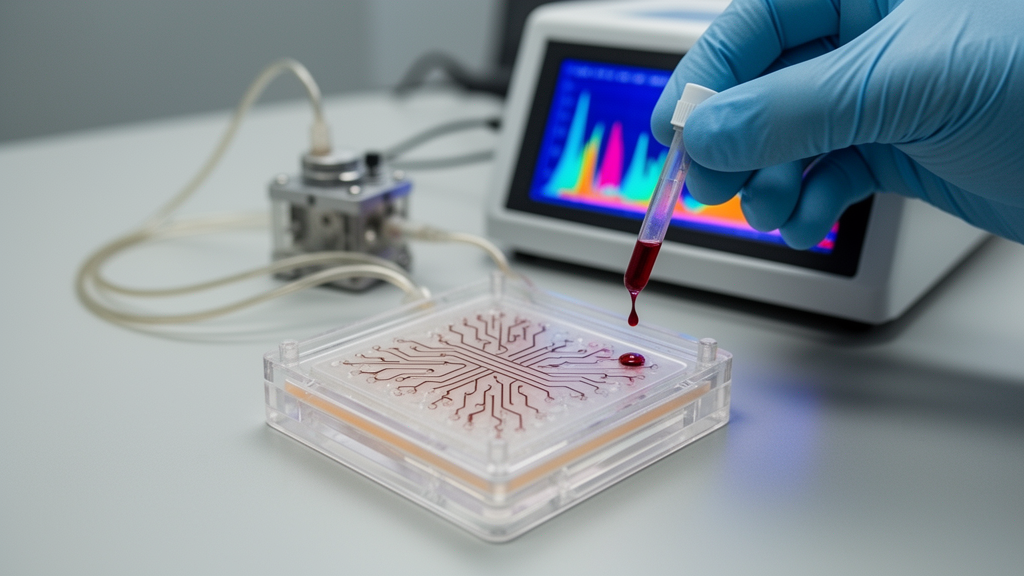
For decades, point-of-care diagnostics have promised laboratory-quality answers at the bedside, in the clinic, and in the field, yet most devices in widespread use remain stubbornly one-dimensional. A rapid antigen test tells you whether one viral protein is present. A molecular assay confirms or excludes one genetic target. What decentralized medicine actually needs, researchers argue, is the ability to read multiple biological signals at once, from several samples, across different molecular classes, without sending anything to a central laboratory. A team led by Tao Xu, Ying Zhang, and Xin Tang at Huazhong University of Science and Technology, working with colleagues at Northeastern University, Guangdong Medical University, and the Maternal and Child Health Hospital of Hubei Province, now reports a platform designed to do exactly that. Their system, described in Nature Communications under the name SID-WAVES, short for Smartphone-Integrated Diagnostics with Wax-encoded Amplified and Versatile Evaluation System, is a programmable microfluidic cartridge that performs automated, one-step, sample-to-answer testing for both nucleic acids and proteins, with an artificial-intelligence-assisted smartphone handling the final readout.
The engineering heart of SID-WAVES lies in its fluid control architecture, which replaces the external pumps, valves, and tubing that make conventional microfluidics impractical outside a laboratory. The cartridge integrates low-melting-point phase-change valves with dual-siphon valves, two passive mechanisms that together choreograph the movement of reagents through the chip in a precise spatial and temporal sequence. Phase-change valves exploit materials that solidify or melt across a narrow temperature window, allowing the chip to gate fluid flow according to thermal cues rather than mechanical actuation. Siphon valves, meanwhile, rely on capillary and gravitational principles to trigger liquid transfer only when specific geometric conditions are met, effectively encoding a timed sequence of operations into the physical layout of the channels themselves. The result is a cartridge that, once a sample is loaded, executes its entire analytical workflow autonomously, from sample partitioning through amplification to signal generation, without any user intervention beyond the initial drop of specimen.
That autonomy matters because operator variability has long been the Achilles heel of decentralized testing. Studies of home-based and field-based diagnostics repeatedly show that results depend heavily on who performs the test, how carefully they time each step, and how consistently they interpret the readout. SID-WAVES addresses this by pairing its self-executing fluidics with an AI-assisted smartphone application that standardizes the final interpretation step. Rather than asking a user to judge a color change or count fluorescent signals, the system captures an image of the cartridge and applies machine-learning algorithms trained to extract quantitative results while correcting for lighting conditions, camera angle, and other sources of noise. The authors report that this approach reduces operator-dependent variability substantially, effectively turning a consumer smartphone into a calibrated analytical instrument that any user can operate reproducibly.
The molecular detection chemistry combines two powerful approaches into a single workflow. For nucleic acid targets, the platform uses recombinase polymerase amplification, an isothermal method that copies genetic material at a constant temperature without the thermal cycling required by conventional PCR, followed by CRISPR/Cas12a detection. Cas12a is a programmable nuclease that, once activated by binding to a target sequence specified by a guide RNA, promiscuously cleaves nearby single-stranded DNA reporters, generating a signal only when the correct genetic target is present. This RPA-CRISPR pairing provides both the amplification needed to detect vanishingly small amounts of genetic material and the sequence specificity needed to distinguish closely related pathogens. For protein targets, the system performs immunoassays using a triple-amplification strategy combined with hierarchical capture, a design that the authors say enhances sensitivity 125-fold compared with conventional approaches.
The performance numbers reported in the paper are striking. For molecular assays, SID-WAVES achieves attomolar-level sensitivity, meaning it can detect target molecules at concentrations of 10 to the minus 18 molar, an extraordinarily low threshold that corresponds to detecting individual molecules in vanishingly small volumes. Across 225 clinical and self-collected molecular assays, the system achieved diagnostic accuracy exceeding 95 percent, demonstrating robust usability across both professionally collected specimens and samples gathered by untrained users. For protein detection, the enhanced sensitivity translated directly into improved clinical performance: in 54 simulated samples, accuracy improved from 87.6 percent to 100 percent after the triple-amplification and hierarchical capture strategy was applied.
What distinguishes SID-WAVES from previous multiplexed diagnostics, however, is not just its sensitivity but its approach to encoding information. The system uses spatial-temporal-signal encoding, a design principle that assigns each target, sample, and signal type a unique position in the cartridge’s physical and temporal layout. By partitioning the chip into distinct regions, staggering the timing of reagent delivery, and separating signal modalities, the platform can run multiplexed, multi-sample, and multimodal analyses simultaneously without cross-contamination between channels. This means a single cartridge can test multiple pathogens from multiple specimens, or combine nucleic acid and protein readouts from the same sample, all within one automated run. The authors frame this as a reconfigurable analytical framework in which the diagnostic panel is changed simply by swapping targets and probes, rather than by redesigning the entire chip.
This reconfigurability points toward a broader shift in how decentralized diagnostics are conceptualized. Rather than building a new device for each new pathogen or biomarker, the SID-WAVES architecture treats the cartridge as a general-purpose analytical engine whose specificity is determined entirely by the reagents loaded into it. The authors argue that this design helps mitigate what they call the Sensitivity-Multiplexing-Accessibility trade-off, a long-standing constraint in point-of-care engineering where improving one parameter typically degrades another. Highly sensitive tests are often slow or require complex equipment. Multiplexed panels often sacrifice sensitivity for individual targets. Accessible tests are often simple but narrow. By combining passive fluidic control, isothermal amplification, CRISPR-based specificity, and AI-assisted readout in a single integrated platform, SID-WAVES attempts to advance all three parameters simultaneously rather than trading one against another.
The clinical implications extend beyond infectious disease control, although that remains the primary motivation. Decentralized diagnostics are vital for managing outbreaks, particularly in resource-limited settings where central laboratory infrastructure is sparse and turnaround time directly affects patient outcomes and public health responses. A platform that can deliver multidimensional molecular and protein profiles within minutes, using only a smartphone and a self-executing cartridge, could transform how clinicians and public health workers respond to emerging threats. The ability to profile multiple biomarkers simultaneously also opens the door to more nuanced clinical decision-making, moving beyond simple positive-or-negative screening toward the kind of multi-dimensional health profiling that precision medicine demands.
The work also reflects broader trends in how modern diagnostic platforms are being designed. The convergence of microfluidics, CRISPR-based biosensing, isothermal amplification chemistry, and consumer smartphone hardware represents a maturing interdisciplinary toolkit that individual research groups can now assemble into integrated systems rather than developing each component from scratch. The authors acknowledge the use of generative artificial intelligence tools for language editing during manuscript preparation, a detail that underscores how AI is becoming embedded across the research workflow, from experimental design to publication. The study was supported by funding from the National Natural Science Foundation of China, the National Key Research and Development Program of China, and several provincial and institutional sources, reflecting the substantial investment required to bring such integrated platforms to maturity.
As decentralized diagnostics continue to evolve, platforms like SID-WAVES suggest a future in which the distinction between point-of-care testing and central laboratory analysis becomes increasingly blurred. A programmable, reconfigurable, smartphone-integrated microfluidic system that can read multiple molecular signals simultaneously, with attomolar sensitivity and near-perfect accuracy, reframes what is possible outside a traditional laboratory. The shift from single-target screening to multi-dimensional health profiling, enabled by architectures that treat specificity as a reagent choice rather than a hardware constraint, may ultimately prove as consequential for global health as the original development of rapid diagnostic tests themselves.
Subject of Research: Programmable microfluidic diagnostics for decentralized multimodal health testing
Article Title: Reframing decentralized diagnostics with a programmable multi-dimensional microfluidic system
Article References: Xu, T., Zhang, Y., Tang, X., Wei, H., Kang, L., Zhou, Q., Li, S., Zhao, X., Li, J., Zhang, Z., Wan, C., Zhang, Y., Chen, D., Tian, Y., Liu, B.-F., & Chen, P. (2026). Reframing decentralized diagnostics with a programmable multi-dimensional microfluidic system. Nature Communications. https://doi.org/10.1038/s41467-026-77744-1
Image Credits: AI Generated
DOI: 10.1038/s41467-026-77744-1
Keywords: microfluidics, point-of-care diagnostics, CRISPR, Cas12a, RPA, smartphone diagnostics, decentralized testing, multiplexed assays, immunoassay, attomolar sensitivity, Reframing, decentralized
Cite Scienmag News
Ophelia Keating. (October 17, 2026). Programmable microfluidic system brings multidimensional health profiling to point-of-care diagnostics. Scienmag. https://scienmag.com/programmable-microfluidic-system-brings-multidimensional-health-profiling-to-point-of-care-diagnostics/
Ophelia Keating. "Programmable microfluidic system brings multidimensional health profiling to point-of-care diagnostics." Scienmag, 17 October 2026, https://scienmag.com/programmable-microfluidic-system-brings-multidimensional-health-profiling-to-point-of-care-diagnostics/. Accessed 17 October 2026.
Ophelia Keating. "Programmable microfluidic system brings multidimensional health profiling to point-of-care diagnostics." Scienmag. October 17, 2026. https://scienmag.com/programmable-microfluidic-system-brings-multidimensional-health-profiling-to-point-of-care-diagnostics/


