


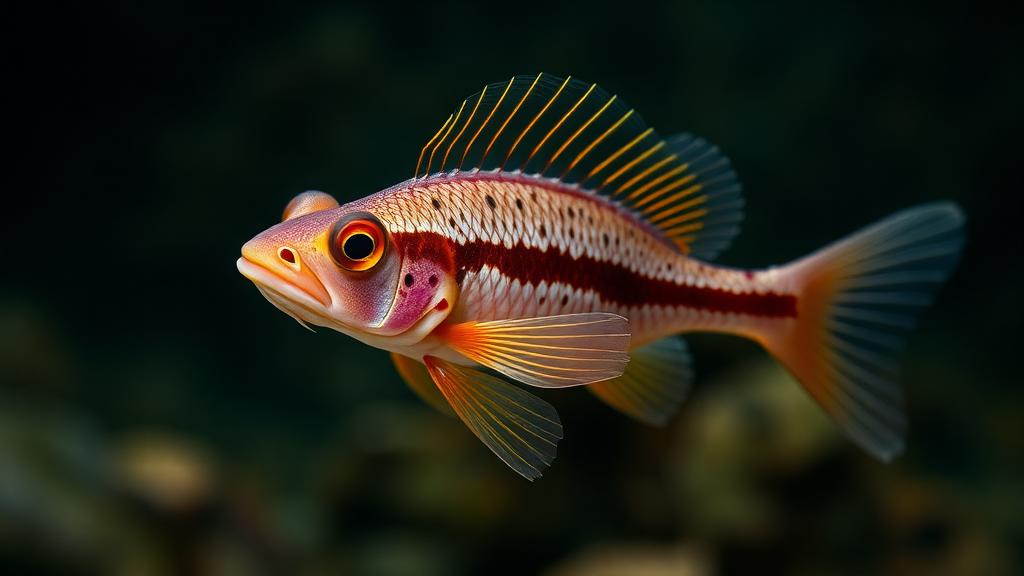
A small, vividly striped fish known only from the Philippines and Papua New Guinea has surfaced more than a thousand kilometers to the north, in the bycatch of a bottom-trawl fishery off southwestern Taiwan. The beautiful dartfish, Ptereleotris kallista, described in 2008 from a type locality near Manila on the Philippine island of Luzon, had never been recorded from Taiwan. Four catalogued specimens, all females measuring between 82.0 and 92.0 millimeters in standard length, together with a fresh photograph of a fifth unretained individual, now establish the species as part of the Taiwanese fauna. The discovery, reported in the journal Acta Ichthyologica et Piscatoria, represents the northernmost record of the species in the northwestern Pacific Ocean and adds a striking new entry to the region’s growing list of range extensions.
The timing of the captures is as intriguing as the geography. All specimens were collected in late July, in 2023 and again in 2024, in the days immediately following typhoon events, and none have been obtained since. The authors suggest that the species may inhabit areas not regularly sampled by trawling operations, such as nearshore zones or rocky substrates, and that typhoon-driven disturbance may have displaced individuals into deeper, trawl-accessible waters. Whether the fish were pushed offshore by storm surge, redistributed by altered currents, or simply stirred out of hiding along the coast remains unresolved, but the pattern implies that extreme weather events can open rare windows into the distributions of small reef-associated fishes.
Dartfishes belong to the gobiid subfamily Ptereleotrinae, a group of small, schooling fishes typically associated with coral reefs or with sandy, muddy, and rubble bottoms. Although most species are benthic dwellers, some inhabit rocky shores or mangrove areas, and a few are frequently observed swimming in the water column, a habit that distinguishes them from many of their bottom-hugging gobiid relatives. Currently, seven genera and approximately 61 species are recognized as valid worldwide, spanning Aioliops, Parioglossus, Navigobius, Nemateleotris, Ptereleotris, Pterocerdale, and Oxymetopon. The group’s taxonomy remains unsettled in places. At least two species described in recent years, Navigobius khanhoa and Zagadkogobius ourlazon, were each based on a single juvenile and are now considered doubtful, with the former probably a species of Oxymetopon and the latter closely resembling a species of Tryssogobius and excluded from the subfamily altogether.
Taiwan’s dartfish fauna was previously understood to comprise three genera and 12 species, including familiar aquarium fishes such as the decorated firefish Nemateleotris decora and the magnificent dartfish Nemateleotris magnifica, alongside members of the genera Parioglossus and Ptereleotris. The genus Ptereleotris, to which the new record belongs, is characterized by a suite of anatomical features: segmented dorsal-fin rays numbering 23 to 39, segmented anal-fin rays 22 to 39, segmented pelvic-fin rays numbering four, cycloid body scales rarely bearing even one or two ctenii, a vertebral count of 10 plus 16, a specific dorsal-fin pterygiophore interdigitation pattern, a highly protrusible upper jaw, and a compressed body. Twenty species are currently recognized as valid, distributed mainly across the Indo-Pacific region, with three species occurring in the western Atlantic Ocean.
The Taiwanese specimens were obtained as bycatch of the bottom-trawl fishery operating off Dong-gang fishing port in Pingtung County, at coordinates of approximately 22 degrees 22 minutes north and 120 degrees 27 minutes east, from depths presumably shallower than 200 meters. Three specimens were collected on 30 July 2023 and deposited under catalogue number NMMB-P 39670 at the Pisces Collection of the National Museum of Marine Biology and Aquarium in Pingtung, and a fourth, catalogue number NMMB-P 42775, was collected on 29 July 2024. All were fixed in 4 percent formaldehyde and transferred to 70 percent ethanol for permanent preservation. The specimens were collected alongside other gobies, including Mahidolia mystacina, species of Oxyurichthys, Paratrypauchen microcephalus, Tomiyamichthys russus, and Tomiyamichthys smithi, a bycatch assemblage typical of the soft-bottom gobiid fauna of the region.
Identification rested on a detailed comparison of meristic and morphometric characters with the type specimens described by Randall and Suzuki in 2008. The Taiwanese material shows dorsal-fin rays VI-I, 25 to 28; pectoral-fin rays 22 to 26 on the left side and 23 to 24 on the right; pelvic-fin rays I, 4; anal-fin rays I, 24 to 26; segmented caudal-fin rays 9 over 8, with 7 over 6 branched; gill rakers on the outer face of the first arch numbering 6 to 7 plus 16 to 17, totaling 22 to 24; pseudobranchial filaments 11 to 13; and longitudinal scale rows of approximately 191 to 215. X-radiographs confirmed 26 total vertebrae, arranged as 10 plus 16, and the dorsal-fin pterygiophore interdigitation pattern 3/32010/9. Measurements were made with digital calipers to the nearest 0.1 millimeter, and morphometric data were expressed as percentages of standard length or head length following the protocols of Randall and Hoese and of Randall and Suzuki.
The body of the fish is slender and elongated, slightly compressed and oval in cross section, with a small oval head, large eyes, and a broad, slightly convex space between them. The snout is blunt and does not protrude before the premaxilla, the mouth is small and oblique, and the upper jaw is protrusible, its posterior end reaching slightly beyond a vertical through the anterior margin of the eye. The lower jaw projects before the upper jaw, and its tip bears no barbels, instead forming a small blunt knob at the symphysis. Canine teeth are present on both the premaxilla and the dentary, with the outermost premaxillary teeth distinctly enlarged and the dentary teeth arranged in about three rows anteriorly, decreasing to one row posteriorly. The vomer and palatine are edentate. Body scales are small, cycloid, and embedded in the skin, covering the body, abdomen, chest, and pectoral-fin base, while the head, nape, isthmus, and gular areas are naked. Head pores are absent, and sensory papillae, though present, were mostly abraded by the bottom trawling.
It is the fresh coloration that earns the species its English name. The body is pale to slightly pinkish or bluish, and the head is paler than the body and slightly yellowish, with a yellow stripe running from the upper margin of the eye to about the upper end of the gill opening. Three silvery-blue stripes adorn the head, the uppermost just behind the eye and extending onto the opercle, the second below the first and running from the preopercle to the opercle, and the last originating on the cheek below the eye. The upper opercle carries a black blotch slightly smaller than the pupil. The first dorsal fin is somewhat yellowish with yellow stripes near the base, the second dorsal fin is dusky with three yellow stripes, and the anal fin is dusky with two or three yellow stripes and a white distal margin. The pectoral-fin base bears two horizontal silvery-blue stripes. Most remarkably, the inner caudal fin is yellow and encircled by three layers of U-shaped rings, the innermost white and somewhat bluish, followed by yellow and white rings. In preservation, the caudal fin retains two dusky U-shaped rings, a diagnostic feature that aids identification of formalin-fixed material.
The identification is supported by a combination of characters: soft dorsal-fin rays 25 to 28; soft anal-fin rays 24 to 26; gill rakers 6 to 7 plus 16 to 17; longitudinal scale rows of approximately 191 to 215; the absence of predorsal scales, head pores, chin barbels, and filamentous caudal-fin rays; the fourth dorsal-fin spine longest, reaching 51.5 to 56.8 percent of standard length; interorbital width of 4.9 to 5.4 percent of standard length; and, in preserved specimens, the two black U-shaped markings on the caudal fin. Nevertheless, the comparison revealed several differences from the original description. The Taiwanese specimens have slightly fewer dorsal-fin soft rays, slightly more pectoral-fin rays, slightly more longitudinal scale rows, slightly fewer gill rakers, a slightly longer body depth at the anal-fin origin, a slightly shorter snout, a slightly shorter caudal peduncle, and a distinctly longer pelvic fin than the type material. The authors consider most of these differences, based on so few specimens, to fall within the natural range of variation observed across species of Ptereleotris and to represent intraspecific variation, though additional specimens are required to determine whether the difference in pelvic-fin length is likewise intraspecific, as it does not appear to be correlated with sex.
Fresh coloration also differed in ways that complicate the picture. In the Taiwanese specimens, the background coloration of the first dorsal fin is yellow, whereas the holotype illustrated by Randall and Suzuki and the individual from Milne Bay, Papua New Guinea, reported by Allen and Erdmann in 2024, show blue. White blotches on the caudal fin, present in those earlier records, are absent in the Taiwanese fish. Because so few specimens are available, it remains unclear whether these differences result from post-mortem color changes, represent intraspecific variation, or alternatively indicate the presence of an undescribed species. Given the substantial variation observed in meristic and morphometric characters and in caudal-fin coloration, the authors provisionally assign their specimens to Ptereleotris kallista pending the availability of additional material. The record nonetheless carries broader significance. It documents a species previously known only from Luzon and Milne Bay at its northernmost extent, hints that typhoon events may briefly expose the hidden distributions of small reef-associated fishes to scientific sampling, and underscores how much of the tropical northwestern Pacific’s dartfish diversity still awaits discovery, particularly in the poorly sampled waters between the Philippines and Taiwan.
Subject of Research: New records of the beautiful dartfish, Ptereleotris kallista (Actinopterygii, Gobiiformes, Gobiidae), from southwestern Taiwan
Article Title: New records of the beautiful dartfish, Ptereleotris kallista ( Actinopterygii , Gobiiformes , Gobiidae ), from southwestern Taiwan
Article References: Su, Y., Fan, Y.-C., Hsu, Y.-C., & Lin, T.-Y. (2026). New records of the beautiful dartfish, Ptereleotris kallista (Actinopterygii, Gobiiformes, Gobiidae), from southwestern Taiwan. Acta Ichthyologica et Piscatoria, 56, 55-61. https://doi.org/10.3897/aiep.56.177807
Image Credits: AI Generated
Keywords: records, beautiful, dartfish, Ptereleotris, kallista, Actinopterygii, Gobiiformes, Gobiidae, southwestern, Taiwan, scientific research
Cite Scienmag News
Margaret Porter. (October 17, 2026). Beautiful dartfish turns up in Taiwan, pushing its range north after typhoons. Scienmag. https://scienmag.com/beautiful-dartfish-turns-up-in-taiwan-pushing-its-range-north-after-typhoons/
Margaret Porter. "Beautiful dartfish turns up in Taiwan, pushing its range north after typhoons." Scienmag, 17 October 2026, https://scienmag.com/beautiful-dartfish-turns-up-in-taiwan-pushing-its-range-north-after-typhoons/. Accessed 17 October 2026.
Margaret Porter. "Beautiful dartfish turns up in Taiwan, pushing its range north after typhoons." Scienmag. October 17, 2026. https://scienmag.com/beautiful-dartfish-turns-up-in-taiwan-pushing-its-range-north-after-typhoons/


