


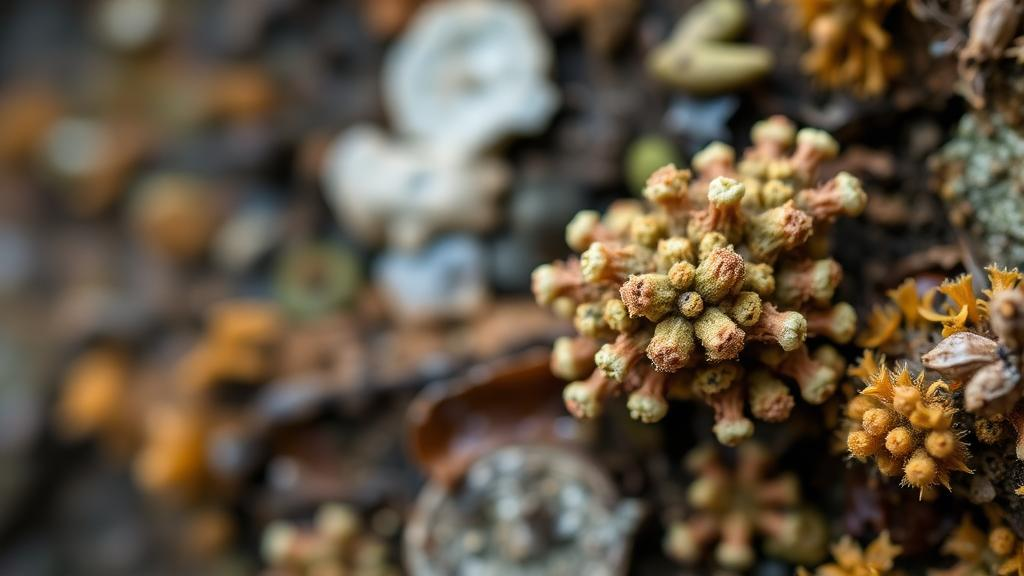
A century-old mystery hidden in the mountains of Central Europe has just been solved, and it comes with a twist worthy of the science fiction writer at the heart of the story. Lichenologists studying the crust-forming genus Myriospora have described a brand-new species from the Czech Republic, Germany and Italy, and at the same time elevated a strange lichen collected exactly once, in 1925, to full species rank. That second organism, now named Myriospora macrophylla, has never been seen again since its original discovery on a windswept gneiss summit in the Jeseníky Mountains, and the researchers behind the new study believe it may be extinct.
The work, published in the journal MycoKeys, combines classical herbarium detective work with modern DNA sequencing. The newly described species, Myriospora hilitzeri, is named after Alfred C. Hilitzer, a Czech lichenologist who collected extensively in the 1920s and who also happened to write science fiction. In 1933 Hilitzer published a novel called Mitigen, gas against war, in which a scientist invents a gas that makes people no longer want to fight. Honoring a collector whose specimens still generate discoveries a hundred years later, the authors note, is a fitting tribute to a man who worked at the intersection of rigorous science and bold imagination.
Myriospora is a small but widespread genus of crustose lichens in the family Acarosporaceae. Until this study it contained thirteen accepted species found on every continent except Australia and Africa. The genus is defined by a set of microscopic traits: a tall spore-producing layer called the hymenium, usually exceeding 150 micrometers, extremely thin fertile filaments known as paraphyses measuring roughly one micrometer across, and an algal layer that is interrupted rather than continuous. Most species in the group produce few or no secondary metabolites, the chemical compounds lichenologists often rely on for identification, which makes morphology and DNA especially important for telling species apart.
To untangle the relationships within the genus, the team extracted DNA from seven dried herbarium specimens and sequenced four genetic markers: the nuclear internal transcribed spacer, the nuclear large subunit ribosomal DNA, the mitochondrial small subunit, and the protein-coding beta-tubulin gene. The concatenated alignment totaled 2,894 characters, of which 592 were parsimony-informative. Phylogenetic trees were built using both Bayesian inference and maximum likelihood, with the lichen Pycnora sorophora serving as the outgroup. The resulting well-supported phylogeny confirmed that Myriospora is a monophyletic clade, meaning all its species descend from a single common ancestor, and revealed that the sequences of the new species form a distinct lineage separate from all other members of the genus except its two closest relatives.
Myriospora hilitzeri itself is easy to overlook and has been misidentified repeatedly. It forms pale brown, smooth to lumpy areoles, small tile-like patches of the lichen body, typically around two millimeters wide, each bearing one to four immersed fruiting bodies called apothecia. Under the microscope it can be distinguished from its lookalike Myriospora myochroa by its flatter areoles, a much narrower parathecium, the rim of tissue surrounding the apothecium, a lower hymenium, and crucially the absence of norstictic acid, a compound that M. myochroa produces. The species grows on siliceous, acid rocks, sometimes in sheltered underhangs, at elevations ranging from 130 meters in the Czech lowlands to about 2,750 meters in the Maritime Alps of Italy.
The story of the second species is more dramatic. In August 1925, Hilitzer collected a lichen on the summit of Keprník Mountain at 1,424 meters in the Jeseníky Mountains. The Swedish lichenologist Adolf Hugo Magnusson studied the specimen and in 1929 described it as a form of Acarospora smaragdula, naming it Acarospora smaragdula form macrophylla. The lichen is unmistakable: its squamules, scale-like lobes of the thallus, reach four to ten millimeters wide and up to 1.35 millimeters thick, borne on stout stalks, with ten to twenty apothecia embedded in each one. Such large squamules overshadow and apparently destroy neighboring lichens, a competitive habit unusual in the genus. Hilitzer himself wrote that only a small number of low gneiss rocks existed at the Keprník summit, and it was there, and only there, that he found the species.
No one has collected it since. Hilitzer never found it again, and generations of Czech lichenologists, from early twentieth-century figures to contemporary researchers, have failed to rediscover it. In April 2019, a team revisited the Keprník summit and found only Myriospora hilitzeri tucked in a rock underhang, not the large, sun-exposed squamules of macrophylla. Because the species is conspicuous and could not easily be missed by any skilled lichenologist, and because repeated targeted searches have come up empty, the authors consider Myriospora macrophylla probably extinct in the Czech Republic. Because no material suitable for DNA extraction could be obtained, the species was not included in the molecular phylogeny; its recognition rests on its unique morphology, its historical description, thin-layer chromatography of a tiny fragment, and examination of the type specimens and photographs of the holotype held in Sweden.
The genetic work also produced a surprise from North America. A specimen of Myriospora smaragdula collected in Canada by Jesuit lichenologist John McCarthy on calcareous rock rich in iron fell squarely within the M. smaragdula lineage. That is remarkable because no Myriospora species had ever been reported on calcareous rock, and M. smaragdula was known to favor copper-rich substrates. A lichen curator at the Slovakia National Museum examined the specimen with Raman spectroscopy searching for novel mineral oxalates, but found only whewellite, calcium oxalate monohydrate, one of the most common oxalates in lichens, crystallized on the underside of the squamules where they touched the rock. The finding hints that the ecological tolerances of even well-known lichens may be broader than current records suggest.
The study also tidies up the genus’s boundaries. The authors reject Myriospora himalayensis, published in 2021 from the Himalayas, arguing that the traits used to justify its placement, a high hymenium, small ascospores, norstictic acid and pruinose apothecia, are not restricted to Myriospora, and that the single known specimen needs sequencing before it can be assigned to the genus. They likewise flag reports of the Californian species M. hassei from Europe and interior North America as doubtful, noting that some may represent undescribed taxa or even M. hilitzeri itself. With the two additions, the genus now contains fifteen accepted species, and the paper supplies a worldwide identification key to all of them, a practical tool for lichenologists everywhere.
Beyond the taxonomy, the study is a reminder of how much biodiversity history is stored in herbarium packets. Hilitzer’s collections from the 1920s, some with illegible labels and others annotated by Magnusson with identifications later shown to be wrong, turned out to hold a species new to science hiding in plain sight for a century. They also preserve the only trace of a distinctive lichen that may have vanished from its single mountaintop home. As genomic methods grow more powerful and old specimens are re-examined with modern tools, researchers expect more such revelations, and more sobering reckonings with what has been lost while it sat, unrecognized, on a museum shelf.
Subject of Research: Taxonomy and phylogenetics of two new European lichen species in the genus Myriospora
Article Title: Two new species of Myriospora ( Lecanoromycetes , Acarosporomycetidae , Acarosporales , Acarosporaceae ) from Europe, one last observed in 1925
Article References: Knudsen, K., Pušová, T., Kocourková, J., & Kondrysová, E. (2026). Two new species of Myriospora (Lecanoromycetes, Acarosporomycetidae, Acarosporales, Acarosporaceae) from Europe, one last observed in 1925. MycoKeys, 139, 73-87. https://doi.org/10.3897/mycokeys.139.200273
Image Credits: AI Generated
DOI: 10.3897/mycokeys.139.200273
Keywords: lichenology, Myriospora, Acarosporaceae, new species, phylogenetics, DNA sequencing, Czech Republic, biodiversity, possibly extinct, taxonomy, MycoKeys, Europe
Cite Scienmag News
Juliet Wilcox. (October 17, 2026). Lichen Lost Since 1925 Rediscovered as New Species, and a Second One Joins It. Scienmag. https://scienmag.com/lichen-lost-since-1925-rediscovered-as-new-species-and-a-second-one-joins-it/
Juliet Wilcox. "Lichen Lost Since 1925 Rediscovered as New Species, and a Second One Joins It." Scienmag, 17 October 2026, https://scienmag.com/lichen-lost-since-1925-rediscovered-as-new-species-and-a-second-one-joins-it/. Accessed 17 October 2026.
Juliet Wilcox. "Lichen Lost Since 1925 Rediscovered as New Species, and a Second One Joins It." Scienmag. October 17, 2026. https://scienmag.com/lichen-lost-since-1925-rediscovered-as-new-species-and-a-second-one-joins-it/


