


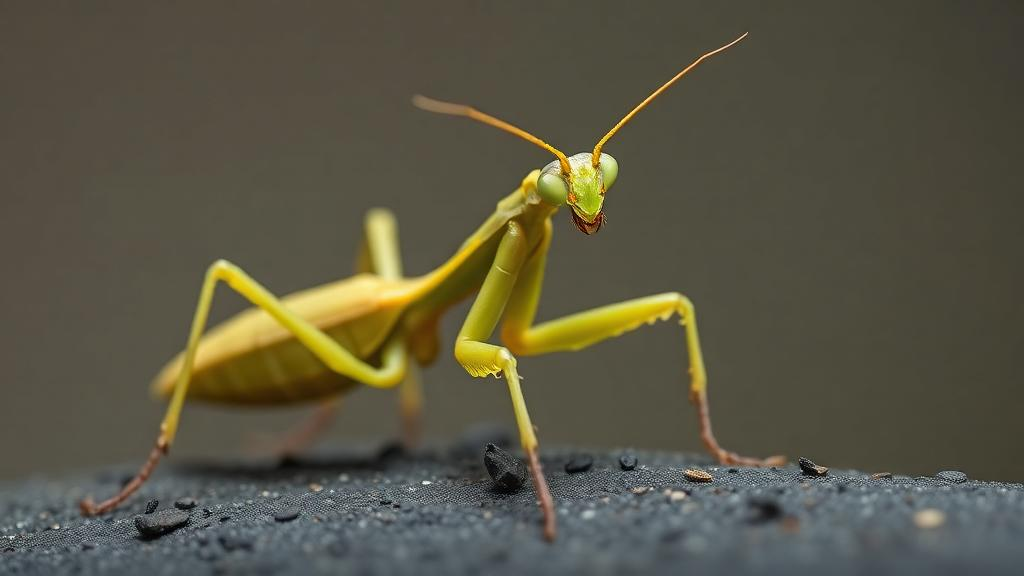
The Galápagos Islands, the volcanic archipelago that helped inspire Darwin’s theory of evolution, has quietly acquired a new resident that nobody invited. Scientists have confirmed the first record of an alien praying mantis in the islands, a bark-dwelling predator known as Liturgusa maya, marking only the second mantis species ever documented across the entire archipelago. The discovery, published in the Journal of Orthoptera Research, reveals how easily stowaway insects can breach even the most isolated and protected ecosystems on Earth.
What makes the finding particularly striking is how it came to light. The invasive mantis was initially detected not by professional entomologists but through citizen science observations uploaded to the iNaturalist platform, where amateur naturalists photographed unfamiliar insects clinging to tree bark and walls near Puerto Ayora on Santa Cruz Island. Researchers from the Charles Darwin Foundation followed up these public sightings with field collections, confirming the taxonomic identity of the specimens and establishing that the species has been present on the island since at least 2017.
Until now, the only praying mantis known from the Galápagos was Galapagia solitaria, an endemic species described in 1893 that hunts at ground level and on low vegetation across nearly every major island. The archipelago has a rich history of insect surveying, and its native and introduced fauna are relatively well documented for many groups. For that reason, the researchers consider it unlikely that a conspicuous bark mantis escaped detection during decades of biological surveys. Its sudden emergence on iNaturalist, its absence from the historical literature, and its tight association with buildings and trees near urban centers and agricultural lands all point to a recent arrival.
Liturgusa maya is a master of disguise built for life on vertical surfaces. Its body is flattened and narrow, with thickened mid- and hind-legs but slender tibiae, an anatomy optimized for sprinting up and down tree trunks with uncanny agility. Females measure between 24 and 34 millimeters in body length, while males are slightly smaller and slimmer at 19 to 25.5 millimeters. The background color ranges from pale green to yellowish-green, overlaid with strong mottling of light to dark brown and dark-banded legs, a disruptive coloration that renders the insect nearly invisible against bark. Some individuals even display asymmetrical forewing coloration, with one wing mottled and the other markedly darkened, sometimes with a reddish tone.
The species’ egg case, or ootheca, is equally well suited to covert travel. Shaped like a round-bottom bottle, with a thick, smooth, caramel-brown external wall that abruptly tapers into a rigid, short tubular projection, the ootheca resembles a piece of bark or organic debris. Females attach these cases to flat substrates such as tree bark by their proximal end, leaving the tubular emergence opening pointing upward. To untrained eyes conducting cargo inspections, an ootheca can easily pass as harmless organic material, providing developing embryos with a safe passage across hundreds of kilometers of open ocean.
How the mantis reached the Galápagos remains unknown, but the evidence points strongly to human-mediated transport. In 2017, approximately 75 percent of the islands’ agricultural food supply was transported from the Ecuadorian mainland to supply the booming tourist industry and the growing local population, a figure projected to reach up to 95 percent by 2037. Imported food and construction materials are an ongoing concern to local authorities precisely because they offer safe traveling conditions for stowaway insects. The researchers therefore consider it reasonable to assume that Liturgusa maya arrived among agricultural products or construction materials, with cryptic oothecae slipping unnoticed through inspections.
Once established, the introduced population appears to have expanded rapidly, and its reproductive biology may hold the key. To date, every adult specimen observed in the Galápagos has been a female, with adults and nymphs overlapping in time across urban and rural zones of Santa Cruz Island. This pattern suggests facultative parthenogenesis, the ability of females to reproduce asexually without males, which is believed to have driven the establishment of the species’ only other known introduced population, uncovered in Florida. Asexual reproduction offers colonizers enormous advantages: a single fertilized female, or even a lone stowaway carrying viable eggs, can seed an entire population, exploiting resources optimally and expanding swiftly without the need to find a mate.
The species possesses nearly every hallmark of a successful invader. Across its native range, which stretches from southern Mexico through Central America into northwestern South America and western Amazonia, Liturgusa maya occupies diverse environments including tropical and seasonally dry forests, making it one of the most widespread praying mantises in the Neotropics and one of the few trans-Andean species in the region. It thrives in human-altered landscapes, hunting on poles, fences, and wooden constructions that mimic its natural tree-based habitat, and it has been found associated with tree crops including cacao. Its generalist diet allows it to exploit whatever prey is available, while the hardiness, cryptic appearance, and high egg capacity of its oothecae protect developing embryos from environmental stressors.
The potential ecological consequences for the Galápagos are complex, and the researchers caution that it is still too early to estimate the mantis’s impact. As a generalist predator confined to tree bark and vertical surfaces, its influence is likely limited to arthropod communities in those environments. In the disturbed agricultural zones of Santa Cruz Island, where more than 80 percent of arthropod diversity consists of introduced species, the mantis may interact mostly with other aliens rather than with endemic fauna. It could even provide pest control services, reducing populations of insects that move along tree trunks and human-made structures. However, the abundant introduced ant Solenopsis geminata, known to significantly impact other arthropods, could represent a limiting factor on the mantis’s future spread.
One particularly intriguing dynamic is the prospect of intraguild competition with another introduced bark hunter, the flattie spider Selenops mexicanus, which has also established itself in the Galápagos across multiple islands. Both predators employ remarkably similar tactics: flattened bodies with disruptive coloration and swift movements around tree trunks for hunting and evading danger. Because the two species are sympatric on Santa Cruz Island and occupy similar ecological niches, competition between them could shape local population dynamics, influencing distribution and abundance within their shared habitat. By contrast, the mantis is unlikely to compete with the endemic Galapagia solitaria, which hunts at ground level and on low vegetation with its stick-like appearance and discreet gait, occupying an entirely different niche.
The broader context of this invasion is sobering. Introduced species now represent the most significant threat to Galápagos biodiversity, with 562 of the 651 introduced species recorded in the archipelago being insects, according to the Charles Darwin Foundation. These aliens compete with local fauna for resources, may introduce new diseases, and can trigger cascading ecological effects, a danger amplified in the Galápagos where species have evolved in relative isolation and often lack defenses against invaders. Established troublemakers already include paper wasps, invasive ants, and the cottony cushion scale, some of which cause significant disturbances to both biodiversity and human residents. As the human population on the islands grows, so does insect diversity, a trend documented decades ago and now accelerating with rising volumes of imported goods.
For the researchers, documenting newly established species is the critical first step in assessing invasiveness and formulating management strategies. Follow-up studies examining the genetic diversity of the introduced mantis population will be key to uncovering its most likely geographic source and determining whether its presence resulted from one or multiple colonization events. Genetic variation within the population will also reveal insights into its adaptability and potential impact on local ecosystems, offering valuable baseline data on the mechanisms underlying the early stages of colonization by alien praying mantises. Continued monitoring and management efforts, the team emphasizes, are essential to protect the archipelago’s native and fragile ecosystems from the growing tide of biological invasions driven by increased human activity.
Subject of Research: Liturgusa maya (Mantodea, Liturgusidae), the first record of an alien praying mantis in the Galápagos Islands
Article Title: Liturgusa maya ( Mantodea , Liturgusidae ), the first record of an alien praying mantis in the Galápagos Islands
Article References: Rivera, J., Picón-Rentería, P., Avendaño, J. M., Román, A. C., & Betancourt-Cargua, L. (2025). Liturgusa maya (Mantodea, Liturgusidae), the first record of an alien praying mantis in the Galápagos Islands. Journal of Orthoptera Research, 34(2), 249-256. https://doi.org/10.3897/jor.34.143096
Image Credits: AI Generated
Keywords: Liturgusa, maya, Mantodea, Liturgusidae, first, record, alien, praying, mantis, pagos, Islands, scientific research
Cite Scienmag News
Gavin Prescott. (October 17, 2026). Alien Praying Mantis Sneaks Into the Galápagos Islands. Scienmag. https://scienmag.com/alien-praying-mantis-sneaks-into-the-galapagos-islands/
Gavin Prescott. "Alien Praying Mantis Sneaks Into the Galápagos Islands." Scienmag, 17 October 2026, https://scienmag.com/alien-praying-mantis-sneaks-into-the-galapagos-islands/. Accessed 17 October 2026.
Gavin Prescott. "Alien Praying Mantis Sneaks Into the Galápagos Islands." Scienmag. October 17, 2026. https://scienmag.com/alien-praying-mantis-sneaks-into-the-galapagos-islands/


