


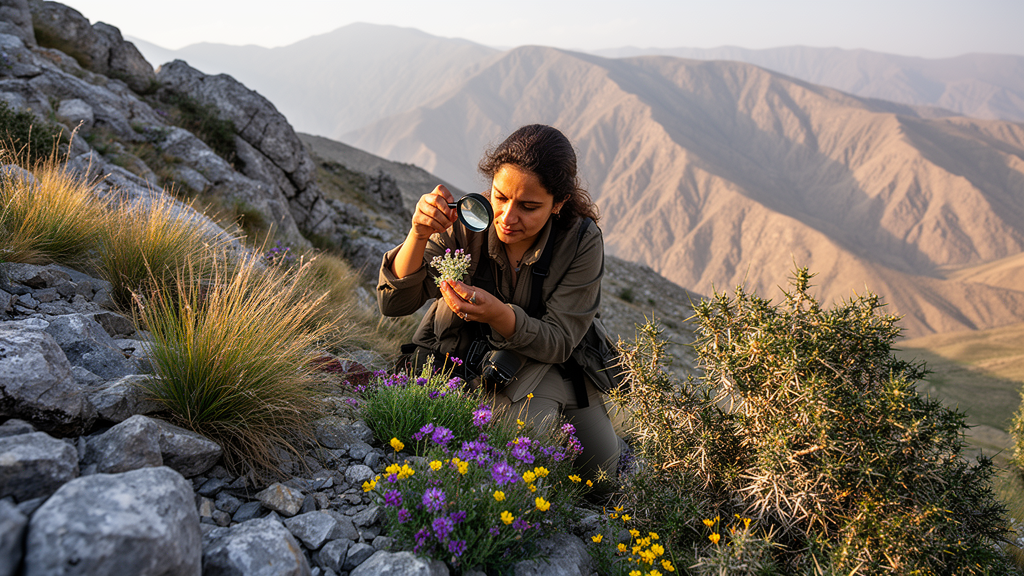
High in the Central Zagros mountains of western Iran, a three-year botanical survey has documented one of the country’s least explored centers of plant endemism in unprecedented detail. Researchers collected more than 1,000 vascular plant specimens between 2018 and 2020 across the subalpine and alpine zones of Fereydunshahr County, an area of roughly 150 square kilometers located about 180 kilometers west of Isfahan. The effort identified 308 vascular plant species belonging to 185 genera and 47 families, providing the first complete species list for the high elevations of a region long suspected to be a refuge for montane flora. The findings, published in Vegetation Classification and Survey, come at a critical moment: the area is not protected, and the team reports that overgrazing is degrading its plant communities at an alarming rate.
The Zagros is Iran’s largest mountain range, stretching from the northwest to the south of the country with many peaks exceeding 3,500 meters above sea level. It lies within the Irano-Turanian phytogeographic region and has been recognized as an area of endemism inside the Irano-Anatolian global biodiversity hotspot, a designation reserved for regions with high numbers of endemic species and heavy impacts from human activity. Although alpine ecosystems cover only about 1 percent of Iran’s land surface, they harbor 4 percent of the country’s non-endemic flora and 7 percent of its endemic flora. Many mountains within the Zagros remain poorly explored because of their vast extent and inaccessibility, and the high-elevation flora of Fereydunshahr had never been systematically documented before this study.
The study area encompasses several significant peaks, including Mount Zardigari at 3,700 meters in the northwest, Mount Didtseri at 3,620 meters in the north, Mount Tatara at 3,520 meters in the south, Mount Tsikhe at 3,320 meters in the west, and Mount Kalabis kobi at 3,000 meters in the northeast. The region’s geomorphology is shaped by the Zagros Fault, which divides the area into the Elevated Zagros to the west and the Sanandaj-Sirjan zone to the east. Diverse limestone formations and soils consisting mainly of Inceptisols and Entisols create a mosaic of microclimates that support distinct vegetation types and ecological zones. The climate is Mediterranean in regime, with cold, wet winters and dry, warm summers; the mean annual temperature is 11.65 degrees Celsius and annual precipitation totals 540 millimeters.
Fieldwork was carried out during the growing season from April to September across three years, with sampling conducted randomly from mountain slopes to summits within an elevation range of 2,500 to 3,700 meters. Each of the more than 1,000 collected specimens was tagged with detailed location, elevation, and habitat information, then identified using Flora Iranica and Flora of Iran and deposited in the Herbarium of the University of Isfahan. The researchers assigned species to major vegetation types, elevation zones, and chorotypes based on field observations, literature studies, and the reference floras. Life forms were classified using Raunkiaer’s system, which groups plants into chamaephytes, geophytes, hemicryptophytes, phanerophytes, and therophytes according to where their buds sit relative to the ground surface.
The largest plant families recorded were Asteraceae with 44 species, Fabaceae with 32, Brassicaceae with 29, Lamiaceae with 27, Apiaceae with 20, and Poaceae with 18, an ordering similar to the entire flora of the Zagros range. At the genus level, Astragalus was by far the richest with 23 species, followed by Allium with seven, Scorzonera with six, and Nepeta and Stachys with five each. Astragalus is the biggest genus in Iran with approximately 885 species, roughly 589 of them endemic, and it dominates the study area with 14 species endemic to Iran and six to the Zagros. Interestingly, Cousinia, the second biggest genus of Iran with about 300 species and roughly 80 percent endemism, was represented by only four species in the study area, a pattern the authors attribute to the genus being poorly represented in the alpine zone of Iran overall.
Life form analysis revealed that hemicryptophytes, plants whose buds lie at or just below the ground surface, dominate the flora at 53 percent of species. This is consistent with alpine habitats worldwide, where hemicryptophytes succeed because their protected buds shield them from frost and desiccation while their low-growing structures reduce wind exposure and retain heat. Therophytes, the annual plants that complete their life cycle within a single growing season, accounted for 49 species, but only three of these are specifically subalpine or alpine; the rest belong to lower elevation zones. The short growing season at high elevations makes this strategy largely untenable there, and therophytes comprise only about 2.5 percent of Iran’s alpine flora. Geophytes made up 7 percent of the subalpine and alpine species, in line with the 6 percent recorded for Iran’s alpine flora, while phanerophytes, mainly shrubs of the genera Amygdalus, Cerasus, Cotoneaster, Rosa, and Daphne, were concentrated in the montane zone. Juniperus excelsa, which forms treeline woodlands in parts of the Alborz and Zagros, has become very scarce in the study area, most likely due to human activities.
Chorological analysis showed that 52 percent of the identified species are Irano-Turanian elements, with the remainder belonging to combinations of the Irano-Turanian, Euro-Siberian, Mediterranean, and Saharo-Sindian regions. Notably, the floristic affinity with the Euro-Siberian region proved stronger than with the Mediterranean region, the reverse of the pattern for the entire Zagros flora. The authors suggest this reflects the study area’s high elevation, since higher precipitation and lower temperatures at altitude favor Euro-Siberian affinities, and the fact that the Alborz and Zagros have historically acted as migration corridors between Central Asia and the European mountains. Affinity with the dry Saharo-Sindian region was very poor, as expected given the region’s arid climate. Approximately 19 percent of the identified species are endemic to Iran and 7 percent are endemic to the Zagros, and previous work has ranked the mountains of Fereydunshahr among the top 10 percent richest endemic hotspots on the Iranian Plateau.
Species distribution across elevation zones followed a pattern seen in mountains worldwide, with richness declining as elevation increases, driven by reductions in both surface area and temperature. A third of the species occupy both montane and subalpine zones, 20 percent are subalpine, and only 9 percent are true alpine species, reflecting the small extent of genuine alpine habitat below the 3,700-meter summit. Yet the endemism rate climbs steeply with altitude: 57 percent of the alpine species are endemic to Iran, compared with 38 percent in the subalpine zone and just 20 percent in the montane zone. This trend matches global studies showing that endemism increases along elevation gradients, a phenomenon attributed to increasing isolation that raises allopatric speciation rates. The high-elevation flora thus represents the region’s most irreplaceable biological heritage.
Vegetation type analysis placed 24 percent of species in subalpine and alpine thorn-cushion grasslands, the vegetation type with the greatest gamma diversity in the study area. These communities, dominated in the subalpine zone by Acantholimon hohenackeri, Astragalus brachycalyx, and Bromus tomentellus and above 3,500 meters by Astragalus murinus, A. raswendicus, and Cousinia multiloba, thrive on windswept slopes where snow cover is brief and the growing season correspondingly long. Cushion plants function as foundation species: their tightly packed apical meristems and dense layers of stems and dead leaves buffer environmental extremes, creating micro-refugia that facilitate less stress-tolerant species and boost the alpha, gamma, and phylogenetic diversity of their communities. Montane steppe shrublands, characterized by Astragalus microcephalus and shrubs of Amygdalus, Cotoneaster, and Cerasus, contained 19 percent of species. The tall-umbelliferous vegetation of steep scree slopes, dominated by Apiaceae such as Prangos ferulacea and Ferulago angulata, held only 5 percent of species but a striking 56 percent endemism rate, followed by chasmophytic rock-dwelling vegetation with 43 percent endemism, consistent with global patterns of high endemicity in scree and cliff habitats.
The study concludes that the region’s rich flora faces severe pressure from anthropogenic activities, above all overgrazing. Paleobotanical evidence shows the Zagros vegetation has been shaped by human activity for five millennia, and genetic studies indicate goats were domesticated in the Zagros roughly 10,000 years ago. Today, the abundance of poisonous and thorny overgrazing indicators such as Euphorbia, Cirsium, and Cousinia in the Fereydunshahr highlands signals heavy livestock pressure, which drives soil erosion and community degradation. Illegal harvesting of rare plants, agricultural expansion, and infrastructure projects including roads, dams, and mines further fragment habitats, while climate change threatens to shift vegetation zones across all alpine ecosystems. Because no protected area currently exists in this recognized center of endemism, the researchers strongly recommend establishing one, alongside strict land-use regulation and community engagement, to preserve the unique ecological value of these mountains before their endemic flora is lost.
Subject of Research: Vascular plant diversity, life forms, chorology, and vegetation types of the subalpine and alpine zones of the Fereydunshahr mountains, Central Zagros, Iran
Article Title: Vascular plant diversity of the high mountains of Fereydunshahr, Central Zagros, Iran
Article References: Yaselyani, M., Bagheri, A., Saeidi, H., & Noroozi, J. (2024). Vascular plant diversity of the high mountains of Fereydunshahr, Central Zagros, Iran. Vegetation Classification and Survey, 5, 329-346. https://doi.org/10.3897/vcs.110546
Image Credits: AI Generated
DOI: 10.3897/VCS.110546
Keywords: plant biodiversity, Zagros mountains, endemism, alpine flora, Iran, conservation, Astragalus, overgrazing, Vascular, plant, diversity, high
Cite Scienmag News
Margaret Porter. (October 17, 2026). Hidden Flora of Iran’s Zagros Mountains Reveals 308 Species and a Hotspot of Endemism. Scienmag. https://scienmag.com/hidden-flora-of-irans-zagros-mountains-reveals-308-species-and-a-hotspot-of-endemism/
Margaret Porter. "Hidden Flora of Iran’s Zagros Mountains Reveals 308 Species and a Hotspot of Endemism." Scienmag, 17 October 2026, https://scienmag.com/hidden-flora-of-irans-zagros-mountains-reveals-308-species-and-a-hotspot-of-endemism/. Accessed 17 October 2026.
Margaret Porter. "Hidden Flora of Iran’s Zagros Mountains Reveals 308 Species and a Hotspot of Endemism." Scienmag. October 17, 2026. https://scienmag.com/hidden-flora-of-irans-zagros-mountains-reveals-308-species-and-a-hotspot-of-endemism/


