


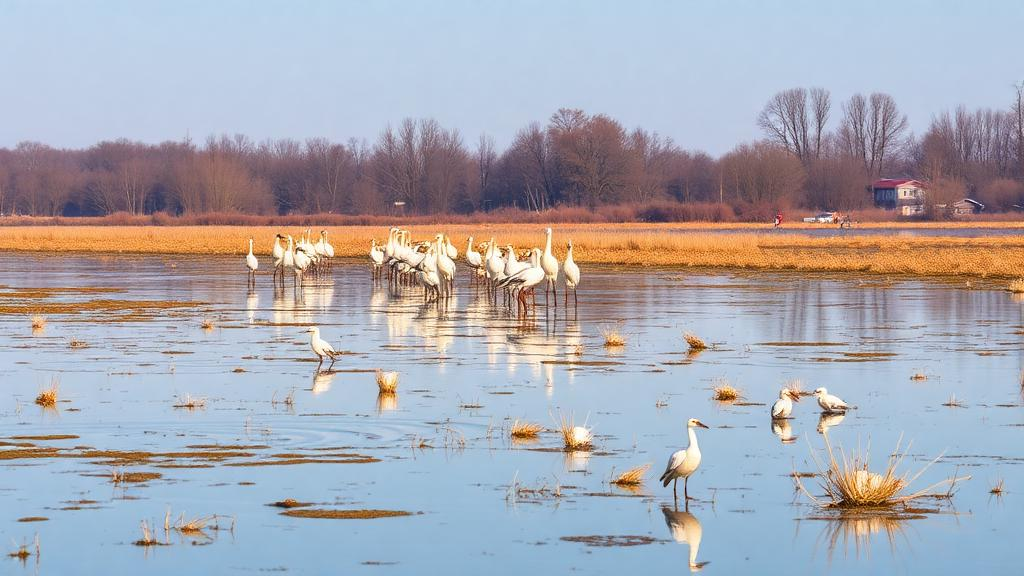
Every winter, when the vast natural lakes of the Yangtze floodplain freeze over or fall silent under human pressure, tens of thousands of migratory waterbirds must find somewhere else to eat, rest, and survive. A new study reveals that the answer, at least around Chao Lake in eastern China, lies in a patchwork of small, overlooked wetlands scattered like stepping stones across the landscape — aquaculture ponds, paddy fields, reservoirs, and natural ponds that most people would never glance twice at. Between November 2023 and February 2024, researchers surveyed 55 of these satellite wetlands and recorded 20,425 individual waterbirds belonging to 44 species, including some of the most endangered birds on Earth.
Among the species documented were Baer’s Pochard, a diving duck listed as Critically Endangered on the IUCN Red List, and the Oriental Stork, classified as Endangered. Both are Class I nationally protected species in China. Seven species recorded in the surveys appear on the IUCN Red List, ranging from Near Threatened to Critically Endangered, and six enjoy national protection. The findings, published in the journal Nature Conservation, suggest that these fragmented, human-shaped wetlands are not ecological afterthoughts but lifelines for waterbirds along the East Asian–Australasian Flyway, one of the world’s great migration corridors.
The context is sobering. The middle and lower reaches of the Yangtze River historically hosted a network of river-connected lakes whose natural seasonal flooding created shallow zones, mudflats, and vegetated margins teeming with food for wintering birds. But since the 1950s, sluices and embankments have severed many lakes from the main river. Chao Lake, a typical example, has long been hydrologically disconnected from the Yangtze. Year-round high water levels have suppressed the natural drawdown that once exposed mudflats and shallow foraging grounds, degrading habitat heterogeneity and leaving many waterbirds unable to find suitable feeding and resting sites within the main lake itself. Under these conditions, large numbers of birds have shifted to the surrounding satellite wetlands, which now serve as critical alternative habitats.
Satellite wetlands are shaped by both natural hydrological processes and human activity. Aquaculture ponds, typically ranging from 0.1 to 50 hectares and sometimes forming complexes exceeding 100 hectares, are enclosed by low earthen dikes and maintain water depths of 80 to 150 centimeters during cultivation. They are typically drained in winter, exposing mudflats for several weeks — a boon for wading birds. Paddy fields follow a double-cropping system, with rice harvested in July and October, after which many are left fallow with shallow water. Reservoirs are small and regular in shape with managed water levels, while natural ponds are irregular, less controlled, and often covered by aquatic vegetation. Collectively, these varied microhabitats attract waterbirds with different ecological requirements.
To understand how these communities assemble, the research team conducted four monthly surveys using the point count method, once in the middle of each month under clear, windless conditions. The same survey team carried out all counts to minimize observer bias. At each wetland, one to three observation points were established according to the site’s area, shape, and surroundings, and each point was surveyed for 20 minutes using binoculars and a spotting scope. Species were recorded only if they were using the wetland itself, excluding birds merely flying over. The 55 sites, selected randomly from a larger pool of candidates, ranged from 2.5 to 7.56 hectares and were all located within 10 kilometers of the main body of Chao Lake, forming three spatial clusters: a northwestern group of 31 sites, a northeastern group of 11, and a southern group of 13.
The team quantified three dimensions of biodiversity: taxonomic diversity, measured through species richness and the Shannon-Wiener index; functional diversity, reflecting variation in ecological roles such as diet, foraging strategy, and habitat use; and phylogenetic diversity, representing the evolutionary relatedness among species. Functional traits included body mass, primary diet, foraging method, and foraging stratum, while phylogenetic data were drawn from a global bird phylogeny database. For each community, the researchers computed two abundance-weighted metrics — mean pairwise distance (MPD), which captures overall divergence among all species pairs, and mean nearest taxon distance (MNTD), which measures the average distance to each species’ closest relative in trait or evolutionary space.
The results revealed striking patterns. Species richness was lowest in November, averaging about 31 species per month overall, with no significant differences among December, January, and February. Shannon diversity was similarly lower in November than in December. In contrast, functional and phylogenetic diversity remained stable throughout the wintering season, likely because newly arriving species shared similar traits and evolutionary histories with those already present. Trait redundancy and phylogenetic conservatism in the wintering assemblages may have constrained variation in these dimensions even as species richness increased.
Environmental factors shaped the communities in nuanced ways. Species richness increased with wetland area, habitat diversity, landscape connectivity, and distance from settlements, but decreased with shape complexity. Shannon diversity was positively associated with habitat diversity and distance from roads. Interestingly, a trade-off emerged driven by edge effects: while irregular wetland shapes were associated with lower species richness, they supported higher functional and phylogenetic differentiation, likely because complex boundaries create heterogeneous microhabitats with variable water depths and vegetation types, enabling the coexistence of diverse evolutionary lineages and functional guilds. Wetlands with higher connectivity exhibited lower functional and phylogenetic MNTD, reflecting greater community similarity driven by frequent bird movements among sites. Generalist dabbling ducks such as the Chinese Pond Heron’s wetland companions — the Indian Spot-billed Duck and Mallard — were frequently recorded across highly connected sites, indicating functional and phylogenetic convergence. In contrast, wetlands farther from settlements showed higher functional MPD but lower phylogenetic MNTD, implying that low-disturbance environments promote functional diversification while maintaining phylogenetic clustering.
Perhaps the most intriguing finding concerns community assembly itself. By comparing observed functional and phylogenetic indices with null models — 999 randomized communities generated for each wetland and survey round — the researchers found that most standardized effect sizes fell within the range expected by chance. This indicates that stochastic processes, rather than deterministic environmental filtering or competitive exclusion, dominated the assembly of wintering waterbird communities in these satellite wetlands. The pattern may partly reflect the limited spatial extent of the Chao Lake system, which constrains environmental variation and weakens deterministic filtering across sites. Waterbird behaviour likely plays a role too: during winter, most waterbirds forage opportunistically and move frequently among wetlands rather than remaining in fixed locations, disrupting stable species-environment relationships. Their strong mobility, combined with short distances between satellite wetlands — the average nearest-neighbour distance was just 1.80 kilometers — facilitates frequent dispersal and temporary occupancy, enhancing the role of stochastic dispersal limitation and priority effects.
Notably, phylogenetic MPD showed no significant association with any environmental variable, likely because most waterbirds belong to a few closely related lineages, making this broad-scale index less responsive to habitat variation. The study’s implications for conservation are clear. Management should prioritize the protection of large satellite wetlands with diverse habitat structures to maintain heterogeneity, enhance connectivity among wetlands to facilitate waterbird movement and dispersal, maintain moderate edge complexity to create varied microhabitats, and establish vegetation buffers near human infrastructure to reduce disturbance. Although limited to a single wintering season, the large number of surveyed sites provides robust spatial coverage, offering valuable insights for the conservation and management of fragmented wetlands at a time when the loss and degradation of large natural wetlands shows no sign of slowing. As waterbirds increasingly depend on these small, scattered, human-shaped habitats, understanding how their communities assemble — and how chance, rather than strict environmental rules, often governs who shows up where — could prove essential for keeping the flyway’s migrants returning year after year.
Subject of Research: Ecology
Article Title: How wintering waterbird communities assemble and respond to environmental variation in satellite wetlands around Chao Lake, China
Article References: Yuan, M., Wang, G., Lu, Z., Li, C., & de Boer, W. F. (2026). How wintering waterbird communities assemble and respond to environmental variation in satellite wetlands around Chao Lake, China. Nature Conservation, 63, 59-78. https://doi.org/10.3897/natureconservation.63.177016
Image Credits: AI Generated
DOI: 10.3897/natureconservation.63.177016
Keywords: waterbirds, satellite wetlands, Chao Lake, Yangtze River, community assembly, biodiversity, conservation, East Asian-Australasian Flyway, functional diversity, phylogenetic diversity, wintering, waterbird
Cite Scienmag News
Margaret Porter. (October 17, 2026). Wintering Waterbirds Turn Small Satellite Wetlands Around Chao Lake Into Vital Refuges. Scienmag. https://scienmag.com/wintering-waterbirds-turn-small-satellite-wetlands-around-chao-lake-into-vital-refuges/
Margaret Porter. "Wintering Waterbirds Turn Small Satellite Wetlands Around Chao Lake Into Vital Refuges." Scienmag, 17 October 2026, https://scienmag.com/wintering-waterbirds-turn-small-satellite-wetlands-around-chao-lake-into-vital-refuges/. Accessed 17 October 2026.
Margaret Porter. "Wintering Waterbirds Turn Small Satellite Wetlands Around Chao Lake Into Vital Refuges." Scienmag. October 17, 2026. https://scienmag.com/wintering-waterbirds-turn-small-satellite-wetlands-around-chao-lake-into-vital-refuges/


