


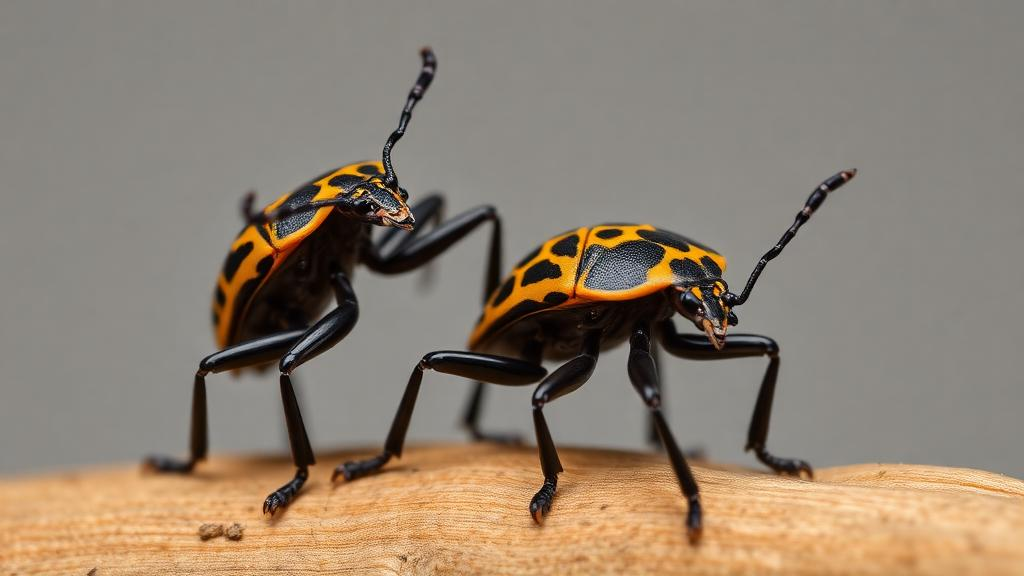
Deep in the rain-drenched slopes of Trafonaomby Mountain, in Andohahela National Park at the southern end of the Malagasy Highlands, a single female true bug collected in 1972 has finally been given a name. The insect, described as Dismegistus madagascariensis sp. nov. in the Deutsche Entomologische Zeitschrift, is more than just another new species from one of the planet’s great biodiversity hotspots. It is the first representative of the entire family Parastrachiidae ever recorded from Madagascar, a discovery that extends the known range of a small and enigmatic bug family across the Mozambique Channel and adds a fresh chapter to one of the longest-running taxonomic detective stories in entomology.
The new species belongs to the genus Dismegistus, a group of strikingly colored pentatomoid bugs whose name derives from the Greek dis mégistos, meaning twice as big. Until now, the genus comprised six valid species distributed mostly in eastern and southern Africa, from Kenya and Ethiopia down to South Africa and Namibia. The genus was also unknown in the nearby Comoro Islands, which share a significant part of their fauna with Madagascar, making the appearance of a Dismegistus species on the island itself all the more unexpected. The holotype, a female measuring 8.33 millimeters, was collected on the leeward south-west slopes of Trafonaomby Mountain at 1,770 to 1,950 meters above sea level, just under the mountain top, and had rested in the collections of the Muséum National d’Histoire Naturelle in Paris for over five decades before being formally described.
What makes this discovery resonate far beyond the catalogues of hemipterists is the extraordinary systematic history of the genus. Since its description by Amyot and Serville in 1843 for Cydnus circumcinctus Hahn, 1834, Dismegistus has travelled restlessly through the accepted classification of the superfamily Pentatomoidea, the group that includes stink bugs, burrower bugs, and their relatives. The genus was initially placed within the Sehirides, comparable to the modern subfamily Sehirinae, as part of the expansive concept of the Spinipedes, a grouping that at the time encompassed species of the Cydnidae as well as certain representatives of the tribe Sciocorini within the Pentatomidae. Dallas in 1851 categorized Dismegistus alongside Sehirus within the family Cydnidae, and Stål in 1876 positioned it close to the sehirine genera within his subfamily Cydnina, although Stål considered that group a subfamily of the Pentatomidae rather than a distinct family.
The travels did not stop there. Signoret, in his decision of 1880, transferred the genus to the tribe Strachiini, formally placing it within the family Pentatomidae, and consequently omitted it entirely from his extensive world revision of the Cydnidae published between 1881 and 1884. Most subsequent authors followed this placement, but Bergroth in 1923 moved the genus from the Pentatominae to the Asopinae based on the morphology of the bucculae and labium, while Hesse in 1925, like Jeannel before him in 1913, retained it in the Pentatominae. The genus had, in effect, been shuffled between two of the largest families of the Pentatomoidea and among several of their subunits, depending on which anatomical characters each author considered decisive.
A turning point came in 1956, when Leston examined the morphology and anatomy of Dismegistus in detail and demonstrated that the genus should be excluded from the Pentatomidae and returned to the Cydnidae, indicating its undeniable affinity with the Sehirinae. Yet even this careful study failed to settle the matter. Dolling, in his 1981 analysis of the higher classification of the Cydnidae, disagreed with Leston and excluded Dismegistus from the Cydnidae, categorizing the genus as Pentatomoidea incertae sedis, a formal acknowledgment of its uncertain position. In a curious twist of academic timing, Schaefer published a study of the stridulitrum and plectrum in certain primitive Pentatomoidea in the same month, unaware of Dolling’s conclusions, and placed Dismegistus within the Sehirinae, consistent with Leston’s earlier classification. For over a decade afterward, species of the genus were excluded from analyses of the superfamily altogether, a neglect best illustrated by the fact that even the most significant reference work of that period, Schuh and Slater’s 1995 catalogue of the world Heteroptera, did not mention the genus despite its previously contentious nature.
Resolution finally arrived at the beginning of the twenty-first century. Morphological studies of the Cydnidae published from 2001 to 2005 examined two species of Dismegistus, namely D. cf. binotatus and D. cf. fimbriatus, but still interpreted the genus as of uncertain systematic position. An analysis of the spermatheca by Pluot-Sigwalt and Lis in 2008 revealed significant similarities in the structure of this organ in Dismegistus and Parastrachia, a genus Bergroth had already discussed alongside Dismegistus a century earlier. Then, in 2008, Grazia and colleagues analyzed families within the Pentatomoidea based on morphological features and DNA sequences and unequivocally demonstrated the monophyly of a group comprising Parastrachia and Dismegistus, broadening the concept of the family Parastrachiidae to include Dismegistus for the first time. Subsequent morphological and molecular analyses have confirmed the affiliation of these two genera to a single monophyletic group, although nuclear ribosomal DNA gene analyses produced a different pattern, with species from both genera falling within a monophyletic Sehirinae. The systematic position of Dismegistus thus varied not only with the author’s concept of the families within the Pentatomoidea but also with the characters considered, having been classified under the Sehirinae or Cydninae of the Cydnidae, the Pentatominae or Asopinae of the Pentatomidae, and finally in its own family, the Parastrachiidae.
The description of the new species rests on a detailed morphological examination of the holotype, documented through high-resolution macro photography and environmental scanning electron microscopy. The specimen, black with a bright orange-red pronotum and propleura, shows the characteristic pentatomoid body plan in miniature: a triangular declivous head with mandibular plates slightly surpassing the apex of the clypeus, crescent-shaped bucculae, a labium reaching the middle of the mesosternum, and a reduced external scent efferent system of the metathoracic scent glands with V-shaped ostioles and rudimentary evaporatoria. Each abdominal ventrite bears two trichobothria postero- or posterolaterad of each spiracle, bothria of type A, and the female terminalia feature semicircular valvifers VIII with medially fused laterotergites VIII. The tibiae carry four rows of stout black semierect spines, a feature that once contributed to the genus’s original placement among the Spinipedes, the spined-legged bugs.
Dismegistus madagascariensis can be distinguished from its closest congeners by its coloration and body proportions. It is similar in body length to D. cf. fimbriatus, D. cf. funebris, and D. royeri, species whose females measure approximately 5.0 to nearly 9.0 millimeters, whereas females of D. cf. binotatus, D. cf. costalis, and D. cf. rufomarginatus typically exceed 10.0 millimeters and can occasionally reach 16.0 millimeters. Unlike the other three small species, in which only the lateral portions and posterior parts of the pronotum show red, the pronotum of the new species is uniformly red on the dorsal side. The same applies to the outer sections of the exocoria, which in the continental species are predominantly red along their length and distinctly differ from the darker mesocoria, whereas in the Malagasy insect the base of each exocorium is noticeably darker, resembling the color of the mesocorium. Furthermore, unlike all other species in the genus, the hemelytra of D. madagascariensis are broadly expanded laterally, reaching distinctly laterad of the humeral angles.
The type locality itself hints at the ecological uniqueness of the find. Andohahela National Park is divided into three zones: Malio, with dense lowland and montane rainforest rising to the 1,956-meter summit of Pic d’Andohahela; Ihazofotsy-Mangatsiaka, containing dry spiny forest; and Tsimelahy, with the unique Ranopiso transitional forest. The mountains form a natural barrier to the moist trade winds blowing from the east, producing 1,500 to 2,000 millimeters of rainfall per year on the eastern side, one of the few rain forests south of the Tropic of Capricorn, while the western edge receives just 600 to 700 millimeters and supports dry spiny forest characteristic of southern Madagascar. The holotype was collected on the leeward south-west slopes of Trafonaomby Mountain, suggesting a finding in the forest zone, though the exact forest type remains speculative. Available habitat information concerning continental African species of the genus concerns relatively drier habitats, making the montane Malagasy record ecologically intriguing. The habitat and biology of the new species remain unknown, and collecting fresh specimens is necessary to elucidate its bionomy and habitat requirements.
The discovery also carries a historical footnote. Leston, in his 1956 study, noted that his material included specimens from Madagascar that he assigned the name D. pauliani, but he classified it as a nomen nudum, a Latin name without formal description, suggesting the species would be described once sufficient material became available for a comprehensive revision of the genus. Unfortunately, this Malagasy species was neither described by Leston nor mentioned in his subsequent publications, and it is currently difficult to determine whether the specimens underlying D. pauliani represent the same species now described. Given that these are the only specimens of the genus recorded from Madagascar, the name has been tentatively included as a nomen nudum under D. madagascariensis. In the broader context of Malagasy entomology, where recent decades have brought first records of tribes, subfamilies, and even families previously unknown on the island, from the coreid tribes Dasynini and Latimbini to the rhyparochromid tribe Lilliputocorini and the tessaratomid subfamily Natalicolinae, the discovery of the first Parastrachiidae is not a major surprise, but it is a vivid reminder that even well-studied island faunas can still yield entirely unexpected branches of the tree of life.
Subject of Research: A newly described true bug from Andohahela National Park is the first Parastrachiidae from Madagascar, resolving a genus whose classification shifted between Cydnidae, Pentatomidae, and its own family over nearly two centuries.
Article Title: Dismegistus madagascariensis sp. nov., the first representative of the family Parastrachiidae ( Hemiptera , Heteroptera ) in Madagascar
Article References: Kment, P., & Lis, J. A. (2025). Dismegistus madagascariensis sp. nov., the first representative of the family Parastrachiidae (Hemiptera, Heteroptera) in Madagascar. Deutsche Entomologische Zeitschrift, 72(2), 505-516. https://doi.org/10.3897/dez.72.161108
Image Credits: AI Generated
Keywords: entomology, Madagascar, Hemiptera, true bugs, new species, taxonomy, biodiversity, Parastrachiidae, Dismegistus, Andohahela National Park, madagascariensis, first
Cite Scienmag News
Drew Townsend. (October 17, 2026). New Stink Bug Family Turns Up in Madagascar After 150 Years of Taxonomic Travels. Scienmag. https://scienmag.com/new-stink-bug-family-turns-up-in-madagascar-after-150-years-of-taxonomic-travels/
Drew Townsend. "New Stink Bug Family Turns Up in Madagascar After 150 Years of Taxonomic Travels." Scienmag, 17 October 2026, https://scienmag.com/new-stink-bug-family-turns-up-in-madagascar-after-150-years-of-taxonomic-travels/. Accessed 17 October 2026.
Drew Townsend. "New Stink Bug Family Turns Up in Madagascar After 150 Years of Taxonomic Travels." Scienmag. October 17, 2026. https://scienmag.com/new-stink-bug-family-turns-up-in-madagascar-after-150-years-of-taxonomic-travels/


