


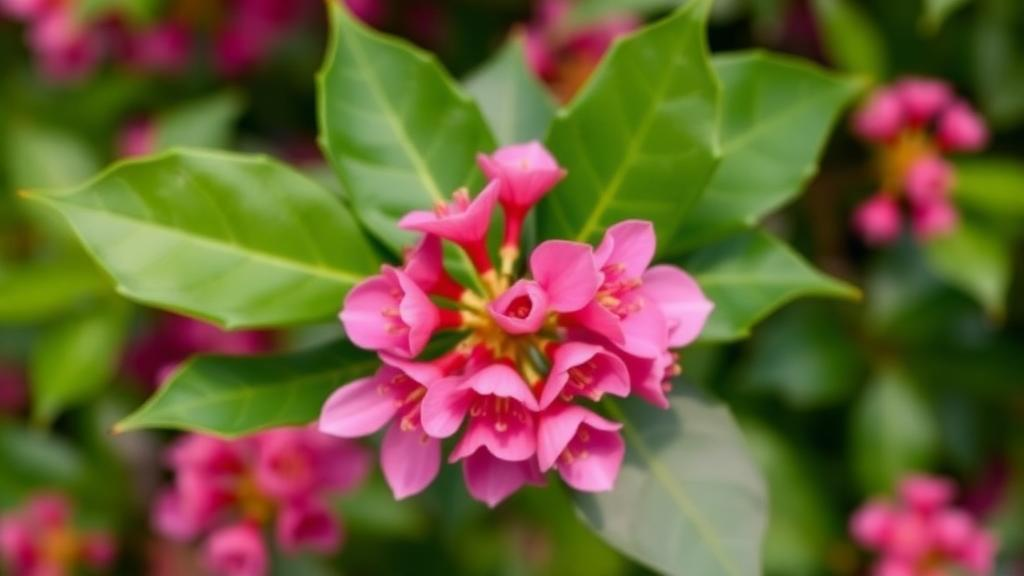
Deep in the evergreen forests of central Vietnam, botanists have uncovered a holly that breaks one of the most consistent rules of its genus. The new species, formally named Ilex decapetala in the journal PhytoKeys, produces female flowers with up to eleven petals, most commonly ten, a floral architecture so rare among hollies that no previously known species combines such high petal counts with a pink corolla. The discovery, based on fieldwork conducted in 2015, 2019 and 2026, was confirmed through a combination of DNA sequencing and detailed morphological comparison, and it adds a striking new branch to the evolutionary tree of one of the world’s most familiar plant groups.
Hollies belong to the genus Ilex, the sole member of the family Aquifoliaceae, which encompasses 571 recognised species of dioecious trees and shrubs distributed across temperate and tropical regions worldwide. The genus is economically significant far beyond its decorative winter berries: it supplies caffeinated beverages such as yerba mate and kudingcha, ornamental staples like English and American holly, and traditional medicines including gangmei and jiubiying. Despite this familiarity, the genus continues to surprise scientists. Twenty-six holly species have been described as new to science in the past decade alone, and nineteen of those came from southern China and the Indochina Peninsula, a pattern that underscores how incomplete our inventory of plant diversity remains even in well-studied groups.
The new species was found in three neighbouring provinces of central Vietnam: Kon Tum, Quang Nam and Thua Thien Hue. The type specimen was collected in the Song Thanh Nature Reserve in Quang Nam Province, on a river bank at an elevation of about 740 metres, during field investigations of the Vietnam-Russia Tropical Center. Additional collections came from protected forests near Mang Den in Kon Tum Province at roughly 1,050 metres and from remnants of primary evergreen broad-leaved forest on sandstone mountains in Thua Thien Hue. Two of the known localities lie only a few kilometres from the border with Laos, leading the researchers to consider it highly likely that the species also occurs there.
To establish the species’ identity and evolutionary position, the team sequenced three nuclear DNA markers: the ITS region, which includes the internal transcribed spacers and the 5.8S rRNA gene; the external transcribed spacer, or ETS; and the protein-coding nepGS gene. The concatenated dataset spanned 2,370 base pairs and included 203 samples representing 190 holly species, with thirteen newly sequenced accessions and the remainder drawn from earlier phylogenetic work. The genera Helwingia and Phyllonoma served as outgroups to root the tree. Analyses were run under both Bayesian Inference in MrBayes and Maximum-Likelihood methods in IQ-TREE, the latter with 1,000 ultrafast bootstrap replicates and a substitution model selected by ModelFinder under the Bayesian information criterion.
The results placed Ilex decapetala with strong support within Ilex sect. Prinifoliae, one of fourteen sections recognised in the most recent comprehensive classification of the genus. This section comprises seven species divided into two subclades, and the new species occupies the basal position of one of them, sister to a group containing I. pubescens, I. stewardii, I. aff. hainanensis, I. angulata and I. hainanensis. The Bayesian and likelihood trees showed minimal topological conflict, and the placement was corroborated by morphology: the entire leaf margins, cymose female inflorescences and pink petals of the new species all match the diagnostic profile of section Prinifoliae.
Morphologically, the closest resemblance is to I. stewardii, another member of the same section, which shares the branchlet colour, leaf shape, texture, secondary vein count, calyx merism and petal colour of the newcomer. Yet the differences are decisive. Ilex decapetala bears far more flowers in its female inflorescences, ranging from three to eighteen rather than one to five, and its female flowers carry eight to eleven petals and staminodes rather than the six or seven typical of I. stewardii. A second lookalike, I. umbellulata, also occurs in central Vietnam and shares the corymb-like cymose inflorescences, but it is immediately separable by its white flowers with only four or five petals and staminodes. The species epithet decapetala directly references the ten petals that give the plant its singular appearance.
In the field, the plant presents as a small tree or shrub of about four metres, most likely evergreen, with purplish young branches, lanceolate to elliptic leaves of 3.7 to 8.5 centimetres and tiny caducous stipules. Its female inflorescences arise in the leaf axils of current-year and second-year branches, each a corymbiform cyme roughly 1.5 to 2 centimetres across. The fully opened corolla measures 4.5 to 6 millimetres in diameter, its elliptic lobes coloured pink to pink-violet, with staminodes usually matching the petals in number. The ovary is superior, green and glabrous, with nine or ten locules each holding a single ovule, topped by a nine- or ten-lobed discoid stigma. Flowering begins in April or May, but the male flowers and ripe fruits remain unknown, leaving part of the species’ biology to future discovery.
The extraordinary petal count deserves particular attention. Flowers across the holly genus are predominantly four- to seven-merous, meaning their floral organs typically occur in whorls of four to seven. High merism is not unprecedented in Ilex: I. fragilis can carry six to thirteen petals, I. anomala ten to eighteen, and I. arnhemensis and I. zygophylla twelve to thirteen. But these species are scattered across different sections of the genus, and that scattered distribution strongly suggests that high floral merism is a derived trait that has evolved multiple times independently. Even so, no other known holly combines more than eight petals with a pink corolla, making the character combination of I. decapetala unique within the genus on current knowledge.
The discovery also reflects a broader pattern in holly classification. Earlier systems proposed by Loesener in 1942 and Galle in 1997 divided the genus into subgenera, sections and series, but molecular phylogenetics has repeatedly shown those groupings to be inconsistent with evolutionary history. The classification by Yang and colleagues in 2023 abandoned subgenera altogether and recognised fourteen sections informed by genetic data, morphology and distribution. The new study’s trees, congruent with that framework, support the monophyly of Ilex and its subdivision into fifteen major clades, reinforcing a picture of the genus that is now firmly anchored in sequence data rather than superficial similarity.
For now, Ilex decapetala has been assessed as Data Deficient under the IUCN Red List Categories and Criteria. Only three populations have been recorded, with the two most distant separated by 185 kilometres, and the quality of its habitats has yet to be evaluated. The researchers note that targeted searches in additional protected areas of central Vietnam, along with efforts to document the species’ male flowers and mature fruits, are needed to complete the picture. As field surveys continue across the Indo-Burma biodiversity hotspot, one of the world’s richest and most threatened regions for plant life, botanists expect further surprises, and this pink-flowered holly stands as a reminder that even a genus as familiar as Ilex still holds species unknown to science.
Subject of Research: Discovery and phylogenetic placement of a new holly species with unusually high floral merism from central Vietnam
Article Title: Ilex decapetala ( Aquifoliaceae ), a new holly species from Vietnam revealed by molecular and morphological approaches
Article References: Yang, Y., Hu, W., Huang, T., Wang, J., Sinh Nguyen, K., Ban, N. K., Bui, V. T., Xuan Dac, L., & Nuraliev, M. S. (2026). Ilex decapetala (Aquifoliaceae), a new holly species from Vietnam revealed by molecular and morphological approaches. PhytoKeys, 278, 75-90. https://doi.org/10.3897/phytokeys.278.197441
Image Credits: AI Generated
DOI: 10.3897/phytokeys.278.197441
Keywords: Ilex decapetala, holly, Aquifoliaceae, new species, Vietnam, phylogenetics, floral merism, taxonomy, biodiversity, Indo-Burma hotspot, molecular markers, plant discovery
Cite Scienmag News
Gavin Prescott. (October 17, 2026). Pink Ten-Petaled Holly Discovered in Vietnam Rewrites the Genus Rulebook. Scienmag. https://scienmag.com/pink-ten-petaled-holly-discovered-in-vietnam-rewrites-the-genus-rulebook/
Gavin Prescott. "Pink Ten-Petaled Holly Discovered in Vietnam Rewrites the Genus Rulebook." Scienmag, 17 October 2026, https://scienmag.com/pink-ten-petaled-holly-discovered-in-vietnam-rewrites-the-genus-rulebook/. Accessed 17 October 2026.
Gavin Prescott. "Pink Ten-Petaled Holly Discovered in Vietnam Rewrites the Genus Rulebook." Scienmag. October 17, 2026. https://scienmag.com/pink-ten-petaled-holly-discovered-in-vietnam-rewrites-the-genus-rulebook/


