


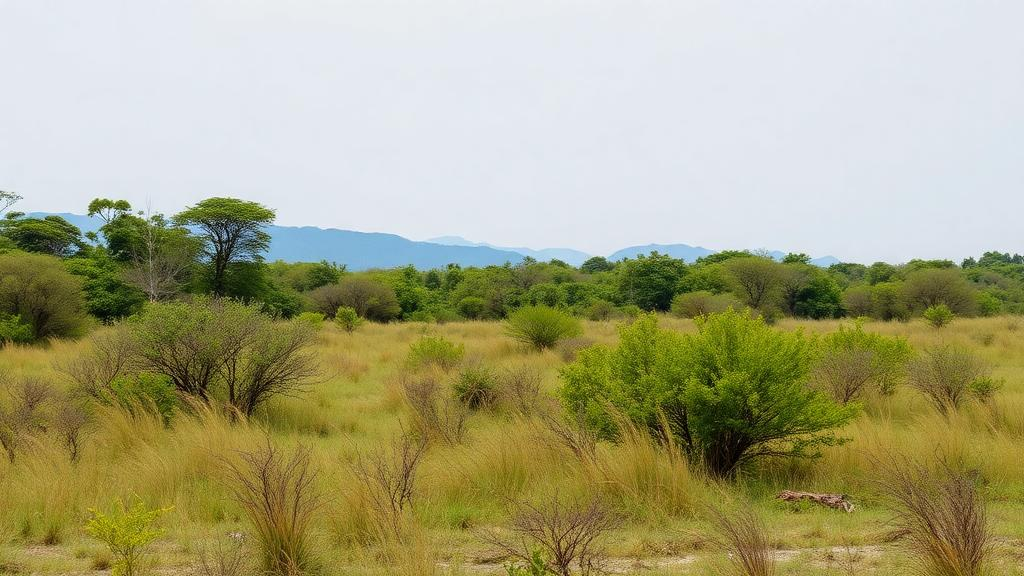
Guatemala’s Pacific coastal plain has been an agricultural engine for more than a century, its volcanic soils converted wholesale into sugarcane fields, coffee farms and rubber plantations. Yet amid this transformed landscape, a new four-year survey has documented a remarkable 218 bird species — roughly 36 percent of the country’s entire avifauna — persisting in the scattered vegetation patches that survive between the crops. The findings, published in Neotropical Biology and Conservation, offer both an encouraging count and a sobering warning about the direction in which this fragmented bird community is drifting.
Between 2018 and 2022, researchers established 166 bird counting points across four departments — Suchitepéquez, Escuintla, Retalhuleu and Santa Rosa — each with a 30-meter radius of influence. The points were clustered into 28 sampling units and classified into four vegetation types: natural riparian forests along riverbanks, secondary forests in various successional stages, timber forest plantations dominated by teak and Handroanthus, and riparian forest plantations featuring fruit trees such as mango and sapota alongside timber species like Gmelina arborea. Over 661 hours of sampling, conducted during constant-speed walks between adjacent units in the early morning, the team recorded 3,168 individual birds belonging to 218 species across 48 families.
The community’s character was immediately apparent from its most frequent members. The Altamira Oriole led with 122 records, followed by the Golden-fronted Woodpecker with 111, the Rufous-backed Wren with 103, the Great Kiskadee with 100, the White-throated Magpie-jay with 99 and the Cinnamon Hummingbird with 91. Just 17 species contributed more than 40 percent of the entire dataset — a statistical signature of a community dominated by generalists adapted to open habitats. Tyrannidae, the tyrant flycatcher family, was the most species-rich with 36 species, followed by Icteridae with 10 and Picidae, the woodpeckers, with 9.
Technically, the team applied rarefaction and extrapolation curves through the iNEXT package to compare species richness across vegetation types with uneven sampling effort, computing the Chao-1 estimator for the whole study site. That estimator suggested a true richness of 272 species, with a 95 percent confidence interval spanning 248.6 to 315.3, meaning more species almost certainly await discovery as sampling continues. Secondary forest proved the richest habitat, with 172 observed species and an expected richness of about 200, while riparian forest plantations recorded the fewest, at 78 observed species. Interestingly, the interpolation analysis revealed no statistically significant differences in richness or in the diversity of common and dominant species among the four vegetation types, with confidence intervals overlapping throughout.
The composition analysis told a more nuanced story. Nonmetric multidimensional scaling ordination, based on Bray–Curtis similarity after Hellinger standardization, clearly separated the riparian forest plantation assemblage from the other three habitats. The Adonis2 permutation test confirmed this: bird composition in riparian forest plantations differed significantly from forest plantations, riparian forests and secondary forests, while the other vegetation types showed no significant compositional differences. Indicator species analysis explained why. Riparian forest plantations hosted a distinctly aquatic avifauna — Great-tailed Grackles, Great Egrets, Cattle Egrets, Little Blue Herons, Spotted Sandpipers and Black Phoebes — species highly reliant on the water bodies that thread through these fruit-tree corridors.
Beta diversity analysis through the betapart package revealed a moderate species turnover value of 0.401, quantifying how much species replacement occurs among vegetation types. More concerning was the nestedness fraction of 0.261, which indicates that a substantial portion of compositional variation reflects species-poor communities acting as subsets of richer ones. In ecological terms, this pattern suggests a decline in overall biodiversity: the more diverse habitats support a wider range of species, while the less diverse ones are left with only a handful of generalists. The PERMANOVA results reinforced the homogenization signal — bird distribution was significantly influenced by avian family, but neither primary diet nor ecological niche showed significant effects across vegetation types, meaning the community’s functional structure is remarkably uniform regardless of habitat.
Among the 218 species, 159 were residents, 58 migrants and one transcendent. Four threatened species appeared on the IUCN Red List, and their habitat preferences carry real conservation weight. The Yellow-naped Parrot, the only critically endangered species recorded, was observed primarily in secondary forests 21 times, followed by riparian forests, forest plantations and riparian forest plantations. The Orange-fronted Parakeet, listed as Vulnerable, was recorded 25 times across secondary forest, riparian forest and forest plantation. The Chuck-will’s-widow and Eastern Meadowlark, both Near Threatened, were each seen only twice, exclusively in secondary forest. A Central American study cited in the paper estimates the entire wild Yellow-naped Parrot population at just 2,361 individuals, making the Guatemalan coastal plain’s surviving patches almost certainly vital for the species.
The shadow of the region’s ecological past looms over these numbers. Seventy-eight species were observed only once during the entire survey, including forest-associated birds such as the Thicket Tinamou and the Collared Forest-Falcon. Species typical of the subtropical wet forest understory, like the Golden-crowned Warbler, were recorded just once, suggesting their populations are small. Some birds, including large frugivores such as the Military Macaw and Scarlet Macaw, are known to be locally extinct from habitat loss. Roughly 23 percent of observed richness — 54 species — were typically associated with forested habitats, and forest-dependent species accounted for 43 percent of all individuals, more prevalent in secondary and riparian forests than in plantations. Between 2016 and 2020, natural vegetation cover fell below 15 percent in Escuintla, Santa Rosa and Retalhuleu, with Suchitepéquez near 27 percent.
Feeding guild analysis showed insectivores dominating at 58 percent of the community, followed by carnivores at 10 percent, aquatic invertebrate eaters at 8 percent, frugivores at 7 percent, omnivores at 5 percent, granivores and nectarivores at 3 percent each, and scavengers at 1 percent. The researchers interpret this insectivore predominance as evidence that birds are exploiting abundant insect prey in agricultural settings, which can reduce beta diversity as species composition becomes more uniform across habitats. This functional redundancy — multiple species fulfilling similar ecological roles — may mask the true differences in species turnover that would appear under more natural conditions, a phenomenon documented in other Mesoamerican agroecosystems from Nicaragua to Costa Rica and Colombia.
The study’s conclusion is a call for landscape-level conservation. Protecting and restoring seminatural patches, even modestly sized ones, can be critical for safeguarding biodiversity in human-dominated landscapes, the authors argue. Riparian habitats deserve particular priority, given their unique bird assemblages and their role as corridors. Management strategies such as selective logging, promoting natural regeneration, and integrating biodiversity considerations into agricultural policies could improve habitat quality and aid the recovery of sensitive bird populations. Scattered native trees like Enterolobium cyclocarpum, Bursera simaruba and Ceiba pentandra provide foraging and perching opportunities, and previous research has shown that increased canopy cover, tree density and structural complexity correlate positively with both resident and migratory bird presence. In a region where sugarcane stretches to the horizon, the survival of Guatemala’s coastal plain birds may depend on the humble forest fragments that remain between the fields.
Subject of Research: Bird diversity in different vegetation types in the Pacific coastal plain of Guatemala
Article Title: Bird diversity in different vegetation types in the Pacific coastal plain of Guatemala
Article References: Aguilar-Jocol, S., Bustamante-Castillo, M., & Tax, M. (2025). Bird diversity in different vegetation types in the Pacific coastal plain of Guatemala. Neotropical Biology and Conservation, 20(1), 1-19. https://doi.org/10.3897/neotropical.20.e131792
Image Credits: AI Generated
DOI: 10.3897/neotropical.20.e131792
Keywords: ornithology, conservation biology, Neotropics, Guatemala, biodiversity, agroecosystems, Bird, diversity, different, vegetation, types, Pacific
Cite Scienmag News
Margaret Porter. (October 17, 2026). Bird surveys reveal which vegetation patches still keep Guatemala’s coastal plain alive. Scienmag. https://scienmag.com/bird-surveys-reveal-which-vegetation-patches-still-keep-guatemalas-coastal-plain-alive/
Margaret Porter. "Bird surveys reveal which vegetation patches still keep Guatemala’s coastal plain alive." Scienmag, 17 October 2026, https://scienmag.com/bird-surveys-reveal-which-vegetation-patches-still-keep-guatemalas-coastal-plain-alive/. Accessed 17 October 2026.
Margaret Porter. "Bird surveys reveal which vegetation patches still keep Guatemala’s coastal plain alive." Scienmag. October 17, 2026. https://scienmag.com/bird-surveys-reveal-which-vegetation-patches-still-keep-guatemalas-coastal-plain-alive/


