


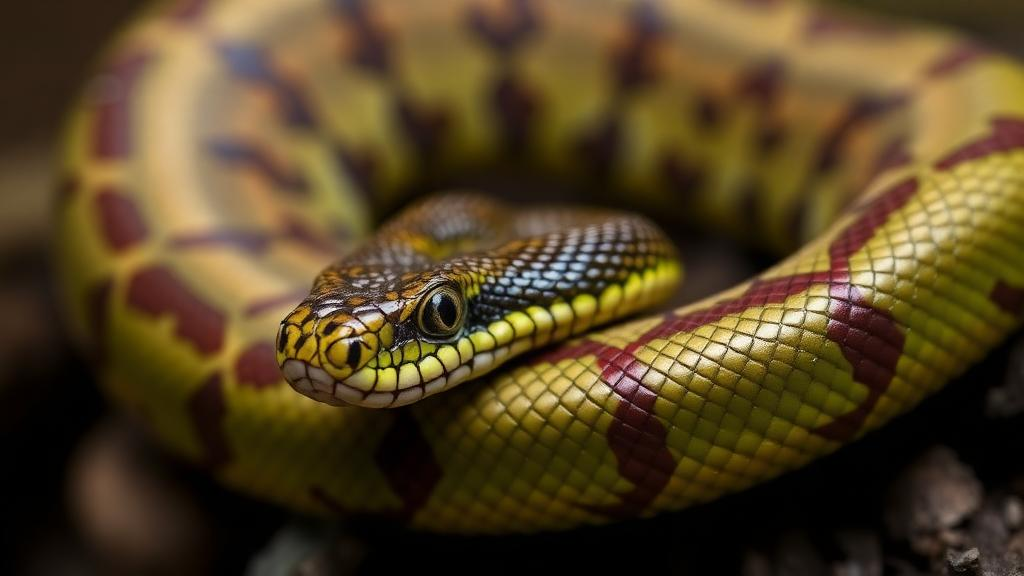
Deep in the karst landscapes of southern China, a small brown snake has been quietly hiding in plain sight. Researchers have formally described a new species of reed snake, Calamaria incredibilis, from two localities in the Guangxi Zhuang Autonomous Region, and the discovery is shaking up what scientists thought they knew about one of Asia’s most taxonomically stubborn snake lineages. The name incredibilis, Latin for unbelievable or extraordinary, refers to the unexpectedly high level of cryptic diversity revealed by the find, particularly given how geographically close the new species is to its nearest relatives.
The genus Calamaria comprises small, semi-fossorial snakes distributed across northeastern India, mainland Southeast Asia, the Greater Sunda Islands, the Philippines, and beyond, with some species crossing Wallace’s Line to inhabit Sulawesi and the Maluku Islands. These are secretive, worm-like serpents with cylindrical bodies, short thick tails, indistinct boundaries between head and neck, small eyes with round pupils, and reduced head scalation. Nine species had previously been recorded in China, but six of those were described or revalidated only in the past decade, a signal that diversity and taxonomy in the genus remain far from completely understood.
At the center of the confusion sits Calamaria pavimentata, originally described from Java Island in Indonesia in 1854. Its type locality has been questioned because no confirmed records of the species have actually been found on Java. In China, C. pavimentata was long reported to have a wide distribution spanning Fujian, Guangdong, Guangxi, Guizhou, Hainan, Sichuan, Taiwan, Yunnan, and Zhejiang. Recent integrative taxonomic work, combining morphological comparisons with mitochondrial DNA data, has shown that several Chinese populations previously assigned to C. pavimentata were actually misidentifications of recently described species such as C. arcana, C. similis, or C. synergis. The traditional concept of C. pavimentata in China likely bundles together multiple cryptic or morphologically similar species.
During fieldwork in Chongzuo and Guilin cities, researchers collected two unidentified snake specimens that were tentatively assigned to Calamaria based on diagnostic characters including a cylindrical vermiform body, a short thick tail, smooth dorsal scales in thirteen rows, a single cloacal plate, and paired subcaudal scales. Based on scalation and tail tip morphology, the specimens were initially identified as Calamaria cf. pavimentata. Subsequent detailed morphological examination, however, revealed a suite of characters clearly distinguishing them from all described species of the genus, and molecular analyses confirmed they were significantly distinct from C. pavimentata from Java, C. jinggangensis, C. similis, and other congeners.
Morphologically, Calamaria incredibilis is distinguished by a specific combination of characters: nine enlarged maxillary teeth; a rostral scale higher than wide; a prefrontal shorter than the frontal and contacting the first two supralabials; a mental scale not in contact with the anterior chin shields; dorsal scales in thirteen smooth rows throughout; a single preocular and postocular; four supralabials with the second and third contacting the eye; five infralabials; six scales surrounding the paraparietal; 170 to 182 ventral scales in males; 21 to 23 paired subcaudals in males; and a relatively short tail, 8.2 to 8.4 percent of total length in males, thick and nearly cylindrical, gradually tapering to an obtuse point. The dorsal coloration is brown with seven longitudinal series of interrupted dark brown stripes running from behind the pale collar to the tail tip, while the margins of the dorsal scales are heavily suffused with black pigment forming an almost reticulate pattern. The ventral surface is yellowish white with dark brown blotches along the outermost lateral margins, and light spots are absent from the dorsal tail.
Phylogenetic analyses based on mitochondrial cytochrome b sequences recovered Calamaria incredibilis as a well-supported independent lineage forming a sister relationship with a subclade comprising C. andersoni, C. synergis, and C. yunnanensis. The new species is separated from its closest relatives by substantial mitochondrial genetic divergence, with uncorrected p-distances of 12.67 percent based on the cytochrome b gene. The final alignment contained 1,109 aligned nucleotides, of which 554 sites were conserved, 555 variable, and 481 parsimony-informative. Both maximum likelihood and Bayesian inference analyses yielded largely congruent topologies, strongly supporting the genus Calamaria as monophyletic and grouping all sampled species into three major clades corresponding to Sundaland, Northeast India, and Indochina with China and East Asian islands.
Genetic distances tell a striking story. Pairwise interspecific distances among the Calamaria species examined ranged from 6.29 percent between C. jinggangensis and C. arcana to 24.95 percent between C. berezowskii and C. schlegeli. The new species differs from C. yunnanensis by 14.97 percent, from C. andersoni by 14.52 percent, and from C. synergis by 12.72 percent. Intraspecific divergence between the two samples of C. incredibilis from Chongzuo and Guilin was moderate at 4.19 percent, comparable to or higher than values observed in several other Calamaria species, including C. gervaisii at 8.87 percent and C. cf. lumbricoidea at 7.48 percent.
The two known specimens, both adult males, came from localities separated by more than 500 kilometers. The holotype, SYS r002596, was collected from Nazhi Village in Ningming County, Chongzuo City, at an altitude of 1,060 meters, while the paratype, GEP r093, came from Huaping National Nature Reserve in Lingui District, Guilin City, at 760 meters. Both were encountered on roads during daytime surveys. Given the semi-fossorial habits of the species, it likely has a broader distribution within Guangxi, and because the holotype was collected near the China-Vietnam border, researchers hypothesize the species may also occur in Mau Son Mountain in Lang Son Province, northern Vietnam. Due to the very limited number of confirmed records and the lack of information on population size, trends, and threats, the species is provisionally recommended for assessment as Data Deficient under IUCN Red List criteria.
To study skeletal morphology, researchers performed detailed micro-CT scanning on the holotype using a dual tube system at the Institute of Vertebrate Paleontology and Paleoanthropology in Beijing. The skull is subcylindrical in general shape, with strong laterally expanded nasals and septomaxillae, broad flattened conchal processes, right-triangle-shaped frontals, and a scutiform parietal longer than wide. The maxillary teeth are laterally compressed, reduced in number, with distal tips posteriorly recurved, numbering nine on each maxilla, alongside six palatine teeth, ten to eleven pterygoid teeth, and eight dentary teeth per side. This osteological detail adds a dimension rarely captured in descriptions of small fossorial snakes.
The discovery adds further evidence that populations historically assigned to Calamaria pavimentata in southern China do not represent a single widespread species but instead comprise multiple independent evolutionary lineages. Guangxi emerges as a particularly important hotspot of cryptic diversification, representing a biogeographic transition zone between southern China and northern Indochina characterized by extensive karst formations, pronounced elevational heterogeneity, and complex geological history. These factors likely promoted lineage isolation and subsequent diversification. The geographic proximity and potential sympatry of the new species with other members of the complex suggest diversification was not driven exclusively by strict allopatric isolation; historical range shifts followed by secondary contact, or fine-scale habitat heterogeneity, may have played important roles. Consistent morphological differences among closely related species, such as relative tail length, ventral scale counts, tail shape, and ventral coloration, may reflect subtle ecological differentiation linked to burrowing behavior, microhabitat use, or resource partitioning, potentially facilitating stable coexistence among congeners. Future research should prioritize increased sampling across southern China and adjacent regions, especially Guizhou and Hunan provinces and northern Vietnam, and incorporate nuclear genetic markers alongside ecological and behavioral data to clarify species boundaries and reconstruct the evolutionary history of this remarkably hidden lineage.
Subject of Research: An unexpected discovery of hidden diversity: a new species of the genus Calamaria H. Boie in F. Boie, 1827 (Squamata, Calamariidae) from Guangxi, China
Article Title: An unexpected discovery of hidden diversity: a new species of the genus Calamaria H. Boie in F. Boie, 1827 ( Squamata , Calamariidae ) from Guangxi, China
Article References: Qi, S., Nguyen, T. V., Wang, J., Zeng, Z.-C., Shi, J.-S., Xu, Y.-H., Song, H.-M., Huang, Z., Mo, Y.-M., Poyarkov, N. A., & Wang, Y.-Y. (2026). An unexpected discovery of hidden diversity: a new species of the genus Calamaria H. Boie in F. Boie, 1827 (Squamata, Calamariidae) from Guangxi, China. Zoosystematics and Evolution, 102(2), 701-718. https://doi.org/10.3897/zse.102.188045
Image Credits: AI Generated
Keywords: unexpected, discovery, hidden, diversity, species, genus, Calamaria, Boie, Squamata, Calamariidae, Guangxi, China
Cite Scienmag News
Drew Townsend. (October 17, 2026). Hidden snake species found in Guangxi reveals unbelievable cryptic diversity. Scienmag. https://scienmag.com/hidden-snake-species-found-in-guangxi-reveals-unbelievable-cryptic-diversity/
Drew Townsend. "Hidden snake species found in Guangxi reveals unbelievable cryptic diversity." Scienmag, 17 October 2026, https://scienmag.com/hidden-snake-species-found-in-guangxi-reveals-unbelievable-cryptic-diversity/. Accessed 17 October 2026.
Drew Townsend. "Hidden snake species found in Guangxi reveals unbelievable cryptic diversity." Scienmag. October 17, 2026. https://scienmag.com/hidden-snake-species-found-in-guangxi-reveals-unbelievable-cryptic-diversity/


