


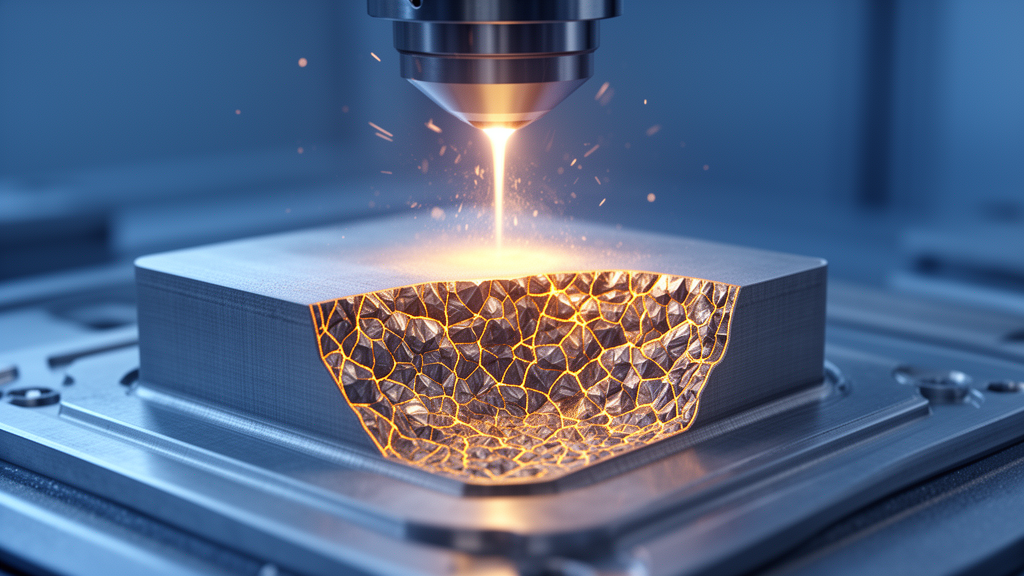
Researchers at Northwestern Polytechnical University in Xi’an have shown that a simple annealing treatment can dramatically reshape the internal grain architecture of 316L stainless steel printed by micro laser powder bed fusion, a precision 3D-printing technique for tiny metal components. By heating the as-printed alloy to 1100 degrees Celsius for one hour, the team raised the fraction of special twin boundaries in the material to 55.6 percent and nearly doubled its elongation to failure, from roughly 30 percent to about 48 percent. The work, published in the Journal of Materials Science, demonstrates a shortcut to grain boundary engineering that sidesteps the expensive forging and rolling steps traditionally required.
Grain boundary engineering is the deliberate manipulation of the types of boundaries that separate individual crystals in a polycrystalline metal. Not all grain boundaries are equal: random high-angle boundaries act as highways for crack propagation and corrosion, while so-called special boundaries, particularly annealing twins with low coincidence site lattice values, are far more resistant to damage. Since Tadashi Watanabe first proposed the concept in 1984, engineers have pursued stronger, more ductile polycrystals by boosting the share of these benign boundaries. The catch is that conventional routes demand repeated cycles of plastic deformation and annealing, complex forming procedures, and high costs, which limits their practical reach.
The Xi’an team, led by Huibin Jia with Hui Chen and Xin Lin as corresponding and senior authors, recognized that micro laser powder bed fusion offers an unusual starting point. The technique fabricates high-precision components by selectively melting powder with a micro-scale laser beam, and the resulting alloy emerges with an exceptionally high dislocation density. Dislocations are line defects in the crystal lattice, and in the as-printed 316L they accumulate from the intense thermal gradients and rapid solidification inherent to the process. Crucially, this dense dislocation network exists in a material that has never been plastically deformed, making it a deformation-free precursor for recrystallization-based grain boundary engineering.
When the researchers annealed the as-built specimens, the stored dislocations supplied the driving force for recrystallization, in which new strain-free grains nucleate and grow, consuming the defective lattice. The annealed samples developed an optimized grain boundary character distribution, the statistical portrait of which boundary types populate the microstructure. Twin-related domains proved central to this manipulation. These domains arise not from grain coarsening after recrystallization, the team found, but from interface reactions involving strain-induced grain boundary migration during the early stages of annealing, in which existing boundaries sweep through the dislocation-rich lattice and leave twin boundaries in their wake.
A key mechanistic insight concerned the two dislocation populations identified in the as-built material. Statistically stored dislocations accumulate as tangled networks within grains, while geometrically necessary dislocations accommodate local strain gradients, such as those between the fine cellular substructures characteristic of printed 316L. Both populations decreased after annealing, but the evidence points to the geometrically necessary dislocations as the dominant driver of recrystallization. This distinction matters for anyone seeking to control the process, because it suggests that tuning the printing parameters to shape the geometrically necessary dislocation structure could offer a lever for engineering the final grain boundary character distribution.
The mechanical consequences were striking. The as-built alloy posted a yield strength of 620 megapascals, an ultimate tensile strength of 721 megapascals, and an elongation to failure of 29.8 percent, figures that reflect the strengthening contribution of its dense dislocation network. After annealing, the yield strength fell sharply to 322 megapascals, a direct consequence of the dislocation density reduction. Yet the ultimate tensile strength dropped only slightly, by about 30 megapascals to roughly 688 megapascals, while the elongation to failure climbed to about 48 percent, an increase of nearly 60 percent. The annealed material thus trades some of its early resistance to plastic flow for a far greater capacity to deform before breaking.
The twin boundaries themselves contribute to this improved ductility in several ways. Annealing at 1100 degrees Celsius for one hour produced a high fraction of twin boundaries, 55.6 percent, accompanied by twin-induced grain refinement, which subdivides grains into smaller twin-related domains. In face-centered cubic metals such as 316L, twin boundaries impede dislocation motion while still allowing dislocations to pass through under sufficient stress, a behavior that promotes gradual, distributed plastic deformation rather than abrupt strain localization. Prior studies have linked high twin boundary fractions to improved resistance to creep, fatigue, and fracture in nickel-based superalloys and other engineering metals, and the present results extend that logic to a printed austenitic stainless steel.
What makes the approach genuinely novel is its simplicity. Conventional grain boundary engineering requires thermomechanical processing routes that involve heavy deformation, precise control of strain and temperature, and multiple iterations, all of which add cost and complexity, particularly problematic for small or intricate parts where forging is impractical. Here, the printing process itself generates the dislocation density that recrystallization needs, and a single annealing step completes the transformation. The researchers describe the as-built microstructure as a deformation-free precursor, meaning the alloy arrives at the annealing furnace already primed for grain boundary engineering without any prior mechanical working.
The implications reach beyond 316L. Micro laser powder bed fusion is attracting attention for fabricating miniature components in aerospace, medical devices, and precision instrumentation, where the ability to print tiny, complex geometries with fine features is essential. The Xi’an group’s results suggest that any alloy printed by this technique, with its characteristic high dislocation density, could be transformed into a grain boundary engineered material through a straightforward heat treatment. The team notes that the twin-related domains play a central role in manipulating the grain boundary character distribution, and that understanding the interface reactions during early-stage annealing offers a pathway to deliberately design the final microstructure.
For the broader materials community, the study adds to a growing body of work on additive grain boundary engineering, a concept that broadens the design space of engineering materials by exploiting the unique microstructures that additive manufacturing produces. The finding that geometrically necessary dislocations, rather than statistically stored dislocations, likely dominate the recrystallization driving force provides a mechanistic foundation for future work. As printed metals continue to move from laboratory curiosities to certified structural components, techniques that enhance ductility without sacrificing much strength will be essential, and this annealing-based route offers a remarkably accessible example of how the printing process and a single heat treatment can work together to produce stronger, tougher, and more reliable parts.
Subject of Research: Grain boundary engineering of micro laser powder bed fusion 316L alloy: manipulating grain boundary character distribution for enhanced mechanical properties
Article Title: Grain boundary engineering of micro laser powder bed fusion 316L alloy: manipulating grain boundary character distribution for enhanced mechanical properties
Article References: Jia, H., Guan, L., Sun, Y., Wang, J., Chen, H., & Lin, X. (2026). Grain boundary engineering of micro laser powder bed fusion 316L alloy: manipulating grain boundary character distribution for enhanced mechanical properties. Journal of Materials Science, 61(43), 33896-33913. https://doi.org/10.1007/s10853-026-13541-x
Image Credits: AI Generated
DOI: 10.1007/s10853-026-13541-x
Keywords: additive manufacturing, 316L stainless steel, grain boundary engineering, laser powder bed fusion, annealing twins, mechanical properties, Grain, boundary, engineering, micro, laser, powder
Cite Scienmag News
Denise Maddox. (October 17, 2026). 3D-Printed Steel Gets Ductility Boost by Tweaking Grain Boundaries. Scienmag. https://scienmag.com/3d-printed-steel-gets-ductility-boost-by-tweaking-grain-boundaries/
Denise Maddox. "3D-Printed Steel Gets Ductility Boost by Tweaking Grain Boundaries." Scienmag, 17 October 2026, https://scienmag.com/3d-printed-steel-gets-ductility-boost-by-tweaking-grain-boundaries/. Accessed 17 October 2026.
Denise Maddox. "3D-Printed Steel Gets Ductility Boost by Tweaking Grain Boundaries." Scienmag. October 17, 2026. https://scienmag.com/3d-printed-steel-gets-ductility-boost-by-tweaking-grain-boundaries/


