


A wave of car thefts that began sweeping the United States in 2020 may not crest for decades. Researchers at the University of California, Los Angeles, led by anthropologist Jeffrey Brantingham, have traced the surge in thefts of certain Kia and Hyundai models to an unlikely convergence of forces: missing anti-theft hardware, pandemic-era disruptions to daily routines, traditional news coverage, and a viral social media phenomenon known as the Kia Boys. Their new study, published in the International Journal of Forecasting, projects that these vehicles will remain targets through at least 2042 and likely through 2050.
Brantingham has spent two decades studying car theft, but the Kia and Hyundai episode presented an unusually rich case. The surge began in several U.S. cities, including Los Angeles, before spreading nationwide. To understand it, his interdisciplinary team combined ideas from foraging ecology, social learning theory, criminology, and methods drawn from mathematical modeling and computer science. Working with data from the Los Angeles Police Department, the researchers built forecasts showing that the theft wave is not a short-lived spike tied to a fleeting internet trend, but a slow-moving phenomenon governed by the life cycle of the vehicles themselves.
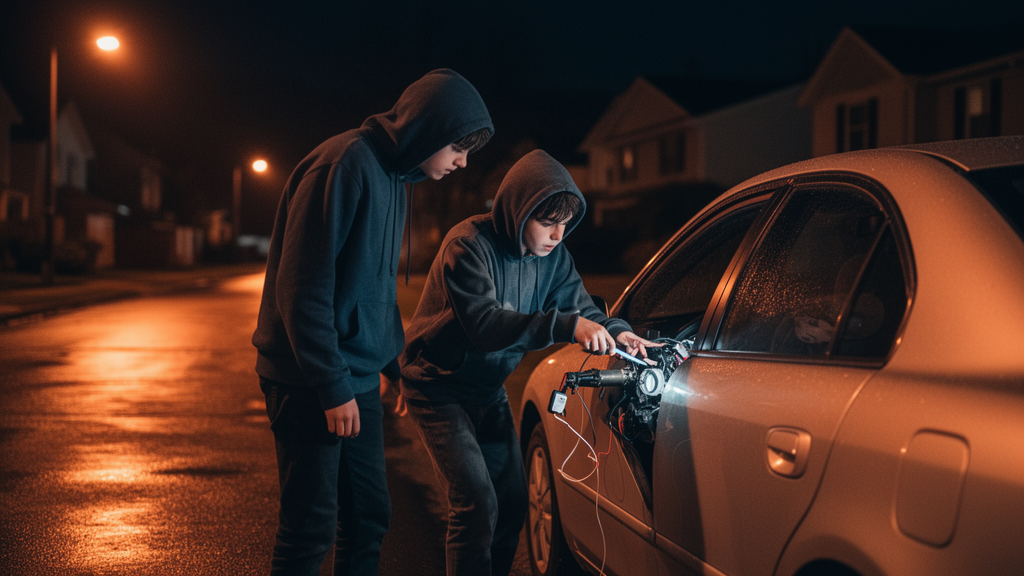
The root of the problem lies in a manufacturing decision. From 2011 to 2022, Kia and Hyundai left engine immobilizers out of 20 car models. These electronic devices, standard anti-theft equipment in most modern vehicles, prevent an engine from starting without the correct key. Without one, stealing the affected cars became a relatively low-skilled crime. During the COVID-19 pandemic, when cars sat unattended on the street for long stretches and school and business closures left young people with more unstructured time, even inexperienced thieves had hours to experiment. The technique they learned was simple: pry apart the steering wheel casing, expose the starter, and turn the ignition with a plain USB cable.
Social media then amplified what had begun as a localized discovery. Videos tagged Kia Boys or Kia Challenge spread across YouTube and TikTok, some offering step-by-step instructions for the thefts. But Brantingham notes that even clips without explicit instructions were enough to signal to naive thieves that these models could be taken in minutes. Social media, he observed, is remarkably effective at creating experts when the required skill is low. The platforms did not invent the vulnerability, but they broadcast it, standardized it, and glamorized the joyrides that followed.
Perhaps the most counterintuitive finding concerns traditional media. The evidence from Los Angeles indicates that the vulnerability was initially discovered without the help of social media, and the same pattern held in Milwaukee, the birthplace of the Kia Boys posts, as well as in Denver. Print and cable news coverage of the theft wave may itself have encouraged copycats, the researchers suggest, extending the crime spree to places that viral videos never reached directly. The interplay between old and new media, rather than either alone, appears to have shaped the trajectory of the epidemic.
One of the most striking insights from the study is geographic. Crime hotspots, the researchers found, move with the underlying new and used car market. New vehicles tend to be sold in more affluent areas, held for a couple of years, and then resold. As cars age and depreciate, each change of hands shifts them toward less affluent neighborhoods. A vulnerable vehicle that began its life on an affluent street in Los Angeles will, some twenty to twenty-five years later, likely end its life in a far less prosperous one. The same pattern held for Honda Civics and Toyota Camrys, frequent targets in the 1980s, 1990s, and 2000s, and it will hold for the Kia and Hyundai models as well.
For people living in those less affluent areas, Brantingham explained, the crime hotspot comes to them. The movement is not about offenders relocating from one neighborhood to another, he said, but about ripe criminal targets migrating through the used car market. This means that by the time higher-income areas of Los Angeles have long forgotten the Kia Boys vulnerability, lower-income communities will still be absorbing the aging, unprotected vehicles as they drift toward the end of their life cycles. The burden of the crime wave, in other words, is not static; it travels with the cars.
The forecast that thefts will continue through at least 2042, and likely through 2050, follows directly from this logic. Because the vulnerable models remain on the road and continue to change hands, the pool of easy targets persists for decades. The research, funded by the Air Force Office of Scientific Research, offers a quantitative window into how social media shapes offline crime and how long the shadow of a single manufacturing decision can stretch across a vehicle fleet.
There are practical lessons for consumers. Brantingham points to the demonstrated success of electronic engine immobilizers, noting that Toyota introduced them on the Camry in 1992 and Honda on the Civic in 2001, with marked reductions in theft. His advice is straightforward: verify that any car you buy comes with an immobilizer as standard equipment, and if you own an older model without one, buy a steering wheel lock and use it correctly. Owners of vulnerable Kia and Hyundai models should also take advantage of manufacturer recalls that improve anti-theft technology, or consider trading in the vehicle for one with modern protections.
Policy has begun to catch up as well. A class action lawsuit brought by 36 states against Kia and Hyundai led to a settlement in 2025 in which both companies agreed to equip all future cars with industry-standard engine immobilizer anti-theft technology, provide ignition cylinder protectors, and offer some monetary compensation for cars damaged by thieves. For Brantingham, the episode carries a broader significance beyond one brand or one crime wave. We live in one of the safest times ever recorded, he noted, yet crime remains incredibly common, and documenting how people behave in complex online and offline environments is core to a better understanding of the human condition.
Subject of Research: Forecasting the impact of the viral Kia Boys social media trend on Kia and Hyundai car thefts in the United States
Article Title: Car owners beware! Lessons from the ‘Kia Boys’ crime spree
Article References: Car owners beware! Lessons from the ‘Kia Boys’ crime spree. (n.d.). Original publication
Image Credits: AI Generated
DOI: Not provided
Keywords: Kia Boys, car theft, Hyundai, Kia, social media, engine immobilizer, UCLA, criminology, forecasting, used car market, TikTok, COVID-19
Cite Scienmag News
Kristina Jarvis. (October 17, 2026). Viral Kia Boys Trend May Keep Fueling Car Thefts Until 2050. Scienmag. https://scienmag.com/viral-kia-boys-trend-may-keep-fueling-car-thefts-until-2050/
Kristina Jarvis. "Viral Kia Boys Trend May Keep Fueling Car Thefts Until 2050." Scienmag, 17 October 2026, https://scienmag.com/viral-kia-boys-trend-may-keep-fueling-car-thefts-until-2050/. Accessed 17 October 2026.
Kristina Jarvis. "Viral Kia Boys Trend May Keep Fueling Car Thefts Until 2050." Scienmag. October 17, 2026. https://scienmag.com/viral-kia-boys-trend-may-keep-fueling-car-thefts-until-2050/


