


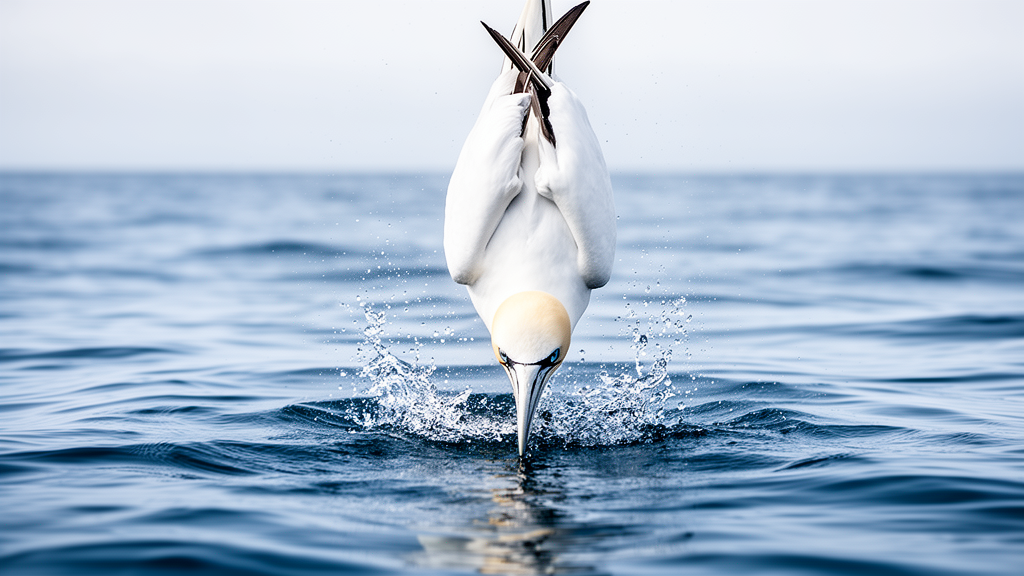
From a height of roughly 100 feet, a northern gannet picks out a shimmering school of fish beneath the ocean surface, folds its wings back, and pitches into a vertical nosedive. Within moments its body is slicing into the water at speeds approaching 70 miles per hour, an impact that by any intuitive measure should shatter its neck. Yet this maneuver is not a stunt; it is routine hunting behavior repeated thousands of times across a gannet’s life. The apparent paradox of a slender-necked bird surviving a collision that would injure a human diver has long intrigued biologists, and a new study from the University of Washington offers the most detailed anatomical explanation yet for how plunge-diving seabirds manage it.
The research, published on October 12 in The Anatomical Record, shows that gannets and their close relatives the boobies possess distinctive morphological adaptations in the cervical vertebrae that allow their necks to withstand enormous compressive forces. Using computed tomography scans of museum specimens and a statistical shape-analysis technique called geometric morphometrics, the team found that these birds have both stockier vertebrae and an additional joint surface between several neck bones that stabilizes the cervical column at the moment of impact. The findings illuminate a remarkable case in which skeletal architecture has been shaped by one of the most physically demanding feeding strategies in the animal kingdom.
Senior author Bart Boom, a postdoctoral scholar at the University of Washington’s Friday Harbor Laboratories, said the goal was to understand what makes gannets so exceptionally good at diving by examining their biology in detail. The ecological record is full of examples in which birds evolve physical traits in response to their environments, a pattern famously noted by Charles Darwin in the 1830s when he studied finches on the Galápagos Islands. The relationship between beak shape and foraging behavior is well documented in ornithology, but far less attention has been paid to how neck structure relates to the way birds feed. This study helps fill that gap by connecting a specific skeletal feature to a specific and violent feeding style.
The engineering puzzle at the heart of the research is deceptively simple. When a gannet hits the water, the head and neck absorb immense pressure that compresses the cervical column. Engineers designing structures to tolerate compressive force typically favor short, fat elements, because slender columns are prone to buckling. Gannets, however, have long, slender necks built from fifteen stacked vertebrae that bend slightly in an s-curve, precisely the geometry that would seem most vulnerable to collapse under load. Previous work had shown that the muscles surrounding the vertebrae help lock the neck into place in preparation for impact, but few studies had examined the actual shape of the bones themselves in diving birds.
To address that question, the researchers collected specimens of both diving and non-diving birds from the Burke Museum at the University of Washington. They performed CT scans to build detailed three-dimensional models of the cervical vertebrae and then analyzed the images using geometric morphometrics, a statistical method that establishes comparable landmarks across biological samples. The team considered the forces associated with various feeding styles and selected birds representing a spectrum of head and neck use, supplementing their own scans with morphological data drawn from earlier studies. This comparative framework allowed them to ask whether the shape of a bird’s neck bones tracks the mechanical demands of its feeding behavior.
The answer, according to lead author Megan Vanderberg, a graduate student of biology at Friday Harbor Laboratories, was clear. Birds that rotate their heads from side to side or move them front to back separated cleanly in the analysis from birds that use their heads in compression. The plunge-divers stood out with more robust vertebrae that were thicker, wider, and shorter, shaped more like a square than like the elongated elements found in their non-diving relatives. That stocky geometry provides added resistance to the compressive loads a dive generates, effectively converting a seemingly fragile neck into a load-bearing column at the instant of water entry.
The second key discovery concerns an additional contact surface, called an articular facet, present between the second through the sixth cervical vertebrae in gannets and boobies. The researchers believe this extra facet prevents the neck from bending backward when the bird strikes the water at an angle, a scenario that could otherwise hyperextend and injure the cervical column. Instead of allowing the neck to fold, the facet transfers the load down the length of the spine, distributing the force across multiple segments rather than concentrating it at a single vulnerable joint. It is a subtle modification of joint anatomy with profound consequences for survival at high speed.
Perhaps the most striking result is that this solution appears to have evolved more than once. The researchers observed similarly blocklike vertebrae in kingfishers, birds from an entirely different avian family that are far smaller than gannets and boobies but also dive headfirst into water to catch prey. The kingfishers lacked the extra articular facet, but their necks show a comparable shift toward robust, compression-resistant shapes. The structural relationship is also proportional: the larger the neck, the larger the vertebrae. This convergence suggests that the mechanical demands of plunge-diving impose a predictable signature on neck anatomy, one that natural selection has reached through slightly different routes in different lineages.
The biomechanical measurements reinforce that interpretation. Kingfishers and the larger plunge-divers experience the same amount of force per unit of neck area during a dive, meaning that although total force scales with neck size, the strain on the tissue remains constant across the two groups. Both groups also experienced peak force nearly five milliseconds after impact, despite their substantial difference in body size. That shared timing and shared per-area loading point to a common physical constraint: whatever the scale of the animal, the neck must be built to absorb a brief but intense compressive pulse, and square-shaped vertebrae appear to be an effective answer at any size.
The implications extend beyond living birds. Because the link between vertebral shape and plunge-diving appears so consistent, the researchers think the same structural relationship could help paleontologists identify plunge-diving species from fossil remains, offering a new tool for reconstructing the feeding ecology of extinct birds. The team now hopes to explore in more detail how force travels down the neck during a dive, and Vanderberg noted that the work has changed how she views vertebrae generally, prompting curiosity about their mechanics well beyond birds. For now, the study stands as a vivid reminder that even the most dramatic behaviors in nature, like a gannet’s 70-mile-per-hour dive, rest on quiet, precise details of bone architecture refined over millions of years of evolution.
Subject of Research: Cervical vertebrae adaptations that enable plunge-diving seabirds to withstand high-speed water impact
Article Title: Reinforced vertebrae allow plunge-diving seabirds to survive high-speed impact
Article References: Reinforced vertebrae allow plunge-diving seabirds to survive high-speed impact. (n.d.). Original publication
Image Credits: AI Generated
DOI: Not provided
Keywords: gannets, boobies, plunge-diving, cervical vertebrae, articular facet, biomechanics, geometric morphometrics, kingfishers, Anatomical Record, University of Washington, evolutionary morphology, seabirds
Cite Scienmag News
Gavin Prescott. (October 17, 2026). Built to Break the Surface: How Reinforced Vertebrae Save Diving Seabirds from Deadly Impact. Scienmag. https://scienmag.com/built-to-break-the-surface-how-reinforced-vertebrae-save-diving-seabirds-from-deadly-impact/
Gavin Prescott. "Built to Break the Surface: How Reinforced Vertebrae Save Diving Seabirds from Deadly Impact." Scienmag, 17 October 2026, https://scienmag.com/built-to-break-the-surface-how-reinforced-vertebrae-save-diving-seabirds-from-deadly-impact/. Accessed 17 October 2026.
Gavin Prescott. "Built to Break the Surface: How Reinforced Vertebrae Save Diving Seabirds from Deadly Impact." Scienmag. October 17, 2026. https://scienmag.com/built-to-break-the-surface-how-reinforced-vertebrae-save-diving-seabirds-from-deadly-impact/


