


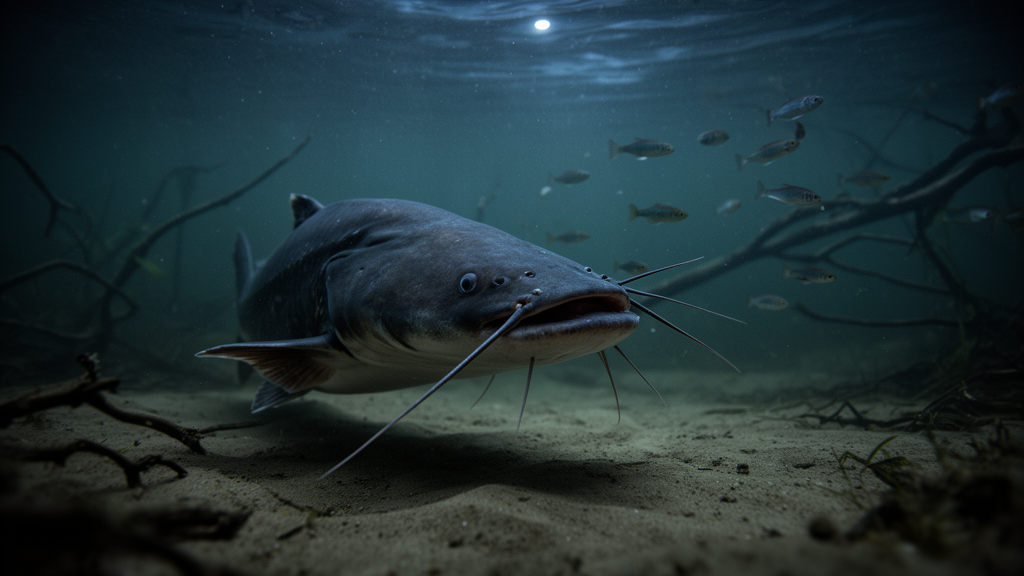
Deep in the middle Negro River basin of the Brazilian Amazon, a slender, boldly patterned catfish has been quietly going about its business, largely unnoticed by science. Now, a team of researchers has pulled back the curtain on the secret life of Ageneiosus lineatus, a medium-sized auchenipterid catfish that prowls the confluence of two strikingly different rivers. The study, published in Acta Ichthyologica et Piscatoria, provides the first integrated look at the feeding ecology, reproductive biology, and population condition of this species, revealing a voracious nocturnal predator with a strong appetite for fish.
The research focused on the Aracá and Demeni rivers and their confluence, tributaries of the Negro River in Amazonas State, Brazil. These waterways present dramatically different limnological profiles: the Aracá carries characteristic black waters rich in dissolved organic compounds, while the Demeni flows with visibly white waters and a low sediment load. Where the two rivers meet, a mixing zone forms a third, unique sampling environment. This confluence of contrasting water types creates a dynamic ecological setting that may shape the availability of prey and the behavior of predators like A. lineatus.
Between 2016 and 2019, the researchers conducted standardized sampling during three hydrological periods, deploying gillnets during both day and night across five consecutive days per campaign. In total, 164 individuals of A. lineatus were collected, ranging from 7.50 to 18.00 cm in standard length and from 4.0 to 362.0 g in total weight. Of these, 104 specimens were analyzed for diet and reproduction, while the remainder contributed to length–weight relationship and condition factor estimates. Notably, 91.46% of all captures occurred during the night, confirming the predominantly nocturnal activity that characterizes the family Auchenipteridae.
The dietary analysis revealed a strikingly carnivorous profile with a strong tendency toward piscivory. Using the frequency of occurrence and volumetric methods combined into the alimentary index, the researchers found that fish dominated the diet of females, accounting for 94.34% of the alimentary index, and 55.40% for males. When all individuals were pooled, fish represented 75.46% of the diet. The fractional trophic level calculated for the species was 3.89 overall, reaching 4.36 in females—firmly within the carnivorous/piscivorous category. This feeding strategy aligns with the broad, protractile mouth morphology of the genus, which is adapted to capture and swallow whole prey.
A high proportion of empty stomachs, 39.42%, was recorded across the sample. This pattern is consistent with observations for other congeneric species such as Ageneiosus pardalis and Ageneiosus ucayalensis, which showed even higher rates of empty stomachs. The researchers attribute this to the feeding behavior of nocturnal piscivorous fish, which digest prey rapidly and feed in discrete, irregular events. Additionally, the flood pulse of the Amazonian system plays a critical role: during high-water periods, small prey fishes disperse into flooded forests and lateral habitats, reducing encounter rates with predators and limiting the detectability of prey in short-term sampling windows.
Reproductive analysis showed that the majority of individuals were in stage II of gonadal maturation, indicating preparation for reproduction during the high-water period. Females reached significantly larger sizes than males in both total weight and standard length, a pattern consistent with teleost species that lack parental care, where greater female size correlates with higher reproductive investment. Interestingly, males matured at slightly smaller lengths than females, with the smallest mature male measuring 11.50 cm in standard length compared to 12.00 cm for females. This difference reflects the lower energetic cost of male gamete production, a common phenomenon among bony fishes.
The sex ratio departed significantly from the expected 1:1 equilibrium, with 1 male to 0.56 females. This deviation contrasts with the pattern documented for A. ucayalensis, a congeneric species in which females are proportionally more abundant. The researchers suggest that variations in capture selectivity, differences in mortality between sexes, or cyclical life-history events may explain this imbalance. However, the limited sampling intervals across hydrological phases prevented definitive conclusions about reproductive seasonality, leaving open the question of whether A. lineatus reproduces in synchrony with the annual flood pulse.
The length–weight relationship estimated for the species revealed positive allometric growth, with an exponent of 3.5339 for all individuals combined. This value exceeds the range recorded in FishBase for the genus, which the researchers explain by the fact that available estimates are generalized rather than species-specific. A previous study reported a lower exponent of 2.4338 for A. lineatus from Catalão Lake in the middle Amazonas River, suggesting that differences may relate to sample size, environmental conditions, or collection methods. The new estimates provide a more robust, species-specific reference for future ecological and management analyses.
Perhaps most notably, the study reports a new maximum standard length for A. lineatus: 18.00 cm, surpassing the previous records of 16 cm in FishBase and 12.9 cm from Catalão Lake. Combined with relative condition factor values above 1 for both sexes and no significant difference between them, these findings indicate a healthy population in good nutritional condition, with adequate prey availability and low competition. The wide size range observed further supports the conclusion that the population in the middle Negro River experiences favorable environmental conditions.
The ecological role of sedentary Amazonian catfishes like A. lineatus remains poorly understood, yet these species occupy important mid-level trophic positions in Amazonian food webs. Some Ageneiosus species appear occasionally in regional fisheries or the ornamental fish trade, while others are discarded by commercial fishers as unvalued resources, a practice that may affect population sustainability when recurrent. The contrasting pressures of exploitation and neglect reinforce the urgency of understanding the biological traits of this group. The researchers emphasize that long-term studies spanning multiple hydrological cycles are essential to unravel reproductive patterns, population dynamics, and trophic responses to changing water levels, and they call for the inclusion of sedentary Amazonian fishes in adaptive management and conservation strategies.
Subject of Research: Trophic ecology and reproductive biology of Ageneiosus lineatus (Actinopterygii, Siluriformes, Auchenipteridae) in the middle Negro River, Brazilian Amazon
Article Title: Trophic ecology and reproductive biology of Ageneiosus lineatus ( Actinopterygii , Siluriformes , Auchenipteridae ) in the middle Negro River, Brazilian Amazon
Article References: Lubich, C., Mc Comb, G., Siqueira-Souza, F., & Freitas, C. (2026). Trophic ecology and reproductive biology of Ageneiosus lineatus (Actinopterygii, Siluriformes, Auchenipteridae) in the middle Negro River, Brazilian Amazon. Acta Ichthyologica et Piscatoria, 56, 91-99. https://doi.org/10.3897/aiep.56.172292
Image Credits: AI Generated
Keywords: Trophic, ecology, reproductive, biology, Ageneiosus, lineatus, Actinopterygii, Siluriformes, Auchenipteridae, middle, Negro, River
Cite Scienmag News
Gavin Prescott. (October 17, 2026). Amazon catfish study reveals a stealthy, fish-hungry night predator. Scienmag. https://scienmag.com/amazon-catfish-study-reveals-a-stealthy-fish-hungry-night-predator/
Gavin Prescott. "Amazon catfish study reveals a stealthy, fish-hungry night predator." Scienmag, 17 October 2026, https://scienmag.com/amazon-catfish-study-reveals-a-stealthy-fish-hungry-night-predator/. Accessed 17 October 2026.
Gavin Prescott. "Amazon catfish study reveals a stealthy, fish-hungry night predator." Scienmag. October 17, 2026. https://scienmag.com/amazon-catfish-study-reveals-a-stealthy-fish-hungry-night-predator/


