


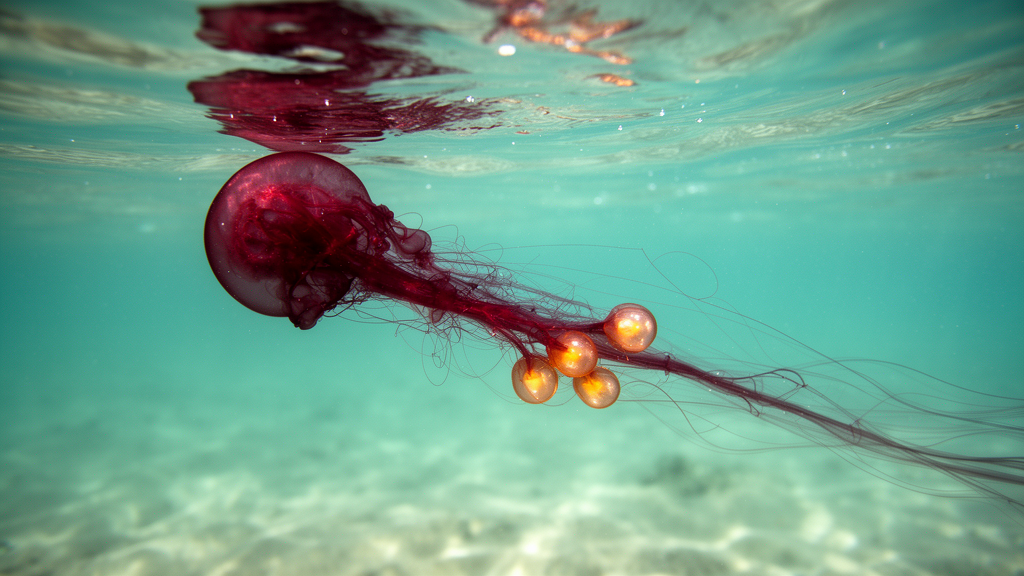
In the cold, kelp-fringed shallows of False Bay near Cape Town, South Africa, a team of snorkeling observers has documented something extraordinary: five colonies of the rare siphonophore Rhizophysa eysenhardtii, a deep-sea predator that has almost never been seen alive at the surface. The observations, made between June and September 2022, represent the first record of this species in False Bay and extend its known southern range by roughly 450 kilometers. The findings, published in African Invertebrates, offer a rare glimpse into the biology of a creature that most scientists have only encountered in preserved fragments or historical illustrations.
Siphonophores are among the most bizarre animals on Earth. Each colony is not a single organism but a superorganism — a floating, drifting assemblage of genetically identical zooids, each specialized for a different task. Some zooids catch prey, some digest it, some reproduce, and some propel the colony through the water. Rhizophysa eysenhardtii belongs to the cystonect group of siphonophores, which includes the infamous Portuguese Man of War. But unlike the Man of War, which has a large float and no stem, Rhizophysa has a smaller gas-filled float, or pneumatophore, at the apex of a long stem that trails behind it, armed with tentacles like living fishing lines.
The five colonies observed in False Bay were photographed and filmed in situ by Jannes Landschoff and Catherine Corder using an Olympus TG6 camera with a fisheye converter. The smallest colonies, seen in June and July, were contracted and measured between 0.05 and 0.1 meters. The September colonies were far larger — the biggest stretched to 0.8 meters in video footage — and displayed most of their tentacles extended for feeding. The colonies were found at depths of just 1 to 3 meters, near a head of bamboo kelp Ecklonia maxima, in remarkably shallow water for a species previously known mostly from deeper pelagic zones.
Identification was based on key morphological features. The tentacles of R. eysenhardtii are characteristically pink, and the side branches, or tentilla, lack the swollen tips found in its congener R. filiformis. Instead, the stinging cells, or nematocysts, are distributed along the entire length of each side branch. The False Bay specimens matched these traits precisely, with pink tentacles clearly visible in contracted colonies and simple tentilla confirmed in the larger, extended specimens. The pneumatophore of the largest colony was estimated at approximately 13 millimeters, consistent with previously described specimens of this species.
The feeding behavior observed was striking. Fish larvae were found inside the gastrozooids — the asexual feeding zooids of the colony — and the researchers counted between 0 and 8 captured larvae per colony by identifying pairs of eyes visible through the transparent tissues. One colony had also captured a chaetognath, a predatory arrow worm, still stuck to a tentacle and not yet ingested. This diet aligns with earlier work by Purcell, who showed that R. eysenhardtii feeds almost exclusively on fish larvae, making it a potentially significant predator in pelagic ecosystems.
What makes these observations particularly valuable is the light they shed on how the colony attracts its prey. Previous research by Haddock and Dunn revealed that a strip of green fluorescence runs along the length of each gastrozooid, likely luring fish larvae toward the colony in the same way that deep-sea anglerfish use bioluminescent lures. This is added evidence that some siphonophores use fluorescent lures to attract fish prey, a strategy also seen in the physonect genus Erenna, whose five species all feed exclusively on fish.
The pneumatophore itself is a marvel of biological engineering. It contains a gas bladder, or pneumatosaccus, surrounded by a hypocystic cavity that is confluent with the gastrovascular cavity of the stem. Hypocystic villi arise from the base of the pneumatosaccus and contain gas-producing cells that secrete carbon monoxide into the bladder. A chitin layer prevents the gas from escaping, except through an apical pore controlled by a sphincter muscle. In the False Bay specimens, this gas chamber was particularly prominent in photographs, reflecting light rays and making the float stand out sharply against the surrounding water.
Reproductive structures were also visible in the larger specimens. Gonodendra — branched complexes bearing sexual gonophores — were seen between the gastrozooids. In the largest colony, a single gonodendron occurred between two gastrozooids, and these structures increased considerably in size toward the posterior end of the stem. Each gonophore releases gametes of one sex only, meaning the colony must produce multiple gonophores to reproduce effectively. The researchers noted that in some specimens there may be two gonodendra per cormidium, though this was not observed in the False Bay colonies.
The range extension is considerable. Previously, the southernmost published record of R. eysenhardtii was slightly southwest of Hondeklip Bay on the west coast of South Africa, at roughly 31 degrees south latitude. The False Bay observations, at about 34 degrees south, push the known distribution approximately 450 kilometers further south. The researchers suggest the species may have arrived via the variability of the Agulhas Current at Cape Hangklip during the winter and spring of 2022, a mechanism previously discussed for other siphonophore species in the region.
Despite being probably common and potentially ecologically important in pelagic zones, published accounts of rhizophysid siphonophores remain scarce. As Totton noted in 1965, these animals rarely come into the hands of systematists, though fishermen suffer from their stings when tentacles adhere to nets and cordage. The False Bay observations add valuable biological and distributional knowledge to a species that has never been sequenced genetically, and they demonstrate that citizen science and careful snorkeling observation can document rare marine creatures in places where formal surveys rarely reach.
Subject of Research: The rare siphonophore Rhizophysa eysenhardtii Gegenbaur, 1859 (Hydrozoa, Siphonophora, Cystonectae) from False Bay, South Africa
Article Title: The rare siphonophore Rhizophysa eysenhardtii Gegenbaur, 1859 ( Hydrozoa , Siphonophora , Cystonectae ) from False Bay, South Africa
Article References: Mapstone, G. M., & Landschoff, J. (2024). The rare siphonophore Rhizophysa eysenhardtii Gegenbaur, 1859 (Hydrozoa, Siphonophora, Cystonectae) from False Bay, South Africa. African Invertebrates, 65(2), 213-221. https://doi.org/10.3897/afrinvertebr.65.136267
Image Credits: AI Generated
DOI: 10.3897/AfrInvertebr.65.136267
Keywords: rare, siphonophore, Rhizophysa, eysenhardtii, Gegenbaur, Hydrozoa, Siphonophora, Cystonectae, False, South, Africa, scientific research
Cite Scienmag News
Margaret Porter. (October 17, 2026). Rare Siphonophore Rhizophysa eysenhardtii Spotted in Shallow Waters of False Bay, South Africa. Scienmag. https://scienmag.com/rare-siphonophore-rhizophysa-eysenhardtii-spotted-in-shallow-waters-of-false-bay-south-africa/
Margaret Porter. "Rare Siphonophore Rhizophysa eysenhardtii Spotted in Shallow Waters of False Bay, South Africa." Scienmag, 17 October 2026, https://scienmag.com/rare-siphonophore-rhizophysa-eysenhardtii-spotted-in-shallow-waters-of-false-bay-south-africa/. Accessed 17 October 2026.
Margaret Porter. "Rare Siphonophore Rhizophysa eysenhardtii Spotted in Shallow Waters of False Bay, South Africa." Scienmag. October 17, 2026. https://scienmag.com/rare-siphonophore-rhizophysa-eysenhardtii-spotted-in-shallow-waters-of-false-bay-south-africa/


