


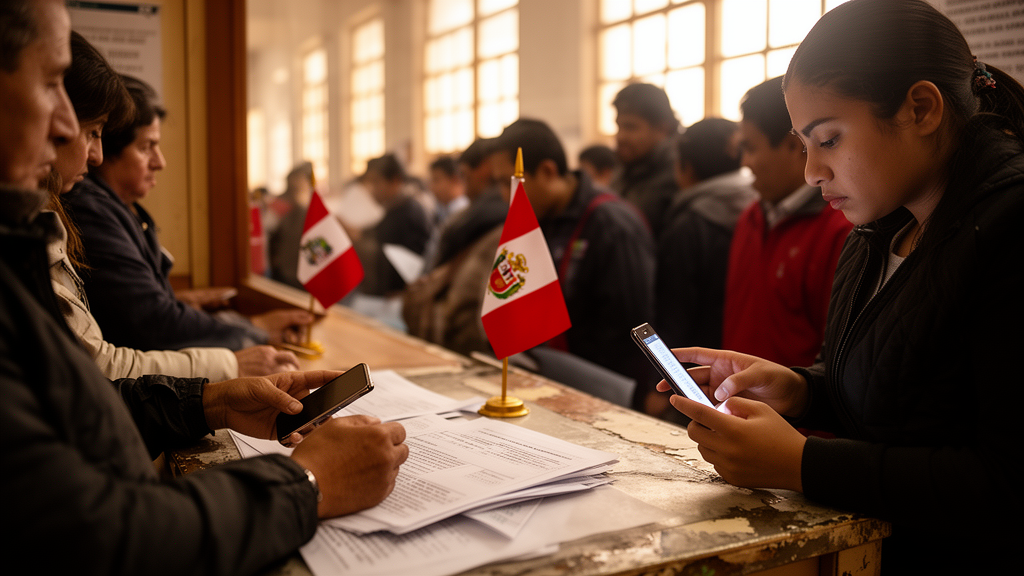
In a region where 95 percent of citizens disapprove of politicians and Congress, a new study from southern Peru has found that trust in government institutions is built not through approval of the political class but through something far more tangible: whether the state actually delivers working services. The research, published in Frontiers in Political Science, analyzed survey data from 1,400 people across four provinces in southern Peru and found that positive evaluations of public services were the strongest correlate of institutional trust, with a path coefficient of 0.58 in the baseline model, falling to 0.45 once political approval and demographic controls were entered simultaneously. Political-institutional approval, by contrast, maintained a significant but weaker association with trust at 0.31. The findings suggest that in a context of deep political crisis, citizens weight concrete problem-solving capacity above approval of the political system itself.
The study was designed to understand how the digitization of the public sphere transforms citizens’ perceptions of how the state functions. Using a quantitative, non-experimental, cross-sectional design, researchers from the National University of San Agustín de Arequipa drew on face-to-face interviews conducted between November 11 and December 16, 2024, across the provinces of Arequipa, Camaná, Caylloma, and Islay. The sample had a margin of error of ±2.6 percent at a 95 percent confidence level, with a two-stage cluster design selecting urban clusters first and then households through systematic sampling, alongside age and gender quotas and socioeconomic stratification in Metropolitan Arequipa.
To test the relationships between service evaluation, political approval, and institutional trust, the team applied partial least squares structural equation modeling (PLS-SEM) in SmartPLS 4.0. The measurement model was evaluated for internal consistency reliability using Cronbach’s alpha and composite reliability, with all constructs exceeding the 0.70 threshold. Convergent validity was confirmed through average variance extracted values above 0.50 and factor loadings above 0.60, while discriminant validity was verified using the Fornell-Larcker criterion and heterotrait-monotrait ratios below 0.85. The structural model estimated path coefficients through bootstrapping with 5,000 subsamples and 95 percent confidence intervals, with explanatory power assessed via the coefficient of determination and predictive relevance via Stone-Geisser’s Q² statistic.
The descriptive statistics revealed a stark divide in how citizens evaluate different aspects of state performance. Basic infrastructure services obtained majority approval, with drinking water rated positively by 81 percent of respondents and electricity by 70 percent. Public management services, however, were rejected: public safety received 88 percent negative ratings, public health 76 percent, and administrative procedures 75 percent. The institutional evaluation was even more severe, with politicians and Congress obtaining 95 percent disapproval, the justice system 85 percent negative, and the police 72 percent negative. This pattern of rejection remained remarkably consistent across all sociodemographic segments, with no substantial differences by socioeconomic level, age group, or geographic location.
The severity of institutional disapproval documented in the study cannot be understood apart from Peru’s national political trajectory over the past decade. Between 2016 and 2023, the country had six presidents, several of whom left office through impeachment, resignation, or removal amid corruption allegations and confrontations between the executive and legislative branches. The removal of President Pedro Castillo in December 2022, following an attempted unconstitutional closure of Congress, triggered nationwide protests and a violent state response that further eroded confidence in both the presidency and the legislature. This prolonged instability, rather than any single administration, forms the backdrop against which the near-unanimous disapproval of politicians and Congress should be read, distinguishing the Peruvian case from settings where distrust reflects dissatisfaction with a particular government rather than a sustained crisis of the political system as a whole.
The study’s most striking finding concerns the moderating role of the digital environment. Political information consumption in Arequipa is highly digitized: Facebook was the primary source of information for 44 percent of respondents, followed by television at 28 percent and radio at 17 percent, while regular use of social media showed an absolute predominance of Facebook at 88 percent, followed by YouTube at 52 percent and TikTok at 42 percent. Seventy percent of the population follows the country’s political events closely or somewhat closely. Using multigroup analysis, the researchers found that both the type of media used to obtain information and the level of politicization significantly intensified the relationship between service evaluation and institutional trust.
Specifically, digital media users showed a stronger path coefficient between service evaluation and institutional trust at 0.65 compared to 0.51 for traditional media users, a moderating effect of 0.14 that was statistically significant at p = 0.012. Highly politicized citizens showed a stronger path coefficient at 0.63 compared to 0.45 for citizens with low politicization, a moderating effect of 0.18 significant at p = 0.006. The integrated model with interaction terms explained 51 percent of the variance in institutional trust, up from 48 percent without moderation. Measurement invariance testing using the MICOM procedure confirmed configural and compositional invariance for both moderators, supporting the validity of the group comparisons, though full invariance was not established, indicating genuine differences in how the constructs operate across groups.
The theoretical framework underlying these findings rests on three complementary traditions. Performance-based legitimacy theory holds that once the normative appeal of a regime is contested, citizens increasingly ground their acceptance of authority on the tangible outcomes that institutions deliver. Institutional trust theory distinguishes diffuse support, the generalized commitment to the political community and its constitutional order, from specific support, the evaluation of incumbent authorities and their concrete performance. Media effects theory, particularly research on algorithmic curation and network amplification, provides the mechanism behind the moderation finding: platforms that rank and circulate content according to engagement tend to intensify affective and evaluative responses through repeated exposure, social validation, and selective reinforcement.
The authors are careful to note that the study did not directly measure the psychological mechanisms underlying the observed moderation, such as differential exposure, selective information processing, or affective polarization. These remain hypotheses for future research rather than demonstrated findings. The cross-sectional design also does not establish the direction of causality, as it remains possible that citizens who already trust institutions evaluate their services more favorably rather than the reverse. The study operationalizes political-institutional approval rather than democratic legitimacy in its full normative sense, and the model did not include variables known to shape institutional trust in prior literature, including perceived corruption, political ideology, economic evaluations, education, and generalized social trust, raising the possibility of omitted-variable bias.
Nevertheless, the findings carry significant implications for how governments in digitally saturated environments should think about rebuilding institutional trust. If the digital information environment functions as an amplifying condition rather than an independent determinant, then objective improvements in government performance might be amplified or neutralized as they circulate through digital narratives. Given the dominance of Facebook among local information sources, one plausible interpretation is that narratives circulating through algorithmic and social-interaction dynamics, dynamics largely absent from traditional one-way media, help account for the stronger association between service evaluations and trust among digital media users. The authors suggest that concrete, visible improvements in government performance carry more weight than communication campaigns alone, and that governments should consider how these improvements might travel through the digital ecosystems where public opinion is predominantly formed.
Subject of Research: How public service evaluation, political approval, and digital information consumption shape institutional trust in southern Peru
Article Title: Political-institutional approval and institutional trust: the moderating role of the digital environment
Article References: Quispe Nina, W., Almanza Cabe, R. B., Morales Gonzales, A. V., Chavez Cuarite, J. L., Donayre Sarolli, A. E., Arguedas Catasi, R. W., & Rodriguez Saavedra, M. O. (2026). Political-institutional approval and institutional trust: the moderating role of the digital environment. Frontiers in Political Science, 8, Article 1802558. https://doi.org/10.3389/fpos.2026.1802558
Image Credits: AI Generated
DOI: 10.3389/fpos.2026.1802558
Keywords: institutional trust, political approval, digital media, public services, Peru, PLS-SEM, political crisis, social media, Political-institutional, approval, institutional, trust
Cite Scienmag News
Phoebe Ingram. (October 17, 2026). Digital Media Amplify How Public Services Shape Institutional Trust in Peru. Scienmag. https://scienmag.com/digital-media-amplify-how-public-services-shape-institutional-trust-in-peru/
Phoebe Ingram. "Digital Media Amplify How Public Services Shape Institutional Trust in Peru." Scienmag, 17 October 2026, https://scienmag.com/digital-media-amplify-how-public-services-shape-institutional-trust-in-peru/. Accessed 17 October 2026.
Phoebe Ingram. "Digital Media Amplify How Public Services Shape Institutional Trust in Peru." Scienmag. October 17, 2026. https://scienmag.com/digital-media-amplify-how-public-services-shape-institutional-trust-in-peru/


