


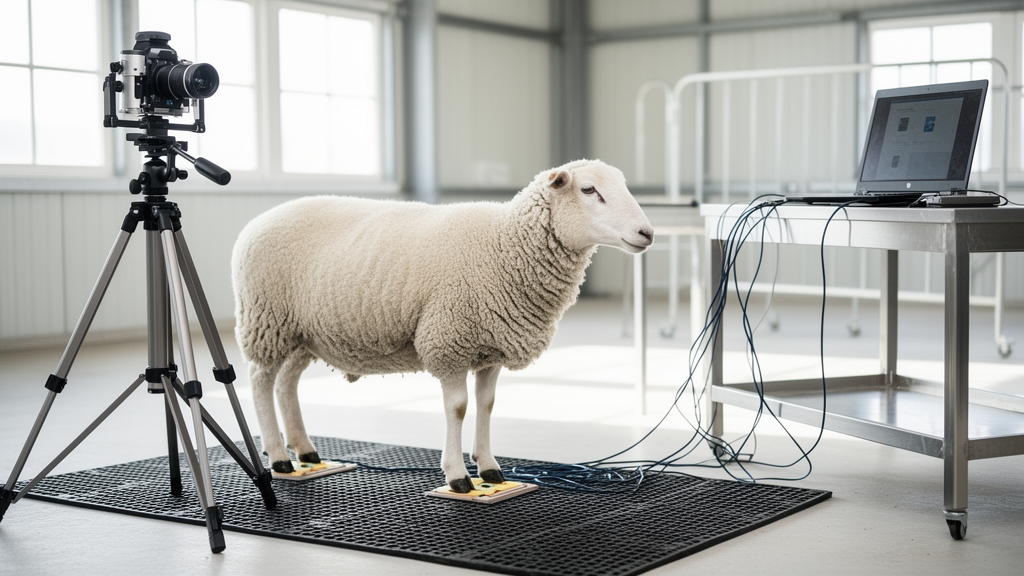
Deep inside a research facility in Switzerland, a quiet revolution in physiology is underway. A team of engineers and veterinarians has built a system that pairs a simple stereo camera with eight simultaneously recorded pressure signals, allowing them to interpret how posture modulates the complex physiology of a living animal. The subject of their work is the sheep, a long-standing animal model whose cranial and vascular anatomy makes it invaluable for studies of cerebrospinal fluid dynamics. What they have achieved is a markerless pipeline that turns ordinary video footage into a complete record of how a sheep’s body position shapes its internal pressure landscape.
The challenge the team faced was a familiar one in animal research: how to measure posture continuously without attaching markers, sensors, or harnesses to the animal. Marker-based systems require extensive animal preparation and can interfere with natural behavior, while manual observation is too imprecise for rigorous analysis. Their solution was a custom pipeline built around a stereo camera that records the animal from two viewpoints simultaneously, feeding the footage into a deep learning system trained to detect fifteen anatomical landmarks on the sheep’s body. The result is a markerless record of how the animal’s body position shapes its internal pressure landscape.
The technical core of the system is a two-stage detection process. First, a custom object detector locates the sheep in each frame, isolating the animal from its surroundings. Second, a landmark detection network identifies fifteen anatomical points on the sheep’s body, from the head and neck to the limbs and hooves. The team trained this network on footage from six sheep, giving it enough appearance variability to handle the low inter-individual variation within the species. The pipeline was designed to work on animals it has never seen before, without requiring additional labeling or retraining.
Once the landmarks are detected, the system reconstructs the sheep’s three-dimensional body position from the two camera viewpoints. This reconstruction is then refined using a smoothing process that enforces temporal continuity, ensuring that the record of the animal’s movement is stable and reliable. The team evaluated this refinement against the raw detections, confirming that the smoothed record is more consistent than the unprocessed data. The result is a stable, three-dimensional record of how the animal moves through its environment.
The final stage of the pipeline classifies the sheep’s body position into predefined categories, such as standing, lying, and other postures. This classification allows the team to segment video sequences into meaningful intervals, facilitating retrospective analysis and simplifying future research. The team trained this classifier on footage from six sheep, giving it enough variability to handle the low inter-individual variation within the species. The result is a system that can automatically segment hours of footage into meaningful intervals.
The team paired this posture pipeline with eight simultaneously recorded pressure signals, selected because they were critical to investigations of cerebrospinal fluid dynamics. The pressure channels are treated generically throughout the system, allowing the number and type of measurements to change without intrinsically tying the pipeline to a specific set of signals. The team synchronized the pressure recordings with the stereo footage, creating a complete record of how the animal’s body position shapes its internal pressure landscape. The result is a system that can correlate posture with physiology in a living animal.
The team evaluated the pipeline on footage from six sheep, confirming that it works on animals it has never seen before without requiring additional labeling or retraining. The annotated landmarks encompass frames from six sheep, providing sufficient appearance variability to support generalization given the low inter-individual variation within the species. The pipeline was designed to be modular, supporting flexible integration of new detection networks and pressure signals. The result is a system that can adapt to future advances in animal research.
The team acknowledged that the pipeline has limitations. The system records eight pressure signals that were selected because they were critical to investigations of cerebrospinal fluid dynamics, but the pipeline is not intrinsically tied to this specific set of measurements. The team also noted that the pipeline was evaluated on a limited number of animals, and that future work should expand the evaluation to more subjects. The result is a system that can adapt to future advances in animal research.
The team concluded that their markerless pipeline offers a new way to correlate posture with physiology in a living animal. By pairing a simple stereo camera with eight simultaneously recorded pressure signals, the system can interpret how body position shapes the internal pressure landscape of a living sheep. The pipeline was designed to be modular, supporting flexible integration of future advances in detection networks and pressure signals. The result is a system that can adapt to future advances in animal research.
Subject of Research: Physiology
Article Title: Automated 3D sheep posture estimation and telemetric pressure synchronization via a markerless computer vision pipeline
Article References: Roncoroni, M., Podgoršak, A., Kaufmann, A., Flürenbrock, F., Trimmel, N. E., Oertel, M. F., Zeilinger, M., Weisskopf, M., & Schmid Daners, M. (2026). Automated 3D sheep posture estimation and telemetric pressure synchronization via a markerless computer vision pipeline. Frontiers in Veterinary Science, 13, Article 1933870. https://doi.org/10.3389/fvets.2026.1933870
Image Credits: AI Generated
DOI: 10.3389/fvets.2026.1933870
Keywords: sheep, stereo camera, posture, pressure signals, cerebrospinal fluid, markerless, animal model, physiology, Automated, estimation, telemetric, pressure
Cite Scienmag News
William Thompson. (October 17, 2026). Markerless Vision: How a Stereo Camera and Eight Pressure Signals Are Rewriting Posture Science in Sheep. Scienmag. https://scienmag.com/markerless-vision-how-a-stereo-camera-and-eight-pressure-signals-are-rewriting-posture-science-in-sheep/
William Thompson. "Markerless Vision: How a Stereo Camera and Eight Pressure Signals Are Rewriting Posture Science in Sheep." Scienmag, 17 October 2026, https://scienmag.com/markerless-vision-how-a-stereo-camera-and-eight-pressure-signals-are-rewriting-posture-science-in-sheep/. Accessed 17 October 2026.
William Thompson. "Markerless Vision: How a Stereo Camera and Eight Pressure Signals Are Rewriting Posture Science in Sheep." Scienmag. October 17, 2026. https://scienmag.com/markerless-vision-how-a-stereo-camera-and-eight-pressure-signals-are-rewriting-posture-science-in-sheep/


