


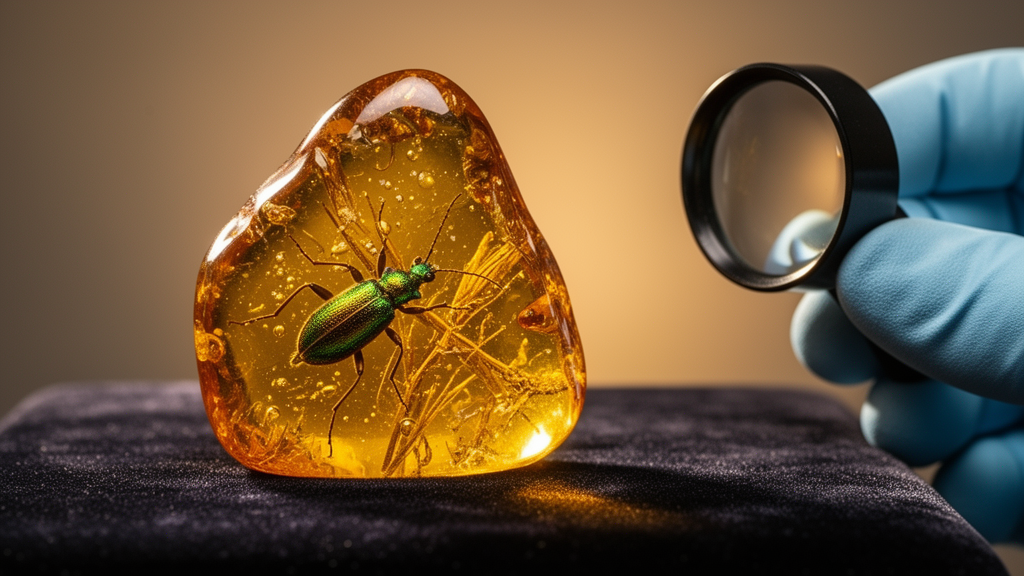
Deep in a shard of golden amber from the mid-Cretaceous of northern Myanmar, a tiny beetle has been waiting for roughly 99 million years. Measuring just under four millimetres long, with a head and pronotum shimmering in green to blue metallic lustre, the insect is unlike any living member of its family. A new study in the journal Fossil Record formally names it Mysteriohelota metallicus, a new genus and species of helotid beetle, and uses it as a springboard for a striking quantitative conclusion: the Cretaceous ancestors of today’s helotids were significantly more morphologically diverse than their modern descendants, hinting that this small family has been quietly losing diversity ever since.
Helotid beetles (family Helotidae) are a small group of elongate, somewhat flattened, shiny metallic beetles with short, apically clubbed antennae. Field observations show that they feed on tree sap, rotten fruits, or flowers. Today the family comprises approximately 100 species in five genera, distributed across tropical Africa and the eastern Palearctic and Indomalayan regions. Members were historically lumped into a single genus until a generic revision in 2000, because living helotids look remarkably uniform: their classification rests mainly on differences in the pronotum and elytra, such as raised patches on the pronotal disc, coloured oval spots on the elytra, or elevated elytral ridges. That uniformity is precisely what makes the new fossil so important.
The holotype specimen, catalogued as YH-COL00005, is embedded in a small, long oval piece of clear-yellow amber measuring 18.0 by 10.0 by 4.0 millimetres, originating from the Hukawng Valley in Kachin State. The amber, legally purchased online and now deposited in the National Museum of Natural Science in Taichung, Taiwan, was polished with a handheld electric grinder and emery papers of varying grain sizes to expose the fossil for detailed observation. Kachin amber is dated to the earliest Cenomanian, about 98.79 plus or minus 0.62 million years ago, and is believed to have formed in a tropical forest ecosystem. The beetle is mostly complete and well preserved, missing only its abdomen and left hind leg.
Imaging the fossil demanded a battery of techniques. Brightfield photographs were captured with a Leica DMC 5400 camera on a Leica Z16 APO stereomicroscope, with source images aligned and stacked in the Leica Application Suite software. Widefield fluorescence images came from a Canon EOS 850D camera attached to a Leica MZ FLIII fluorescence stereomicroscope, and confocal images were obtained with a Zeiss LSM780 confocal laser scanning microscope using the 488-nanometre Argon laser excitation line. Stacking and editing software then combined the images into sharp composite figures. This multi-modal approach allowed the researcher to resolve fine structures, including the presence of a frontoclypeal suture on the head, a feature absent in every other known helotid genus.
The body of Mysteriohelota metallicus is elongate and long oval, 2.9 times as long as wide, uniformly dark brown to black with the characteristic green to blue metallic sheen on the head and pronotum. The head is elongate, longer than wide, abruptly constricted behind large hemispherical eyes to form a broad neck. The antenna is 11-segmented with a well-developed compact three-segmented club roughly 1.9 times as long as wide. The pronotum is roundly trapezoidal, widening posteriad, with a deeply bisinuate posterior margin forming a well-developed rounded median lobe. The elytra are glabrous, lacking elevated ridges, with extremely sparse and shallow punctate striae, and bear no coloured spots. The legs are elongate and slender, with five-segmented tarsomeres that are simple, not lobed.
Several of these traits are atypical of modern helotids. Beyond the frontoclypeal suture, the new beetle has a prosternal process with a truncate apex, whereas living genera usually show a strongly expanded process with a broadly emarginate apex, and its elytral striae are indistinct and finely punctate rather than deeply developed. Such mismatches between Kachin amber fossils and the current fauna are well documented in many fossil insect studies, often complicating systematic placement and prompting reconsideration of family-level diagnoses. The generic name combines the Greek word for mystery, referring to the beetle’s enigmatic morphology, with Helota, the type genus of the family; the species epithet metallicus derives from its shining green head and pronotum.
To confirm that the fossil truly belongs to Helotidae rather than a closely related extinct family, a constrained morphology-based phylogenetic analysis was conducted. The character matrix contained 99 characters and 37 extant genera representing 25 extant cucujoid, erotyloid and nitiduloid families, plus five outgroup families, with two previously studied Cretaceous helotid genera, Trihelota and Lobatihelota, sampled as fossil anchors. Only fossil taxa were allowed to move freely across a reference backbone tree derived from morphological data and a phylogenomic study. A parsimony analysis under implied weights, with a concavity constant of 12, was performed using an exhaustive search implemented in the R package TreeSearch. The analysis recovered a single well-resolved tree placing Mysteriohelota within Helotidae, more closely related to the extant genus Helota than to the Cretaceous genera Trihelota or Lobatihelota. Mapping parsimony scores of alternative placements onto the backbone tree showed that assigning the fossil to Helotidae is substantially more parsimonious than any alternative classification.
The more provocative part of the study is quantitative. To test a previously hypothesised higher morphological diversity of Cretaceous helotids, the researcher scored all eleven described genera of extant and Cretaceous helotids against 25 diagnostic characters, covering body size, head shape, antennal club proportions, pronotal geometry, elytral ridges and spots, tibial shape, and tarsal lobing. Morphological distances among genera were calculated with the R package Claddis using the MORD distance metric, and disparity was quantified with two widely applied metrics: the weighted mean pairwise distance (WMPD), which reduces the influence of missing data, and the sum of variance (SOV), which measures the extent of morphospace occupation as the sum of variance along each dimension.
Because fossil samples are inevitably smaller and riddled with missing data, size-based rarefaction standardised sample sizes between extant and Cretaceous groups, with WMPD values computed over 100 random resampling iterations for each subsampled size, and permutation tests with 10,000 randomisations assessed statistical significance. Bootstrapped median SOV values with 2.5 and 97.5 percent quantiles were obtained from 100 iterations. A second dataset excluding all incomplete characters was analysed following the same procedure to evaluate the potential impact of missing data. The results were unambiguous: Cretaceous helotids occupied a substantially larger region of morphospace than their extant counterparts, WMPD values were markedly higher for the Cretaceous group, and SOV analysis showed higher variance across morphospace dimensions. Both patterns remained statistically significant under standardised sampling, with p values below 0.01, and the refined dataset yielded fully consistent results, indicating the disparity difference is not driven by missing data alone.
The implications reach beyond taxonomy. Morphological diversity has been proposed as a useful proxy for assessing taxonomic diversity in palaeobiological datasets, because the number of described fossil species is typically much lower than that of extant species, biasing direct comparisons of species richness. The decline in morphological diversity observed across time therefore likely reflects a genuine loss of taxonomic diversity within Helotidae, suggesting that modern helotids may represent only a remnant of a once more diverse lineage. A reduction in morphological diversity may also imply a reduction in ecological diversity, though the functional significance of the distinctive characters in early helotids, such as the frontoclypeal suture or the truncate prosternal process, remains unclear, making any inference about ecological changes premature. The Cretaceous fossil genera already showcase remarkable anatomical experiments, from the narrow neck and bilobed tarsomeres of Lobatihelota to the paired carinae on the prosternum and mesoventrite of Trihelota, and now the unique suture-bearing head of Mysteriohelota. Relationships among extant and Cretaceous helotids remain unresolved, and future work should aim to reconstruct a comprehensive phylogeny incorporating both fossil and extant taxa. For now, the tiny metallic beetle in its amber tomb stands as vivid evidence that the evolutionary history of even the smallest beetle families can hold dramatic twists, and that quantitative morphological analysis is the key to unlocking them.
Subject of Research: Quantitative morphological analysis reveals a greater morphological diversity in Cretaceous Helotidae (Coleoptera, Nitiduloidea), with description of a new genus and species from mid-Cretaceous Kachin amber
Article Title: Quantitative morphological analysis reveals a greater morphological diversity in Cretaceous Helotidae ( Coleoptera , Nitiduloidea ), with description of a new genus and species from mid-Cretaceous Kachin amber
Article References: Hsiao, Y. (2026). Quantitative morphological analysis reveals a greater morphological diversity in Cretaceous Helotidae (Coleoptera, Nitiduloidea), with description of a new genus and species from mid-Cretaceous Kachin amber. Fossil Record, 29(1), 171-183. https://doi.org/10.3897/fr.29.185700
Image Credits: AI Generated
DOI: 10.3897/fr.29.185700
Keywords: Quantitative, morphological, analysis, reveals, greater, diversity, Cretaceous, Helotidae, Coleoptera, Nitiduloidea, description, genus
Cite Scienmag News
Gavin Prescott. (October 17, 2026). Amber Beetle Reveals Cretaceous Helotids Were Far More Diverse Than Today. Scienmag. https://scienmag.com/amber-beetle-reveals-cretaceous-helotids-were-far-more-diverse-than-today/
Gavin Prescott. "Amber Beetle Reveals Cretaceous Helotids Were Far More Diverse Than Today." Scienmag, 17 October 2026, https://scienmag.com/amber-beetle-reveals-cretaceous-helotids-were-far-more-diverse-than-today/. Accessed 17 October 2026.
Gavin Prescott. "Amber Beetle Reveals Cretaceous Helotids Were Far More Diverse Than Today." Scienmag. October 17, 2026. https://scienmag.com/amber-beetle-reveals-cretaceous-helotids-were-far-more-diverse-than-today/


