


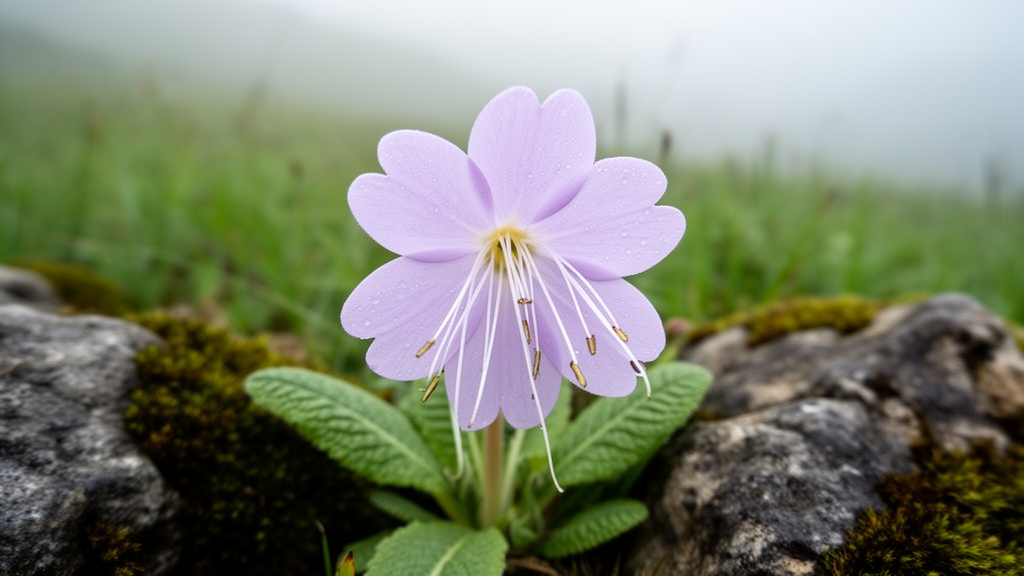
Deep on dry cliffs in the Dawei Mountains of southeastern Yunnan, botanists have identified a primrose so unusual that its discoverers briefly wondered whether it might represent an entirely new genus. The plant, now formally described as Primula exserta in the journal PhytoKeys, belongs to the largest genus in the family Primulaceae, yet its flowers break several of the rules that define the roughly 556 known species of Primula worldwide. With pale purple or pink blossoms bearing seven or eight lobes instead of the usual five, and with stamens and a style protruding dramatically beyond the mouth of the corolla tube, the new species is a striking addition to one of the most species-rich alpine plant lineages on Earth.
The genus Primula is a classic example of an alpine radiation, with its center of diversity concentrated in the Eastern Himalayas and the Hengduan Mountains of southwestern China. China harbors 358 species of the genus, classified into 24 sections, and the province of Yunnan alone supports 182 species after the latest discoveries. The new species was assigned to Primula sect. Aleuritia, a substantial group whose members range from the circumpolar region to the major mountain systems of Europe, North America, and Asia. Notably, sect. Aleuritia is the only section within the genus that includes representative species in South America, and with the addition of P. exserta, the number of species recorded in China has reached 55.
The story of the discovery began in April 2021, during a botanical survey of the Dawei Mountains in Yunnan Province, when researchers encountered a morphologically distinctive population of Primula. The plants were small and entirely glabrous, with obovate to spatulate leaves covered in yellow farina, a powdery waxy coating typical of many members of sect. Aleuritia. The absence of scales at the base of the leaf rosette further confirmed the section placement. But several features immediately set the population apart from all known species: a cup-shaped calyx with seven or eight lobes divided almost to the base, a campanulate corolla with the same unusual lobe count, uniform floral morphology across all flowers, and stamens and a style distinctly exserted far beyond the mouth of the corolla tube.
Between 2022 and 2026, the team returned to the area during the flowering season each year and located only one additional population. The distinctive floral traits proved stable across seasons and individuals, and a thorough examination of relevant literature and herbarium specimens, including material from the Royal Botanic Garden Edinburgh and the Plant Science Data Centre, confirmed that the plants represented a species new to science. The researchers measured 15 randomly selected living individuals per population, assessing growth habit, rhizome morphology, farina presence, leaf characteristics, calyx and corolla structure, and flower color, with digital calipers used for precise measurements at the type locality.
The formal description reveals a perennial herb with a compact rosette of leaves arising from a greatly shortened rhizome. The leaf blades are obovate, oblanceolate, or sub-spatulate, 1 to 3 centimeters long, with densely serrate margins and a lower surface covered with easily deciduous yellow farina. The petiole is broadly winged and nearly as long as the leaf blade, a feature that helps distinguish the species from its closest relatives. Scapes are greatly shortened and almost inconspicuous, with flowers borne within the leaf rosette. The calyx is cup-shaped, 3 to 5 millimeters long, with seven or eight narrowly lanceolate lobes divided nearly to the base and heavily covered with yellow farina on both surfaces.
The corolla is campanulate, pale purple or pink, with a limb 1.2 to 1.8 centimeters in diameter and seven or eight oblong lobes. The corolla tube is slender, 1.2 to 1.5 centimeters long, and all flowers carry seven or eight stamens inserted at the middle of the tube, free from the tube at the mouth and extending approximately 5 millimeters beyond it. The style is 2.5 to 3 centimeters long, longer than the stamens, and protrudes well beyond the corolla tube. This monomorphic floral architecture, in which every flower shares the same configuration, contrasts sharply with the distylous flowers of its closest relatives, P. membranifolia, P. pengzhouensis, and P. mianyangensis, in which anthers and filaments remain included within the corolla tube.
The specific epithet exserta derives from the Latin exsertus, meaning protruding or extended outward, alluding to the style and stamens that extend beyond the mouth of the corolla tube. The species carries the vernacular name Daweishan primrose in Chinese. It is currently known from two populations within the Daweishan National Nature Reserve, one in Hekou County and one in Pingbian County, growing on dry cliffs at elevations between 1700 and 2000 meters. Each population consists of approximately 100 adult individuals, and the species flowers from April to the end of May.
The researchers assessed the conservation status as Data Deficient under the IUCN Red List Criteria, noting that potential populations may still exist in surrounding areas but that further investigations are needed before a formal threat assessment can be made. The restricted distribution, small population sizes, and specialized cliff habitat nonetheless suggest that the species may be vulnerable to environmental change, and continued monitoring will be essential to determine whether additional populations survive in the rugged terrain of the Dawei Mountains.
The evolutionary significance of the new species extends beyond its unusual appearance. The researchers hypothesize that P. exserta may have evolved from a long-styled pin flower in which both filaments and style elongated in response to environmental pressures, facilitating adaptation to a specialized habitat. The precise mechanisms underlying these morphological changes await confirmation through molecular biological studies. The discovery also highlights the southernmost distribution of any known member of sect. Aleuritia in the Northern Hemisphere, occurring in a relatively hot climate unlike the temperate and alpine environments favored by most species in the section. The specialized floral morphology may therefore represent adaptive evolution following speciation, and the new species provides valuable material for future studies on floral evolution within one of the most rapidly radiating lineages among flowering plants.
Subject of Research: Primula exserta
Article Title: Primula exserta ( Primulaceae ), a new species in Primula sect. Aleuritia from Yunnan, China
Article References: Yang, L., Zhang, G.-L., Zheng, Y.-Y., Ye, Q.-Q., Tan, X., Cai, L., & Wu, Z.-K. (2026). Primula exserta (Primulaceae), a new species in Primula sect. Aleuritia from Yunnan, China. PhytoKeys, 278, 117-125. https://doi.org/10.3897/phytokeys.278.202553
Image Credits: AI Generated
DOI: 10.3897/phytokeys.278.202553
Keywords: Primula, exserta, Primulaceae, species, sect, Aleuritia, Yunnan, China, scientific research
Cite Scienmag News
Gavin Prescott. (October 17, 2026). New primrose with protruding stamens discovered in Yunnan. Scienmag. https://scienmag.com/new-primrose-with-protruding-stamens-discovered-in-yunnan/
Gavin Prescott. "New primrose with protruding stamens discovered in Yunnan." Scienmag, 17 October 2026, https://scienmag.com/new-primrose-with-protruding-stamens-discovered-in-yunnan/. Accessed 17 October 2026.
Gavin Prescott. "New primrose with protruding stamens discovered in Yunnan." Scienmag. October 17, 2026. https://scienmag.com/new-primrose-with-protruding-stamens-discovered-in-yunnan/


