


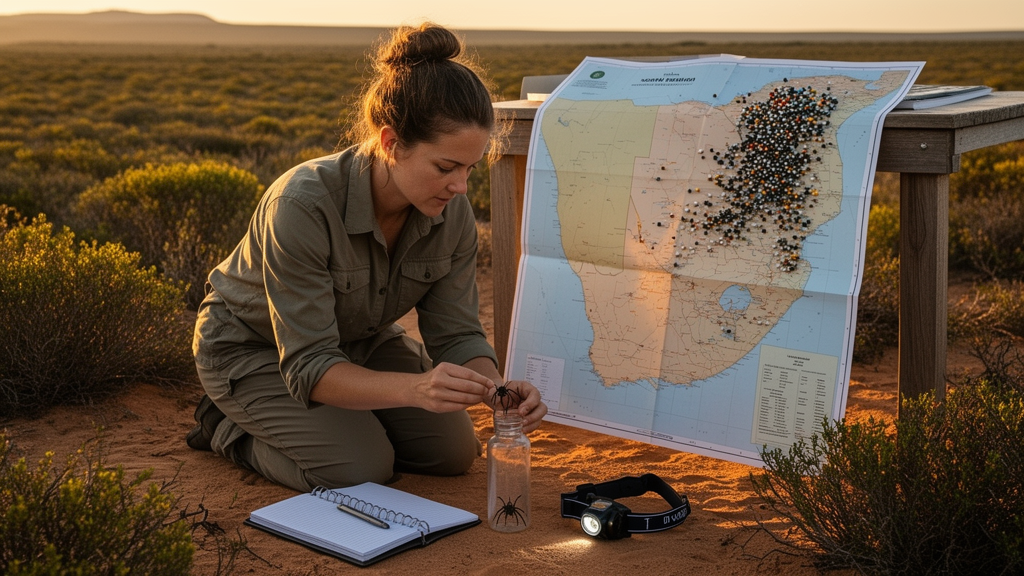
Spiders are among the most successful predators on Earth, and South Africa is home to a staggering share of them. Roughly four percent of the world’s described spider species have been recorded within the country’s borders, and nearly sixty percent of those species are found nowhere else. Yet a new analysis of more than 121,000 spider records, drawn from seven natural history collections, shows that the country’s knowledge of its own eight-legged fauna is far from complete. The study, published in African Invertebrates, quantifies for the first time how sampling bias and knowledge gaps vary across both geographic and taxonomic scales, and the results carry a sobering warning for conservation.
Species distribution datasets are the raw material of macroecology. When scientists model where species live, how diversity changes across landscapes, or which regions deserve protection, they rely on records accumulated over decades, sometimes centuries. But those records are not collected at random. Collectors gravitate toward nature reserves, scenic areas, universities and access routes, and sampling effort is often concentrated in regions expected to be diverse, such as global biodiversity hotspots. The consequence is that databases inherit the idiosyncrasies of the people who built them, and interpretations drawn from biased data can be impossible to correct.
Ecologists have given these gaps memorable names. The Linnean shortfall describes the fact that most species on Earth have never been described or catalogued, while the Wallacean shortfall refers to our ignorance of where known species actually occur and how their ranges change through time. In practice, most regional datasets suffer from both at once: a site may appear depauperate either because nobody has sampled it properly or because the species living there have not yet been formally named. Disentangling these two sources of ignorance is one of the central challenges of biodiversity science, and it is precisely the challenge the South African researchers set out to address for spiders.
South Africa offers an unusually good test case. Spider sampling in the country spans more than 300 years, beginning with the first two species described in the 1700s. Descriptions peaked in the early twentieth century, slowed, and then accelerated again after 1997, when the South African National Survey of Arachnida was launched to chart the country’s arachnid diversity and identify geographic gaps. The First Atlas of South African Spiders, published in 2010, mapped 2,010 species from 71 families, and the latest national checklist now recognises 2,265 species. With such a rich institutional history, the researchers could compile a database of unusual taxonomic accuracy, validating every species name against the national checklist and the World Spider Catalog to eliminate duplicates created by old nomenclature.
The final database contained 121,605 usable records, the vast majority from the National Collection of Arachnida in Pretoria, supplemented by holdings from the Albany Museum, the National Museum in Bloemfontein, the KwaZulu-Natal Museum, the Iziko South African Museum, the Ditsong National Museum of Natural History and the Royal Museum of Central Africa in Belgium. Only records identified to species, genus or family level, and georeferenced with complete coordinates, were retained. Sites whose coordinates contradicted their location information were corrected where possible or excluded. Even so, the database contains roughly 180 fewer species than the national checklist, because type material of species described by the French arachnologist Eugène Simon between 1893 and 1910 resides in overseas museums and could not be included.
To measure completeness, the team divided South Africa at four spatial scales: fine quarter-degree grid cells of roughly 24 by 27 kilometres, coarser degree grid cells of roughly 97 by 110 kilometres, and the ecologically defined bioregions and biomes of the national vegetation map. At each scale, and at each of three taxonomic levels, they compared observed species richness to an asymptotic estimate of expected richness using first-order incidence-based estimators, calculating percentage completeness as the ratio of the two. Because extrapolation from small samples is unreliable, they also imposed minimum record thresholds, borrowed from earlier completeness studies of amphibians, plants, insects and fishes, to filter out false positives. Twelve unique combinations of spatial and taxonomic scale emerged, and completeness was assessed for every unit within each combination.
The geographic pattern was unmistakable. Records and diversity concentrate along the eastern regions and the coast, from the Mozambique border to north of Langebaan, while the drier western interior is strikingly sparse; where western records do exist, they trace river courses such as the Orange River. More than 41 percent of the country’s quarter-degree grid cells contain no spider records at all, a figure that falls to just over five percent at the degree-cell scale, while every bioregion and biome has at least some data. The same east-west gradient holds for species, genus and family richness alike, and it mirrors the record distributions reported for other South African invertebrate groups, including dragonflies, dung beetles and katydids, suggesting a shared and persistent sampling bias rather than a purely ecological explanation.
Completeness, however, scaled exactly as the researchers hypothesised. At the national level, species records are relatively well sampled at 89.2 percent completeness, genus records at 86.6 percent, and family records are fully complete at 100 percent. At finer scales the picture deteriorates dramatically: at the combination of quarter-degree cells and species-level identifications, only 0.15 percent of all grid cells qualify as well sampled, confined to the northeastern and southern regions. As taxonomic level rises from species to genus to family, and as spatial scale coarsens from grid cells to bioregions to biomes, the proportion of well-sampled units climbs steadily, reaching 63.64 percent of biomes at the family level. Ordinal regression models confirmed that these increases are statistically significant across every scale combination, and that the larger the taxonomic jump, the larger the gain in completeness.
One of the study’s most important conclusions is directional: completeness can only be interpreted from fine to coarse, never the reverse. The moderately well-sampled Nama Karoo at the biome scale, for example, cannot be assumed complete at the level of the individual quarter-degree cells within it, many of which have no records whatsoever. Coarser scales absorb the sampling bias of finer-scale data, which means that apparent completeness at large scales can mask profound ignorance locally. The estimated national species richness of 2,338.5, implying only about 73 species remain to be added, is itself likely a gross underestimation, given that taxonomic revisions of Afrotropical spiders continue to reveal many undescribed species and that vast areas of the country remain unsampled.
The implications for conservation are pointed. The regions where spider sampling is most complete correspond strongly to metropolitan areas and to the areas facing the highest threats to biodiversity in South Africa, while the under-sampled Northern Cape and North-West provinces remain data voids even at scales where they appear moderately well covered. The researchers propose a practical remedy: systematically sampling at the centroid of each under-sampled degree grid cell in the western interior, using rapid sampling protocols that have been shown to generate large numbers of specimens and species-level records in under a week. With global invertebrate diversity in decline, and without understanding the underlying patterns of distribution at appropriate scales, conservation efforts for spiders and countless other invertebrates are likely to be ineffective. Completing the web, it turns out, is not merely a metaphor; it is a measurable, achievable and urgent task.
Subject of Research: Biodiversity and macroecology
Article Title: Completing the web: identifying sampling bias and knowledge gaps within South African spider surveys ( Arachnida , Araneae )
Article References: van der Mescht, A. C., Haddad, C. R., Foord, S. H., & Dippenaar-Schoeman, A. S. (2024). Completing the web: identifying sampling bias and knowledge gaps within South African spider surveys (Arachnida, Araneae). African Invertebrates, 65(2), 223-246. https://doi.org/10.3897/afrinvertebr.65.138881
Image Credits: AI Generated
DOI: 10.3897/afrinvertebr.65.138881
Keywords: spiders, South Africa, sampling bias, biodiversity, macroecology, Wallacean shortfall, Linnean shortfall, conservation, natural history collections, African Invertebrates, Completing, identifying
Cite Scienmag News
Margaret Porter. (October 17, 2026). Mapping the gaps: South Africa’s spider records reveal deep sampling bias. Scienmag. https://scienmag.com/mapping-the-gaps-south-africas-spider-records-reveal-deep-sampling-bias/
Margaret Porter. "Mapping the gaps: South Africa’s spider records reveal deep sampling bias." Scienmag, 17 October 2026, https://scienmag.com/mapping-the-gaps-south-africas-spider-records-reveal-deep-sampling-bias/. Accessed 17 October 2026.
Margaret Porter. "Mapping the gaps: South Africa’s spider records reveal deep sampling bias." Scienmag. October 17, 2026. https://scienmag.com/mapping-the-gaps-south-africas-spider-records-reveal-deep-sampling-bias/


