


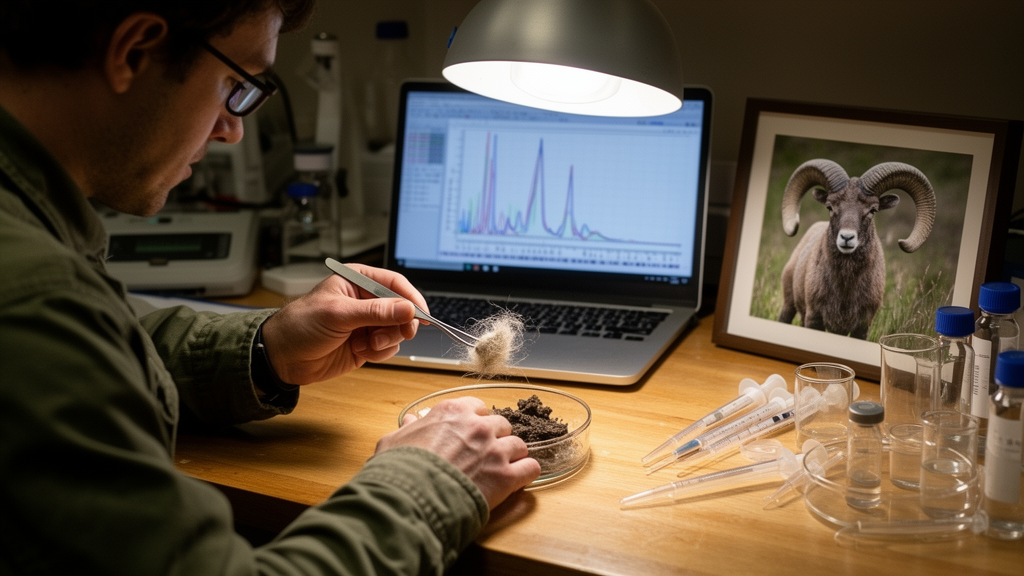
When a grey wolf kills a sheep in the French Alps, the consequences ripple far beyond one lost animal. Livestock depredation drives compensation payments, shapes public attitudes toward wolf recovery and informs decisions about culling and conflict mitigation. But when a wolf kills a European mouflon, a wild sheep introduced centuries ago and now prized by hunters and conservationists alike, the ecological and socio-economic implications are entirely different. For decades, DNA metabarcoding of wolf scats has promised to reveal exactly what these predators eat, yet it has harboured a stubborn blind spot: the inability to reliably tell domestic sheep (Ovis aries) apart from European mouflon (Ovis musimon) in the genetic readouts that underpin every dietary estimate.
The problem stems from evolutionary history rather than laboratory error. Domestic sheep and European mouflon share a close common ancestry, and the mitochondrial markers most commonly used in carnivore diet studies, such as fragments of the 12S rRNA gene and cytochrome b, are too conserved to separate them. In practice, metabarcoding studies can usually assign Ovis prey only to the genus level, leaving researchers unable to say whether a wolf consumed a protected wild ungulate or a farmer’s livestock. Because these two outcomes carry markedly different ecological and socio-economic weight, misidentification can skew predation assessments, bias estimates of livestock losses and ultimately misdirect wildlife conservation and management efforts, particularly for a recovering large carnivore like the grey wolf (Canis lupus).
A research team working in the French Alps has now developed a solution: a short, diagnostic fragment of the mitochondrial D-loop, a highly variable non-coding control region, that effectively discriminates between the two species. The new marker, named OvisCR, is a 178 base pair amplicon containing 43 single nucleotide polymorphisms. In reference samples, it resolved four mouflon haplotypes and 35 domestic sheep haplotypes with no haplotypes shared between the species. Tested on 115 wolf scat samples in which a general metabarcoding marker had already detected Ovis prey, the fragment achieved species-level assignment for more than 81 percent of scats with Ovis reads, regardless of the bioinformatic pipeline used. The findings, published in Metabarcoding and Metagenomics, provide a robust and practical tool for refining ecological inference in carnivore trophic studies.
Building a reliable diagnostic marker required reference data that public databases simply could not provide. Searches of GenBank revealed that none of the available mouflon D-loop sequences originated from French populations, while none of the numerous sheep sequences with geographic information corresponded to breeds commonly raised in France. No haplotype in the database was exclusive to either species. To close this gap, the team collected 46 European mouflon samples from the Corsican population and four mainland populations in south-western France, alongside 46 domestic sheep tissue samples from the main meat processing plant in the Alps, covering breeds such as Merinos, Lacaune, Mourerous and Préalpes. The mouflon samples combined legally hunted or captured animals with non-invasive faecal and hair collections.
Sequencing the entire D-loop region, roughly 674 base pairs, from these 92 reference samples revealed 45 distinct haplotypes with 82 variable sites and no overlap between species. Haplotype diversity was dramatically higher in domestic sheep, with 40 haplotypes and a diversity index of 0.999, than in European mouflon, with five haplotypes and a diversity of 0.685. This asymmetry likely reflects artificial selection and the diverse geographic origins of sheep breeds, in contrast to founder effects and restricted gene flow in introduced mouflon populations. Rarefaction curves confirmed that all mouflon control region haplotypes in the study area had been detected with a relatively small sample size, whereas additional sheep sampling would likely reveal further haplotypic diversity.
From this alignment, the researchers identified the 178 base pair OvisCR fragment, short enough for metabarcoding of degraded scat DNA yet variable enough to discriminate the species. Most mouflon haplotypes differed from sheep haplotypes by at least three mutation sites, and the flanking regions were sufficiently conserved to design primers with minimal degenerate bases. One exception underscored the evolutionary proximity of the two taxa: a mouflon haplotype, CR178_OM004, differed by only a single mutation from two domestic sheep haplotypes at the short-fragment scale, although the longer 674 base pair fragment separated it by at least six mutations. The team conservatively classified scat samples carrying this haplotype as Ovis sp. rather than assigning a species, prioritising robustness over maximal resolution in a management-sensitive context.
The empirical test used 115 wolf scat samples collected in the same geographic area as the reference samples, all previously found to contain Ovis prey. DNA was extracted and two fragments were amplified in parallel: a 60 to 140 base pair portion of the 12S rRNA gene to confirm Ovis presence, and the new OvisCR amplicon. Sequencing was performed on the Ion Torrent platform with a one-step PCR protocol that reduces the risk of cross-contamination and tag-jumps. A species-specific blocker prevented amplification of wolf DNA in the 12S reaction. The 12S marker confirmed Ovis prey in all 115 samples, and the OvisCR fragment detected Ovis with more than 10 reads in 95.7 to 96.5 percent of samples depending on the pipeline.
A central methodological contribution was the comparison of two widely used bioinformatic pipelines: OBITools, which clusters sequences into operational taxonomic units using dissimilarity thresholds, and DADA2, which infers amplicon sequence variants through explicit error modelling. Both pipelines demonstrated similar accuracy, with the OvisCR fragment achieving species-level assignment for more than 81 percent of scats with Ovis reads detected. DADA2 consistently yielded slightly more species-level assignments, particularly at lower read thresholds, likely due to its denoising strategy, while the OTU-based OBITools approach proved more conservative for samples with limited read depth. Discrepancies between pipelines were rare and primarily concerned cases with few OvisCR reads rather than conflicting species assignments, highlighting the robustness of the marker across analytical frameworks.
Read-count thresholds emerged as a critical, yet often arbitrary, step in interpretation. Negative and positive controls showed that contamination levels for the OvisCR fragment were consistently low, never exceeding 10 Ovis reads, which justified exploring a lower threshold of 10 reads per sequence per sample compared with the conservative 100-read threshold applied to the universal 12S marker. Lowering the threshold increased the number of species-level assignments without introducing clear mis-assignments. Samples assigned only at the genus level had significantly fewer reads than those assigned to species, suggesting that taxonomic resolution was partly constrained by sequencing depth rather than by the marker itself. The impact of thresholds depended more strongly on the molecular marker than on the choice of pipeline, a pattern that contrasts with parts of the metabarcoding literature and warrants further investigation.
From a conservation and management perspective, the ability to discriminate between predation on domestic sheep and European mouflon is essential. Domestic sheep predation is a central driver of human-wolf conflict in France and elsewhere, while predation on mouflon, though relevant for game management, carries different implications. Misclassifying one species as the other could lead to incorrect estimates of livestock depredation, misinformed conflict mitigation strategies and flawed compensation or culling decisions. The OvisCR approach can serve as a model for similar developments targeting other taxonomically challenging prey groups, though the authors caution that the diagnostic value of the fragment should not be assumed transferable beyond the French context. Broader geographic applicability requires prior validation using region-specific reference datasets encompassing the diversity of domestic sheep, European mouflon and other Ovis species, a reminder that in metabarcoding, local reference data remain the foundation of every reliable species assignment.
Subject of Research: Genetics
Article Title: A 178 bp diagnostic D-loop fragment (OvisCR) to discriminate domestic sheep ( Ovis aries ) and European mouflon ( Ovis musimon ) in diet metabarcoding studies
Article References: Pirog, A., Lavarec, J., Rousselot, S., Kaerle, C., Duchamp, C., & Queney, G. (2026). A 178 bp diagnostic D-loop fragment (OvisCR) to discriminate domestic sheep (Ovis aries) and European mouflon (Ovis musimon) in diet metabarcoding studies. Metabarcoding and Metagenomics, 10, Article e172476. https://doi.org/10.3897/mbmg.10.172476
Image Credits: AI Generated
Keywords: metabarcoding, grey wolf, DNA diet analysis, mouflon, sheep, mitochondrial D-loop, conservation, diagnostic, D-loop, fragment, OvisCR, discriminate
Cite Scienmag News
Daisy Hatcher. (October 17, 2026). New DNA Marker Separates Sheep From Wild Mouflon in Wolf Diet Studies. Scienmag. https://scienmag.com/new-dna-marker-separates-sheep-from-wild-mouflon-in-wolf-diet-studies/
Daisy Hatcher. "New DNA Marker Separates Sheep From Wild Mouflon in Wolf Diet Studies." Scienmag, 17 October 2026, https://scienmag.com/new-dna-marker-separates-sheep-from-wild-mouflon-in-wolf-diet-studies/. Accessed 17 October 2026.
Daisy Hatcher. "New DNA Marker Separates Sheep From Wild Mouflon in Wolf Diet Studies." Scienmag. October 17, 2026. https://scienmag.com/new-dna-marker-separates-sheep-from-wild-mouflon-in-wolf-diet-studies/


